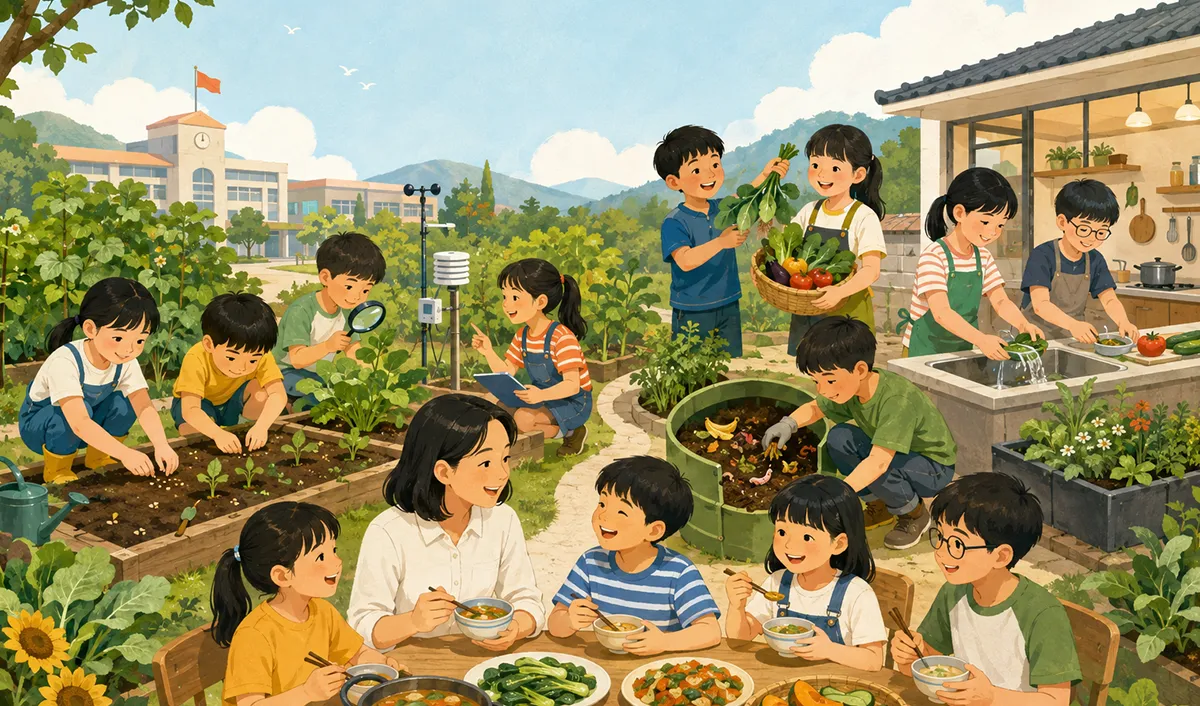
Introduction: Food and Agricultural Education Is More Than a One-Time Experience
Food and agricultural education is not just about having students plant, water, and harvest vegetables, nor is it just about arranging a single farm visit or cooking session. Truly meaningful food and agricultural education should start with food and help students understand the connections between agricultural production, the natural environment, dietary choices, local culture, and sustainable living.
The legislative purpose of Taiwan's Food and Agricultural Education Act explicitly states that food and agricultural education is promoted to strengthen the links between diet, the environment, and agriculture, improve public health, and foster the sustainable development of farming and fishing villages, agriculture, and the environment. This means food and agricultural education is not just an agriculture class; it can also be an interdisciplinary course spanning natural science, health education, environmental education, social studies, integrative activities, living technology, and information technology.
The Ministry of Agriculture's Food and Agricultural Education information platform also provides lesson plans, teaching materials, event information, and teaching resources, and ties the direction of food and agricultural education to areas such as agricultural production and the environment, diet, health, and consumption, and food culture and daily life.
For elementary and junior high schools, the best approach to food and agricultural education is not a single activity but a learning journey in which students can observe, record, discuss, experiment, and present.
This article presents 10 food and agricultural education activity designs for elementary and junior high schools, from school gardens, soil observation, watering experiments, plant phototropism, and food waste reduction to smart agriculture and automatic watering, helping teachers extend food and agricultural education from a "vegetable-growing experience" into courses that are more engaging, more inquiry-driven, and easier to integrate with STEM and sustainability education.
The Core of Activity Design: Go Beyond Hands-On Experience and Get Students Asking Questions
Many schools start food and agricultural education with the most intuitive activities: planting, watering, weeding, harvesting, and cooking. These activities matter because students need physical experience to understand where food comes from. But if every class simply repeats watering, observing, and taking photos, students quickly lose interest, and teachers may find it hard to take the course deeper.
That is why a good food and agricultural education activity needs an extra layer of "question design." For example:
- Do we really need to water today?
- Why are some spots in the same garden drier than others?
- Did the soil actually get wetter after the rain?
- Why do plants grow toward the light?
- Where do the ingredients in our school lunch come from?
- How much food do we leave uneaten each day?
- Can automatic watering help take care of the garden over weekends?
Once students start asking questions, food and agricultural education becomes more than an activity—it becomes inquiry-based learning.
How Can Food and Agricultural Education Activities Be Tiered for Elementary and Junior High Schools?
Activity design for elementary and junior high school students has somewhat different priorities.
At the elementary level, it works best to start with sensory experiences, observation records, and simple comparisons. Students can build a basic understanding of food, agriculture, and the natural environment by looking, touching, smelling, drawing, measuring, and caring for plants.
At the junior high level, more scientific inquiry and systems thinking can be added, such as controlling variables, recording data, analyzing charts, environmental impact, food issues, automatic control, and smart agriculture applications.
The same activity can also be adjusted in depth by grade. For example, "soil moisture observation" can be an observation journal in elementary school, while junior high students can go further by analyzing how the data changes before and after watering and discussing how to set thresholds for automatic watering.
Activity 1: From Seed to Table: Learning Where Food Comes From
Recommended Grades
Suitable for all grades from lower elementary through junior high.
Learning Objectives
Help students understand that food does not simply appear in the supermarket or on their plate; it goes through sowing, cultivation, harvesting, transportation, sales, and cooking before becoming part of our daily diet.
Activity Design
Teachers can pick an ingredient students are familiar with, such as sweet potatoes, leafy greens, tomatoes, rice, corn, or scallions, and have students draw a "seed to table" flowchart. The flow may include:
- Seeds or seedlings.
- Soil and water.
- Sunlight and climate.
- Care by farmers.
- Harvesting.
- Transportation.
- Markets or school lunches.
- Cooking.
- The dining table.
Lower elementary students can complete it with drawings and stickers; middle and upper elementary students can add simple written explanations; junior high students can go further and discuss transportation distance, carbon footprint, local ingredients, and local production for local consumption.
Extended Discussion
Students can discuss: If something goes wrong at one stage, will food become more expensive, scarcer, or unavailable? Drought, typhoons, pest outbreaks, and transportation disruptions can all affect the food that ends up on the table.
This activity works well as an introductory food and agricultural education lesson, helping students first grasp the idea that "there is a production system behind every food."
Activity 2: School Garden Observation Journal: Discovering a Little Change Every Day
Recommended Grades
Best suited for lower through upper elementary grades; can also serve as a long-term observation activity in junior high.
Learning Objectives
Develop students' ability to observe plant growth over time and learn to record changes with drawings, text, photos, or simple data.
Activity Design
Each group of students takes charge of a small garden plot or a potted plant and observes it at a fixed time once a week, recording plant height, number of leaves, leaf color, soil condition, weather, and whether it was watered. Observation items may include:
- Did the plant grow taller today?
- Has the leaf color changed?
- Does the soil look dry or moist?
- Is it sunny, cloudy, or rainy today?
- Are there any insects?
- Has the plant been chewed by insects?
Elementary students can record with "a drawing + one sentence," while junior high students can add data fields such as plant height, soil moisture, air temperature, and rainfall.
Extended Discussion
Teachers can guide students to compare plants across groups and discuss why some grow faster and others slower. This helps students understand that plant growth is not caused by a single factor but is shaped jointly by water, light, soil, climate, and how the plants are cared for.
Activity 3: Does the Garden Really Need Water Today? A Soil Moisture and Watering Experiment
Recommended Grades
Middle and upper elementary grades; junior high.
Learning Objectives
Help students understand that watering should not rely on gut feeling alone but can be decided based on soil conditions and data.
Activity Design
Teachers can first have students touch the soil and observe its color to judge whether it needs watering. Then they can use a soil moisture sensor or soil moisture data from FarmerPack to check whether the students' judgments were accurate. The activity can be divided into three steps:
- Step 1: Students judge whether the soil is dry or moist by sight and touch.
- Step 2: Check the soil moisture data.
- Step 3: After watering, observe whether soil moisture rises and how long it takes to start dropping.
If the school has already adopted FarmerPack, students can view soil moisture curves over time on the platform and observe changes on sunny, cloudy, and rainy days, as well as before and after watering.
Extended Discussion
This activity can guide students to think about:
- If the soil surface is dry, is the soil underneath necessarily dry too?
- Is more water always better?
- Why does soil moisture differ from area to area?
- If we design automatic watering, what conditions should it be based on?
This is one of the most natural activities for connecting food and agricultural education with smart agriculture, because students can see for themselves that "sensors aren't decorations; they're tools that help us make decisions."
Activity 4: Comparing the Garden After Sunny Days, Rainy Days, and Long Holidays
Recommended Grades
Middle and upper elementary grades; junior high.
Learning Objectives
Help students understand how changes in weather affect plants, soil, and irrigation needs.
Activity Design
Teachers can choose a period, such as one or two weeks, and have students compare the garden's condition under different weather conditions. Key observation points may include:
- Does soil moisture drop faster after sunny days?
- Does soil moisture rise noticeably after rain?
- Do plants change differently during extended periods of cloudy, rainy weather?
- What condition are the plants in after a long holiday?
- With no one watering over the weekend, is the change in the soil noticeable?
If rainfall, air temperature, air humidity, and soil moisture data are available, teachers can help students create simple charts and discuss the relationship between weather and garden management.
Extended Discussion
Students can go on to consider: Should an automatic watering system pause after it rains? If it simply waters at a fixed time every day, could it leave the soil waterlogged on rainy days?
This activity is a good bridge to smart irrigation, helping students understand that "automatic" does not mean "starting at a fixed time"; it means making decisions based on environmental conditions.
Activity 5: Plant Phototropism Experiment: Why Do Plants Grow Toward the Light?
Recommended Grades
Middle and upper elementary grades; junior high.
Learning Objectives
Have students observe how light affects the direction of plant growth, leaf condition, and growth rate.
Activity Design
Students can place the same kind of plant in different locations, such as full sun, partial sun, and shade, or use a cardboard box to design a simple phototropism experiment with light entering from only one direction. Observation items may include:
- Do the plants grow toward the light source?
- Do plants with less light grow taller but thinner and weaker?
- Is the leaf color different?
- Do plants in different locations grow at different rates?
If the school has light or sunlight data, students can also compare the data with how the plants are growing.
Extended Discussion
This activity connects well with photosynthesis, plant growth, and environmental adaptation in natural science, and also helps students understand why farms need to assess light, shading, and planting locations.
Activity 6: Designing a Set of Automatic Watering Rules for the School Garden
Recommended Grades
Upper elementary grades; junior high.
Learning Objectives
Help students understand that automatic control is not just flipping a switch; it requires conditions, rules, safety limits, and feedback.
Activity Design
Teachers can first give students a scenario: "No one waters the school garden on weekends. Design a set of automatic watering rules so the plants neither dry out nor get overwatered." Students can discuss:
- When should we water?
- How low should soil moisture drop before watering starts?
- If it rains, should we still water?
- What is the maximum watering time each session?
- If the system fails, how do we keep it from watering nonstop?
- Who will receive notifications?
With FarmerPack and the Smart Control Box, students can understand the complete process:
- Soil moisture sensors collect data.
- The platform determines whether readings fall below the set threshold.
- The Smart Control Box activates the water pump or solenoid valve.
- After watering, soil moisture changes are observed again.
Extended Discussion
This activity connects to conditional logic in information technology and to control systems in living technology. For junior high students, it works well as an "if... then..." flowchart activity. For example:
- If soil moisture falls below the set value and it hasn't rained today, run irrigation for 3 minutes.
- If soil moisture still hasn't risen after irrigation, send an abnormality alert.
- If the equipment is activated consecutively beyond the set limit, stop it and notify the teacher.
This way, students don't just know that automatic watering exists; they understand the logic behind automation.
Activity 7: School Lunch Ingredient Survey: Where Does Today's Food Come From?
Recommended Grades
Middle and upper elementary grades; junior high.
Learning Objectives
Start from the lunches students eat every day to help them understand ingredient sources, local agriculture, seasonal crops, and dietary choices.
Activity Design
Teachers can pick a week's school lunch menu and have students identify several main ingredients, such as leafy greens, rice, soy products, eggs, fish, or fruit. Students can investigate:
- Does this ingredient come from a plant or an animal?
- Where might it be produced?
- Is it in season?
- What steps does it go through from the farm to the school?
- What are the benefits of switching to local ingredients?
Junior high students can go further and discuss food miles, local production for local consumption, food security, and sustainable consumption.
Extended Discussion
The Food and Agricultural Education Act regards connecting diet, the environment, and agriculture as a key direction, so school lunch is not just mealtime; it can also be part of food and agricultural education.
This activity shows students that food and agricultural education happens not only in the garden but also on their plates every day.
Activity 8: Food Waste Detectives: How Much Food Do We Waste Every Day?
Recommended Grades
Middle and upper elementary grades; junior high.
Learning Objectives
Help students understand the relationship between food waste and resource use, and think about how to reduce leftover food.
Activity Design
Teachers can have the class record lunch leftovers for a full week. Recording methods can be adjusted to suit school conditions, such as simple categorization, weight estimates, photo records, or tallying in tables. Observation items may include:
- Which day had the most leftovers?
- Which dish was left over the most?
- Was it because portions were too large, the flavors were unfamiliar, or students didn't recognize the ingredients?
- If students learned about the ingredients and how they are produced beforehand, would they be more willing to eat them?
- What methods can the class propose to reduce leftovers?
Extended Discussion
This activity can be connected to healthy eating, cherishing food, sustainable consumption, and environmental education. Students can propose plans to reduce class leftovers, such as adjusting serving sizes, learning about seasonal vegetables, designing "don't waste food" posters, or giving a presentation on lunch ingredients.
Activity 9: Garden Ecology Observation: Insects, Soil, and Eco-Friendly Farming
Recommended Grades
Middle and upper elementary grades; junior high.
Learning Objectives
Help students understand that a garden is not just crops; it is also a small ecosystem.
Activity Design
Students can observe the insects, earthworms, weeds, fallen leaves, soil, and microenvironments in the school garden, recording where and when different organisms appear. Observation items may include:
- What insects are in the garden?
- Which might be pests? Which might be beneficial insects?
- Are there earthworms in the soil?
- How do fallen leaves or compost affect the soil?
- If there are no insects at all, does that mean the environment is healthier?
Elementary students can record their findings in the style of a field guide, while junior high students can go further and discuss biodiversity, eco-friendly farming, and ecological balance.
Extended Discussion
This activity helps students understand that agriculture and the environment are not at odds. Food and agricultural education is not just about producing food; it should also help students see the relationships between agricultural production and land, ecosystems, and water resources.
Activity 10: Smart School Garden Showcase: Telling Stories with Data
Recommended Grades
Upper elementary grades; junior high.
Learning Objectives
Have students integrate observation records, sensor data, growing results, and course reflections into a food and agricultural education presentation.
Activity Design
This activity works well as the capstone of a semester-long food and agricultural education course. Students can choose a topic, such as:
- When does our class garden need water the most?
- How do sunny and rainy days affect soil moisture?
- Did automatic watering help the plants grow steadily?
- What did we observe in the phototropism experiment?
- How are school lunch ingredients related to local agriculture?
- How can we reduce leftover food?
If the school has FarmerPack and platform data, students can organize soil moisture, temperature, rainfall, sunlight, or irrigation records into charts and present them alongside photos, observation journals, and reflections.
Extended Discussion
This activity builds students' skills in organizing data, interpreting charts, oral presentation, and teamwork. It also ensures food and agricultural education is not just something students "have done," but something that can be recorded, showcased, and shared.
Quick Comparison of the 10 Food and Agricultural Education Activities
| Activity | Recommended Grades | Core Learning | Supporting Tools |
|---|---|---|---|
| From Seed to Table | Lower elementary to junior high | Food sources, production process | Ingredient cards, flowcharts |
| School Garden Observation Journal | Lower elementary to junior high | Long-term observation, recording and expression | Observation sheets, photo records |
| Soil Moisture and Watering Experiment | Middle/upper elementary to junior high | Water management, data-based decisions | Soil moisture sensors, FarmerPack |
| Sunny vs. Rainy Day Garden Comparison | Middle/upper elementary to junior high | Weather, rainfall, soil changes | Rain gauge, FarmerPack, platform charts |
| Plant Phototropism Experiment | Middle/upper elementary to junior high | Light, plant growth | Light sensing, observation records |
| Automatic Watering Rule Design | Upper elementary to junior high | IoT, automatic control | FarmerPack, Smart Control Box |
| School Lunch Ingredient Survey | Middle/upper elementary to junior high | Local ingredients, dietary choices | Lunch menus, origin information |
| Food Waste Detectives | Middle/upper elementary to junior high | Cherishing food, sustainable consumption | Food waste log |
| Garden Ecology Observation | Middle/upper elementary to junior high | Biodiversity, eco-friendly farming | Insect field guides, observation sheets |
| Smart Garden Showcase | Upper elementary to junior high | Data organization, presenting results | Platform data, photos, charts |
How Can FarmerPack + the Smart Control Box Support Food and Agricultural Education Activities?
When schools adopt smart agriculture tools, the goal is not to let equipment replace teaching but to make it easier for teachers to turn the garden into a learning space for observation, experimentation, and discussion.
FarmerPack: Turning the Garden into a Source of Observable Data
FarmerPack helps schools collect environmental and soil data from the school garden, such as air temperature, air humidity, rainfall, sunlight, soil moisture, soil temperature, soil pH, and soil EC. The actual sensing items can be adjusted to fit course objectives, site conditions, and budget.
For food and agricultural education, this data can be used for:
- Soil moisture and watering experiments.
- Comparing the garden on sunny and rainy days.
- Observing plant growth.
- Setting automatic watering conditions.
- Student chart analysis and presentations.
When students can see the data, the garden is no longer just about whether it "looks dry"; they can discuss "why it's dry, how dry it is, and whether watering helped."
Smart Control Box: Making Automatic Watering Part of the Lesson
The Smart Control Box turns platform decisions into on-site equipment actions, such as controlling water pumps, solenoid valves, or other irrigation equipment. In a school garden, it can support:
- Automatic watering on weekends.
- Basic maintenance during winter and summer breaks.
- Starting the water pump when soil moisture is too low.
- Letting students design watering rules.
- Observing soil moisture changes before and after watering.
For teachers, this eases the burden of garden maintenance. For students, it turns "sensors, data, decisions, and control" into a visible learning process.
Cloud Platform and App: Teaching Students to Explain Phenomena with Data
The platform or app visualizes real-time data and historical trends, helping teachers guide students in observing how the garden changes across different dates, weather conditions, and watering conditions. For example:
- Why did soil moisture drop today?
- Did the data change noticeably after it rained?
- Did soil moisture recover after automatic watering was triggered?
- During which time of day does the garden dry out most easily?
- Which area most needs its watering method adjusted?
This helps students move from "feelings" to "evidence," and makes it easier to integrate food and agricultural education with STEM, environmental education, and smart agriculture.
5 Things Schools Should Think Through When Planning Food and Agricultural Education Activities
1. What learning problem should this lesson solve?
Don't just ask "what activity should we do"; first ask "what should students learn." Is it where food comes from? How plants grow? Learning to value food? Observing environmental changes? Understanding smart agriculture? Or building data analysis skills? Different goals lead to different activity designs.
2. Is the activity a single lesson or a semester-long course?
Some activities can be completed in one session, such as the school lunch ingredient survey, food waste investigation, and food flowchart. Others require long-term observation, such as the garden journal, soil moisture experiment, plant phototropism, and automatic watering rule design.
If the school already has a garden, we recommend designing food and agricultural education as a 6- to 12-week learning journey rather than a one-time experience.
3. Should students record data?
As long as there are records, activities are easier to deepen. Records can be simple, such as drawings, photos, tables, and worksheets. They can also become data, such as soil moisture, rainfall, temperature, plant height, and amount of food waste. For junior high students, recorded data can be further turned into charts, comparisons, and analysis.
4. Who takes care of the garden on weekends and during winter and summer breaks?
This is the most practical question for many schools. Without consistent maintenance, food and agricultural education can easily run into withered plants, overgrown weeds, damaged equipment, or interrupted courses. If a school wants to run its garden over the long term, automatic watering and remote monitoring are well worth considering.
5. How will the results be showcased?
Food and agricultural education lends itself well to showcases. Students can present observation journals, plant photos, data charts, lunch ingredient maps, food waste reduction plans, or smart garden control flows. Showcases give students a stronger sense of participation and let parents, school administrators, and the community see the value of food and agricultural education.
Conclusion: Engaging Food and Agricultural Education Isn't About More Activities, but Deeper Questions
There are many food and agricultural education activities, but the ones that truly engage students are not necessarily the liveliest; they are the ones that spark curiosity, prompt questions, and let students observe change and find answers.
A school garden can be a place to grow vegetables, but it can also be a natural science classroom, an environmental education site, a STEM lab, an extension of lunch education, and a base for sustainable living. When students move beyond "I watered the plants today" to asking:
- Why do we need to water today?
- Is the soil really short of water?
- Why do the plants grow differently?
- Do we still need to irrigate after it rains?
- How does automatic watering decide?
- Where does the food I eat come from?
- Can we reduce leftover food?
Then food and agricultural education becomes more than an experience; it becomes a way of understanding life, agriculture, the environment, and technology.
FarmerPack and the Smart Control Box let the school garden generate data and let students see how automatic watering works. They are not the stars of food and agricultural education but tools that make it easier for teachers to design observation, experiments, record-keeping, and discussion. The real stars are still the students, and how a single garden helps them begin to understand the relationships between food, land, water, climate, and the future of agriculture.
If your school is planning a food and agricultural education course or a smart school garden, feel free to contact us so we can design the right activity plan together!
Further Reading
- How to Make Food and Agricultural Education Fun: From Growing Vegetables to Smart Agriculture, Building a School Garden That Gets Students Thinking
- What Is Smart Agriculture? A Complete Guide from Traditional Farming to Data-Driven Management
- What Is an Automatic Sprinkler System? Stop Watering by Feel and Let Irrigation Start and Stop Automatically Based on Conditions
- What Is Intermittent Irrigation? Understanding the Key to Smart Irrigation Through Soil Moisture Management
- What Is Precision Agriculture? Low-Cost, Data-Driven Tools That Small Farms Can Use Too
FAQ | Food and Agricultural Education Activities
Q1: Do food and agricultural education activities require a school garden?
Not necessarily. Food and agricultural education can be carried out through school lunch ingredient surveys, food waste records, farm visits, cooking experiences, food maps, and learning about local produce. However, having a school garden makes it easier to conduct long-term observation, hands-on planting, and connections to natural science.
Q2: What food and agricultural education activities suit lower elementary students?
Lower elementary students do best starting with sensory experiences and simple observation, such as observing seeds, keeping a garden journal, drawing food source flowcharts, learning about lunch ingredients, and simple harvesting and cooking activities.
Q3: What more in-depth food and agricultural education activities suit junior high students?
Junior high students can add scientific inquiry and data analysis, such as soil moisture experiments, sunny vs. rainy day garden comparisons, plant phototropism experiments, food waste statistics, automatic watering rule design, and smart garden showcases.
Q4: How can food and agricultural education be integrated with STEM?
STEM can be integrated through sensors, IoT, automatic control, and data analysis. For example, students can use soil moisture sensors to observe changes in water content and use the Smart Control Box to start a water pump, helping them understand the process of sensing, decision-making, control, and feedback.
Q5: Will adopting automatic watering take away students' chances to care for plants?
No. Automatic watering mainly handles basic care over weekends, long holidays, and winter and summer breaks so the garden isn't interrupted. On regular school days, students can still observe plants, record data, set rules, and discuss watering conditions, which actually makes the course more in-depth.
Q6: Do food and agricultural education activities require a lot of equipment?
Not necessarily. Introductory activities can start with planting, observation, lunch ingredients, and food waste records. If the school wants to go further and integrate smart agriculture, STEM, or automatic watering, it can then add soil moisture sensors, FarmerPack, the Smart Control Box, and platform data.
Q7: How can food and agricultural education results be presented?
Results can be presented through observation journals, plant growth photos, food source maps, food waste charts, soil moisture curves, automatic watering flowcharts, student presentations, or exhibitions. If smart garden data is available, students can also use charts to explain their observations and findings.