1. Introduction: The Impact of African Swine Fever and Epidemic Prevention Challenges
In October 2025, a suspected case of African swine fever (ASF) was reported in Taichung. 195 pigs were culled as a precaution, and a movement and slaughter ban was put in place across Taiwan at the same time, shaking the pig industry and the consumer market. Taiwan's pork self-sufficiency rate is as high as 87.5%, so if the disease spreads, food safety and an industry chain worth hundreds of billions of NT dollars would be affected.
ASF is aggressive and highly contagious, and the virus can survive in frozen pork for as long as a thousand days. There is currently no drug to treat it. Vietnam has approved domestically produced live attenuated vaccines since 2022, but there are still international concerns about their safety, and Taiwan has not approved their use. In Taiwan, losses can only be reduced through biosecurity, early detection, and prompt containment. Faced with this challenge, the traditional approach of relying mainly on manual patrols is no longer enough.
2. How Does Outdoor IoT Enter Pig Farms? An In-depth Look at 3 Core Technologies
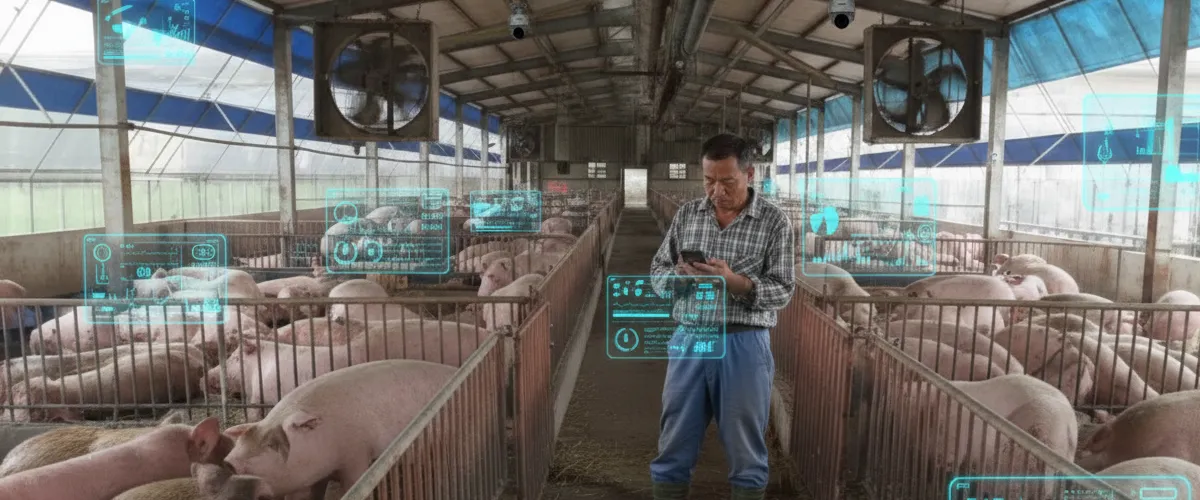
When people talk about smart pig farming, many think of installing sensors or cameras inside enclosed pig houses. But many pig farms in Taiwan are semi-open or outdoor, with wind, rain, sun, and a complex environment, which makes indoor-type equipment hard to use.
Outdoor IoT refers to a set of sensor and monitoring systems capable of operating stably in open environments, including:
- Wearable ear tag sensors: Can record pig activity behavior and body temperature changes over long periods to detect anomalies early.
- Visual recognition and non-contact thermal imaging cameras: Can assess health conditions based on appearance and animal surface temperature without physical contact.
- RFID and GPS positioning technology: Precisely controls the identity and movement traces of pigs for rapid tracking and isolation during an outbreak.
Which one to use depends first on the pig farm's power and network, and on who looks at the data and who handles abnormalities.
3. Complex Outdoor Environments: Who Will Push for Practical Implementation?
For equipment to hold up outdoors, someone also has to help with integration: sensors used outdoors must withstand high heat, humidity, and dust, and the data system must be stable and easy to operate.
YenProtek builds outdoor IoT and provides:
- Sensor devices and camera monitoring systems specifically designed for outdoor environments.
- A Cloud data collection platform and decision-making recommendations.
- On-site installation and operational training.
Pig farm environment sensing, medication and biosecurity records can be kept in one place with YenProtek's Pig Herd Management System: it links breeding, medication, environment and biosecurity records by ear tag, barn conditions are measured by FarmerPack, and you are alerted when a barn exceeds its thresholds.
Conclusion: From Remedying After the Fact to Warning Before It Happens
On April 6, 2026, Taiwan was recognized by the World Organisation for Animal Health (WOAH) as having regained its ASF-free status. But the virus does not care whether it is sunny or rainy, and does not pick where it goes, so monitoring cannot be placed only indoors. To keep ASF-free status, disease prevention has to shift from remedying after the fact to warning before it happens.