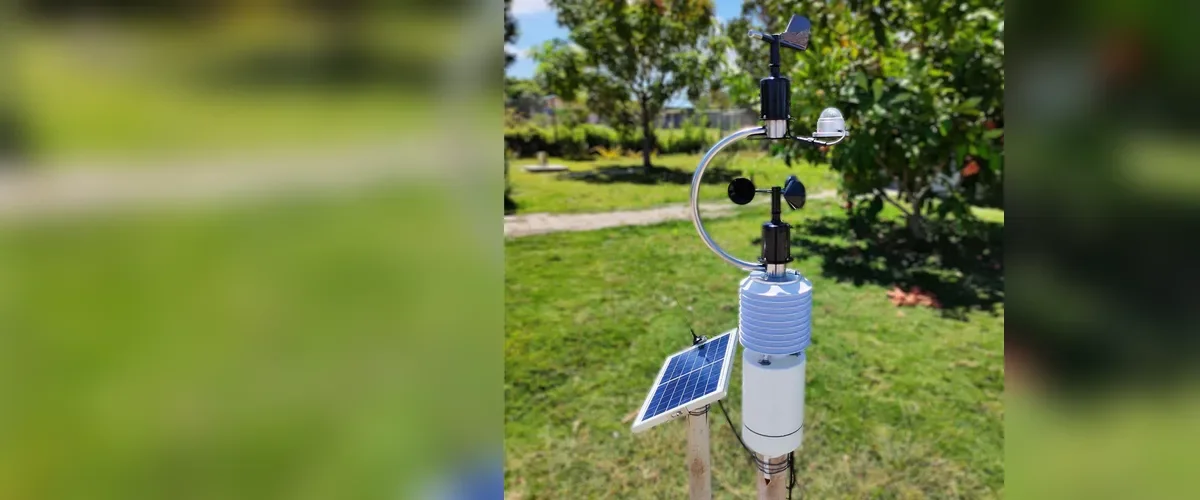
A small weather station (also called a micro weather station or farm weather station) is a small automatic station installed in your own field or greenhouse. It keeps measuring the temperature, humidity, rainfall, wind, sunshine and soil conditions of that plot right now, and sends the data to your phone. A weather agency’s ground station is built to a uniform standard so that it represents the weather over a wide area of 100 to 1,000 km² around it, so the two look at different areas.
Within the same region, the temperature and rainfall can differ a lot between the hillside and the riverside, or between an open field and inside a greenhouse. A University of Florida extension publication also points out that stations at airports or in town are affected by buildings, and that rainfall is naturally uneven, so they are not suited to managing a farm directly. If you want to know how warm “your own field” is right now, whether the soil has dried out and how much rain just fell, you need to put one in the field. Once it is set up, you do not have to walk the field every day to check the water, you can skip watering after rain, and when a cold snap or a heat wave is coming your phone warns you first.
This article goes through the five things buyers ask about most: what to measure, what to check when buying, where to install it, how high it should be to read true, and how to use the data.
What Should You Measure on a Farm? Start with What You Want to Solve
A small weather station is not better just because it measures more. First decide what you want to save yourself from doing, then pick the matching measurements. The table below shows common uses and what we suggest measuring first. For the principles and limits of each sensor, see “What Agricultural Sensors Are There.”
| What you want to solve | What to measure first | How the data helps |
|---|---|---|
| Water: when to irrigate | Soil moisture, rainfall, air temperature | Water only when the soil is dry, and skip it right after rain |
| Estimate how much water crops need | Air temperature, relative humidity, wind speed, solar radiation | These four are the basic data for estimating reference evapotranspiration (crop water use) |
| Guarding against cold and heat damage | Air temperature, relative humidity | Phone alerts for low or high temperatures so you can prepare early |
| Orchard wind protection and spray planning | Wind speed, wind direction, rainfall | Hold off spraying when it is windy, and tie up and reinforce branches before strong winds arrive |
| Greenhouse temperature | Air temperature, relative humidity, CO2, illuminance or photosynthetically active radiation (PAR) | Turn on fans or shading when it is hot, and see how much light the crops are getting |
| Watching the soil change | Soil temperature, electrical conductivity (EC), pH, nitrogen-phosphorus-potassium (NPK) | Follow the trend after fertilizing and when seasons change |
| Drainage ditches and reservoirs | Water level, rainfall | Watch the water level in heavy rain and drain early |
Taking FarmerPack as an example, the sensor modules you can choose fall into three groups. Pick what you need; you do not have to buy the whole set:
- Air and weather: air temperature, relative humidity, atmospheric pressure, wind speed, wind direction, rainfall and water level, plus CO2, PM2.5/PM10, noise and black globe temperature for greenhouses, campuses and similar sites.
- Light: illuminance, photosynthetically active radiation (PAR) and solar radiation.
- Soil: soil temperature, soil moisture, soil electrical conductivity (EC), soil pH and soil nitrogen-phosphorus-potassium (NPK).
Two small reminders: soil NPK is good for watching trends and does not replace soil testing; fertilizer recommendations should still follow soil test results. The relative humidity measuring range is 0 to 95% RH, so for periods of near-saturated, very high humidity, we suggest setting an alert for “humidity staying high for a long time.” It tracks the trend, and you then check in the field.
6 Things to Check When Buying a Small Weather Station
The measuring range and accuracy on the spec sheet are worth reading, but for a machine used in the field, what really decides whether it is a good one is usually the following.
1. Power: does it work without a power outlet in the field?
On most farmland, running power is a hassle, so ask first: what powers it, and how many days of continuous rain or cloud can it last through? FarmerPack comes with a solar panel and a rechargeable lithium battery as standard, and runs for more than 30 days without sunshine. Where there is an outlet you can also connect mains power, and an external lead-acid battery can be added. Wipe the solar panel now and then, because dust or fallen leaves covering it will affect charging.
2. Connectivity: how does the data get from the field to your phone?
It depends on the mobile reception in your field and the network on site. FarmerPack offers 4G, NB-IoT, Wi-Fi or LoRa (which needs a LoRa gateway), and to connect to an existing control cabinet or system it also supports wired Modbus RTU and Modbus TCP. For which connection method suits which kind of site, see “How to Choose IoT Communication Technology.”
3. Data storage and resending: will you lose data if the connection drops?
Reception in the field is bound to be good one time and poor the next. Check whether the device can store data itself and whether it resends it on its own when the connection returns. FarmerPack keeps data temporarily on a MicroSD card and uploads it automatically once the network is back. You can set how often a reading is recorded, from as short as 1 minute to as long as 24 hours. Phones, tablets and computers can all show live readings and historical trends, and an API and MCP are available to connect the data to an existing management system or AI tools.
4. Waterproofing and sun resistance: will it last a full year in the field?
Rain, sun, heat and humidity are everyday conditions. The FarmerPack body is fully waterproof (tested in-house), the housing is industrial-grade UV-resistant PC+ABS, and the operating temperature is -20 to 60 °C. When buying, also ask how it should be fixed in place for heavy rain and typhoon season.
5. Can it connect to controls: does it only show readings, or does it act?
If it only shows numbers, you still have to run out to turn the water on. To save effort, it is best if it can connect to control equipment: FarmerPack can be paired with the Smart Control Box, so on your phone you can set “when soil moisture drops below a certain value, turn the water on for this long,” and your existing pumps, solenoid valves and fans switch on and off automatically, with no need to replace your existing equipment.
6. Maintenance and warranty: who deals with it if it breaks?
Sensors need regular cleaning (see the maintenance schedule in the next section), and you should also ask how a fault is handled. FarmerPack comes with a one-year warranty. If it fails during the warranty period, there is no need to send it in and wait: we ship you a replacement, and the actual warranty terms are as stated in your quotation. The app and platform support multi-language interfaces, so older family members and foreign workers can read them in a language they know.
Where and How to Install It for Accurate Readings
With the same machine, if it is in the wrong place, what it measures is not the conditions of your field. The University of Florida extension publication’s principle is to place the station where it best represents the field, and to avoid the influence of buildings, trees and other obstructions as far as possible. The table below sums up what that publication and WMO (World Meteorological Organization) recommend for each measurement:
| Item | Recommended location | Source |
|---|---|---|
| Air temperature, relative humidity | An open, level area at least 10 m across, with short grass on the ground if possible; at least 4 times the height of any obstruction away from it, and at least 30 m from large paved areas; the sensor needs a radiation shield and good airflow; avoid roofs, steep slopes, tree shade, low spots where water pools after rain, and large heat sources | University of Florida AE502 |
| Rainfall | As far as possible from obstructions, ideally 4 times the height of the nearest obstruction; the rain gauge opening should be level and facing the sky, and higher than the height rain splashes up from the ground | University of Florida AE502; the better classes of WMO siting classification require obstructions to be at least 2 times their height away |
| Wind speed and direction | An open, level place, as far as possible from buildings and trees, ideally 10 times the height of the nearest obstruction | University of Florida AE502; WMO siting class 2 likewise requires 10 times |
| Sunshine and solar radiation | Not shaded by trees, buildings or the station itself at any time of year as the sun’s angle changes; avoid reflective surfaces and artificial light (in the Northern Hemisphere, mounting on the south side of the station is suggested; in the Southern Hemisphere, on the north side) | University of Florida AE502 |
| Soil temperature and moisture | Choose a spot of at least 1 m² that represents the soil in your field; at least 1.5 m from posts or buildings, away from where drainage from around flows through; soil temperature is often measured 10 cm underground, and if you measure only one depth, choose the depth that best represents the root zone | University of Florida AE502 |
Different measuring heights give different numbers
WMO’s standard is that the air temperature sensor sits inside a shield 1.25 to 2 m above the ground, and no lower than 1.25 m; the standard height for measuring wind is 10 m above the ground. The University of Florida’s recommendation for farm stations is to measure air temperature, humidity and wind at 2 m, with the rain gauge at about 1 m.
So when the numbers from your own field do not match a nearby weather station, do not rush to say which one is wrong. First compare the heights and surroundings of the two. A small weather station set up close to the crops measures the conditions right beside the crops, which is more useful for managing the field.
In a greenhouse: put the sensor at crop height
Michigan State University research suggests that a greenhouse temperature sensor should have a shield, have good airflow and be placed at crop height. A temperature taken about 90 cm above the crop can be slightly higher than at crop height, which can make people think the crop is hotter than it really is. As the crop grows taller, move the sensor with it.
How to Install FarmerPack
When it arrives, push it into the soil and finish the setup in the phone app, and it starts recording. No wiring or electrical work is needed. Choose the location by the principles above: pick a plot that represents the whole area, and avoid tree shade, wall sides and spots hit directly by sprinklers. For fields with very different terrain or soil, it is best to put one station in each area with different conditions. For how many to use and how to divide the area, you can start with “Satellite Remote Sensing or a Field Weather Station?”, which uses satellite images to find the areas that differ most.
How Often Does It Need Maintenance?
The inspection schedule recommended by the University of Florida: check the rain gauge once a week, because insects, plant debris and mud most often clog the funnel; wipe the sunshine sensor clean and confirm it is level every week; clean the dust off the temperature and humidity sensor shield every month; check the anemometer every quarter, and if it makes a rubbing sound when it turns or does not turn in a light breeze, the bearings need attention.
Using the Data: Alerts First, Then Let the Equipment Act on Its Own
Use alerts instead of walking the field
Set the thresholds in the app, and when a reading is abnormal you are notified by app push, SMS or email: a cold snap is coming, the greenhouse is too hot, the soil is too dry, the water level is rising. Even when you are not in the field, you know when to go and look. The app also has built-in local weather, a 7-day forecast and a farming calendar. The forecast tells you what may happen next, the station in your field tells you what is happening now, and looking at both together gives you the most peace of mind.
Add the Smart Control Box to switch equipment automatically
With FarmerPack and the Smart Control Box you can set “when… then…” rules on your phone: when soil moisture drops below the set value, turn the water on for 20 minutes; when the greenhouse is too hot, turn on the fans or shading. Because it decides by soil moisture, it will not turn the water on if it has just rained and the soil is still wet, so you do not need to water after rain. Rainfall, time or changes in the weather can also be used as conditions, and a notification is sent to you at the same time. No programming is needed, and you set the thresholds yourself for your own soil and crops. Even if the network goes down, the Smart Control Box keeps running on the last settings it downloaded and does not stop. High-power or three-phase motors such as pumps are wired through an external circuit by a qualified electrician.
Keep records so next season is easier to plan
Each season’s temperature, rainfall and watering times stay on the platform, so you can compare this year with last year and use it as a reference for planning farm work next season. To first understand the overall approach to precision agriculture, see “What Is Precision Agriculture?” If you also use satellite images, remember how the two divide the work: the satellite looks at the whole area, and FarmerPack looks at what is happening now.
Small Weather Station FAQ
Q1: We have weather forecasts. Do I still need a small weather station?
The two work well together. The forecast tells you the weather trend for the region ahead, while a small weather station measures the temperature, rainfall and soil moisture in your own field right now. To decide whether to water today or turn on the greenhouse fans, the numbers in your field right now are the most direct.
Q2: Can I install one where there is no power and poor reception?
Yes. FarmerPack is solar powered as standard and runs for more than 30 days without sunshine; for connectivity you can choose 4G, NB-IoT, LoRa or Wi-Fi. When reception is unstable, data is stored on the memory card first and uploaded automatically when the connection returns.
Q3: The temperature it measures is different from the nearby weather station. Is it broken?
Not necessarily. Weather agencies measure air temperature at 1.25 to 2 m high on an open site, following WMO standards. A station in your field has a different height and surroundings, so the numbers are bound to differ. First check that the sensor is not in direct sunlight, that the shield is clean and that there is no concrete or wall nearby affecting it. If the reading jumps suddenly or does not change for a long time, contact us and we will check it.
Q4: How do I maintain a small weather station?
The University of Florida recommends checking and cleaning the rain gauge and sunshine sensor every week, cleaning the temperature and humidity shield every month, and checking the anemometer every quarter. Wipe the solar panel now and then. If FarmerPack fails during the warranty period, we ship you a replacement, and the actual terms are as stated in your quotation.
Q5: Can it turn on the water automatically when the soil is dry? What if the network goes down?
Yes. With the Smart Control Box, you set a soil moisture threshold and a watering time on your phone, and it switches your existing pump or solenoid valve on and off automatically. If the network goes down, the Smart Control Box keeps running automatically on the last settings it downloaded.
Q6: Can the data be connected to our own system?
Yes. FarmerPack supports wired Modbus RTU and Modbus TCP, and an API and MCP are also available to connect the monitoring data to an existing management system or AI tools. How it is done is assessed according to the interfaces the other system provides.
Want to see how it looks first?
FarmerPack is a solar-powered, modular field micro weather station. You choose the sensors to suit your crops and site, push it into the soil, set it up on your phone, and it starts recording. For the full sensor specifications see the FarmerPack product page, and for applications at different sites see Microclimate Monitoring.
To see how it looks on a phone and on the platform, feel free to request a demo account. Tell us your crops and field conditions, and we will suggest what to measure and how many units to place.
References
- University of Florida IFAS Extension:Your Farm Weather Station: Installation and Maintenance Guidelines(AE502)
- WMO Commission for Instruments and Methods of Observation (CIMO): Siting Classifications for Surface Observing Stations on Land
- University of Delaware Cooperative Extension, reprinting Blanchard and Runkle of Michigan State University: Greenhouse Temperature Variations