Project Overview
In this project, we partnered with a well-known smart traffic data survey company to develop the "Smart Mountain Road Safety Warning Device," with YenProtek providing a full range of underlying technical support. The product is primarily planned for installation along key tourist routes such as Meishan (County Road 166) and Longmei (County Road 129) in Chiayi. Road conditions in these areas are poor, with many sharp curves, forks, and steep grades, and many sections allow only one vehicle to pass at a time. Especially on weekends and holidays when traffic is heavy, drivers lack sufficient awareness of the traffic conditions ahead, leading to misjudgments and accidents. In addition, installing road safety monitoring systems in remote areas is difficult due to terrain constraints: running power is hard and construction is challenging, which often brings high installation and ongoing maintenance costs. Overcoming these difficulties was one of the key challenges this project set out to address.
Based on the client's requirements, we developed the "Smart Mountain Road Safety Warning Device" for remote outdoor areas, mountainous regions, and special road sections. Its goal is to issue clear, real-time flashing warnings via LED signal lights, indicating that a vehicle from the opposite direction or a side road has already entered the curve or narrow section. This reminds road users to watch for oncoming traffic and avoid entering narrow curves at the same time, reducing accidents and congestion caused by forced passing on narrow bends. To meet the needs of outdoor wireless applications, the device features a waterproof design that withstands changeable mountain conditions. To suit remote mountain terrain, it is powered by green energy (solar or wind), eliminating the cost and complex work of adding mains power. Installation is not restricted by terrain or location, making it safer, easier to install, and more cost-effective, while greatly improving the system's adaptability.
Beyond real-time warnings, the system also uploads the collected vehicle and warning data to the Cloud, helping traffic management authorities manage and maintain each installed road section more effectively. This improves traffic management efficiency, lowers system maintenance costs, and creates smart, safe intersections for a worry-free driving environment.
The Smart Mountain Safety Warning System has now been deployed at multiple locations in the mountains of Chiayi with good results, and the Chiayi County Government plans to add more sites to further improve driving safety for mountain residents and visitors.
Project Details
- Client / Site
- Chiayi County Government
- Project Period
- 2019-2021
- Category
- # Smart Traffic # Warning System
- Sensing Technology
- Infrared Sensing Technology
Implementation and Mechanical Design
The system places vehicle sensors at the roadside before curves or at fork intersections. Combined with computational logic, the sensors identify the types of passing vehicles (filtering out motorcycles, bicycles, and pedestrians) and determine their direction of travel. When a vehicle passes an intersection or enters a blind curve, a warning light is triggered at the other end of the road section that needs a warning, alerting road users to oncoming traffic. At the same time, the relevant data is uploaded to the Cloud over the network, allowing the responsible authorities to monitor remotely.
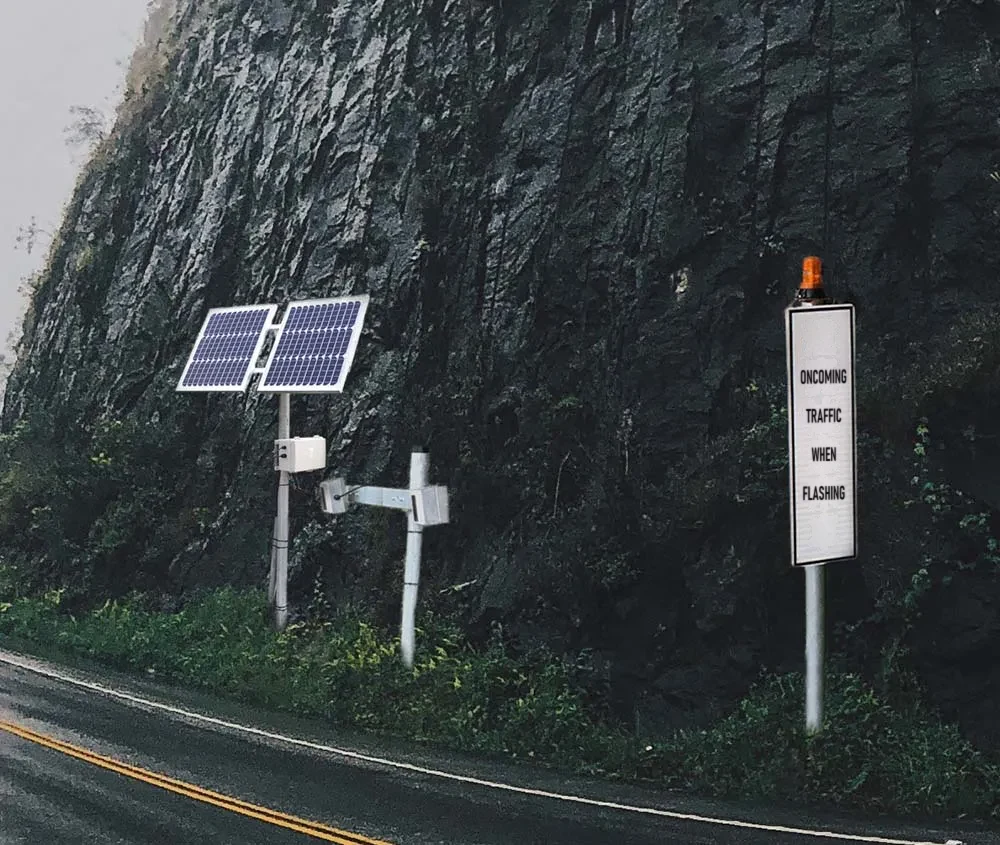
The "Smart Mountain Safety Warning System" consists of at least two sets of vehicle sensors and a cloud system. Each vehicle sensor set mainly includes an infrared sensing module, LED warning light, power supply, and control system. Since the system is installed outdoors, we designed it for quick and easy assembly and disassembly, helping owners reduce the difficulty and cost of installation and ongoing maintenance. The main body is made of stainless steel for sufficient strength and better weather resistance.
Infrared Sensing Module
- Two sets of infrared sensors determine the vehicle type and direction of travel as vehicles pass.
- Single-beam infrared sensors with an effective range of 15M cover the width of typical mountain roads.
- The infrared transmitter and receiver modules are installed on opposite sides of the road, facing each other. The transmitter emits an infrared beam to the receiver; when a vehicle passes, the beam is interrupted, indicating that a vehicle has passed. Two sets of infrared sensors at the same intersection, spaced 1M apart, can effectively determine the vehicle type and direction of travel.
Warning Light
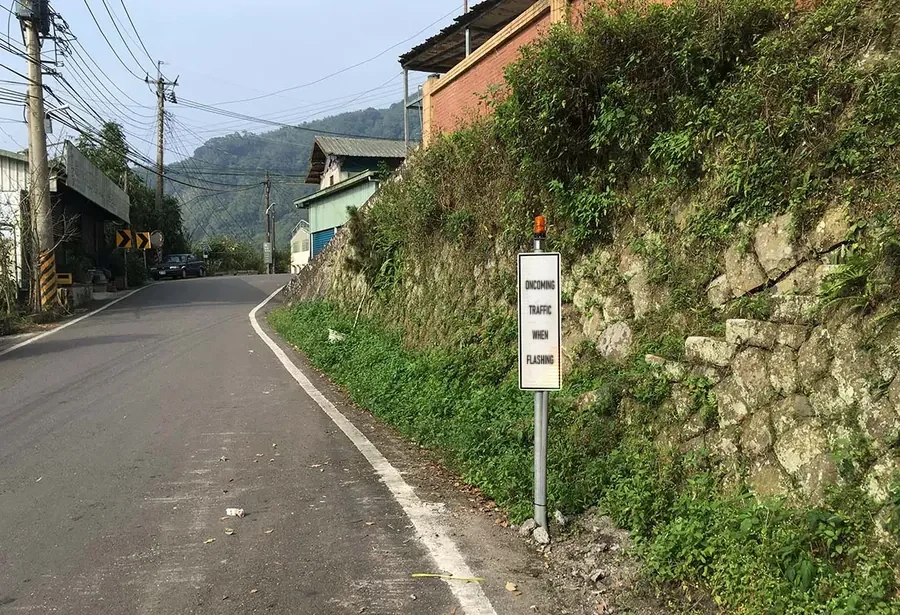
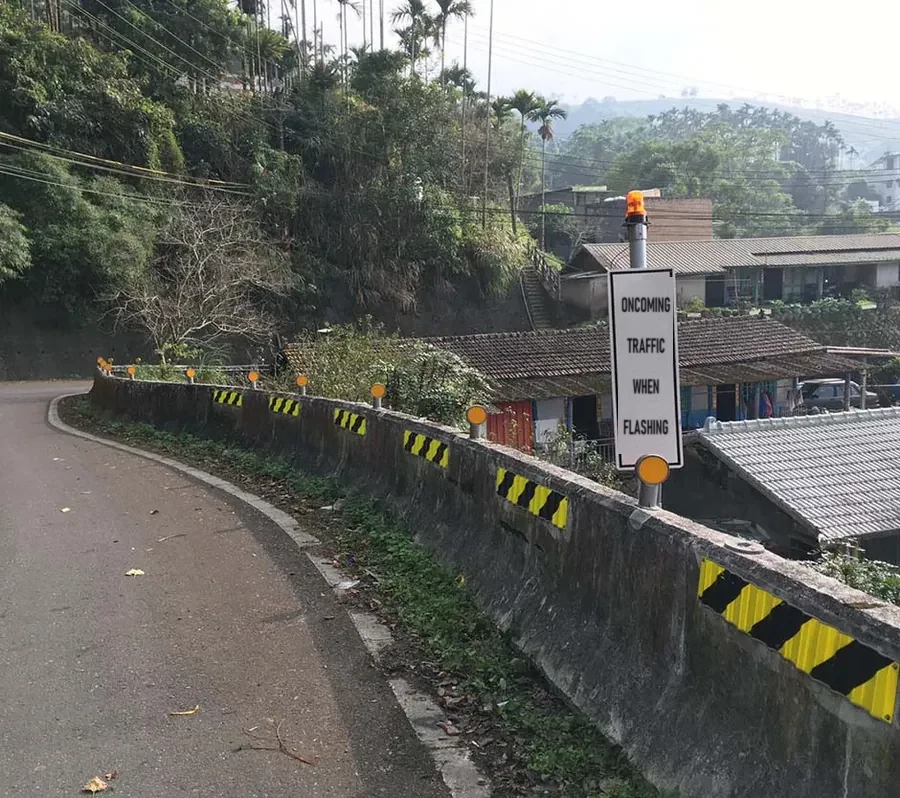
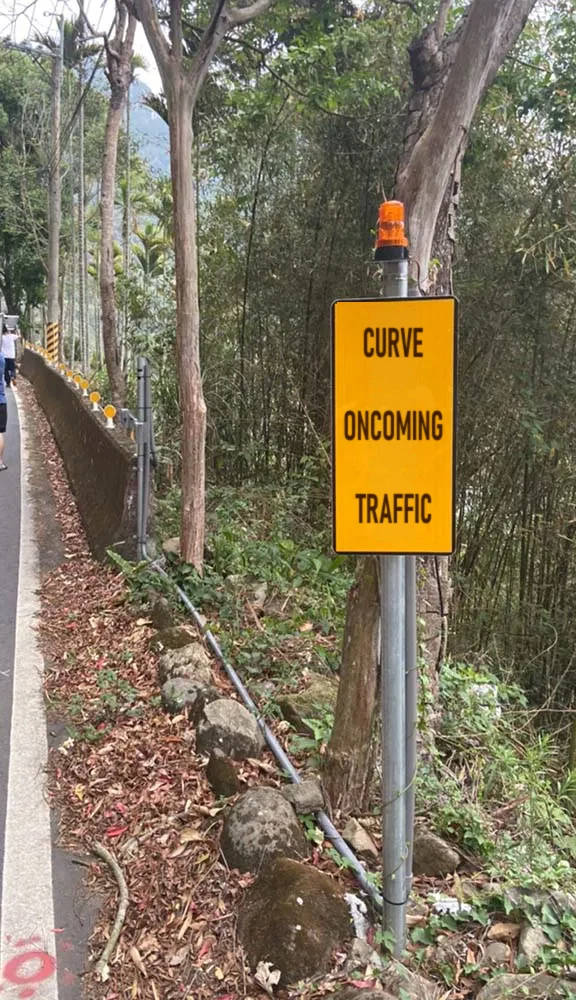
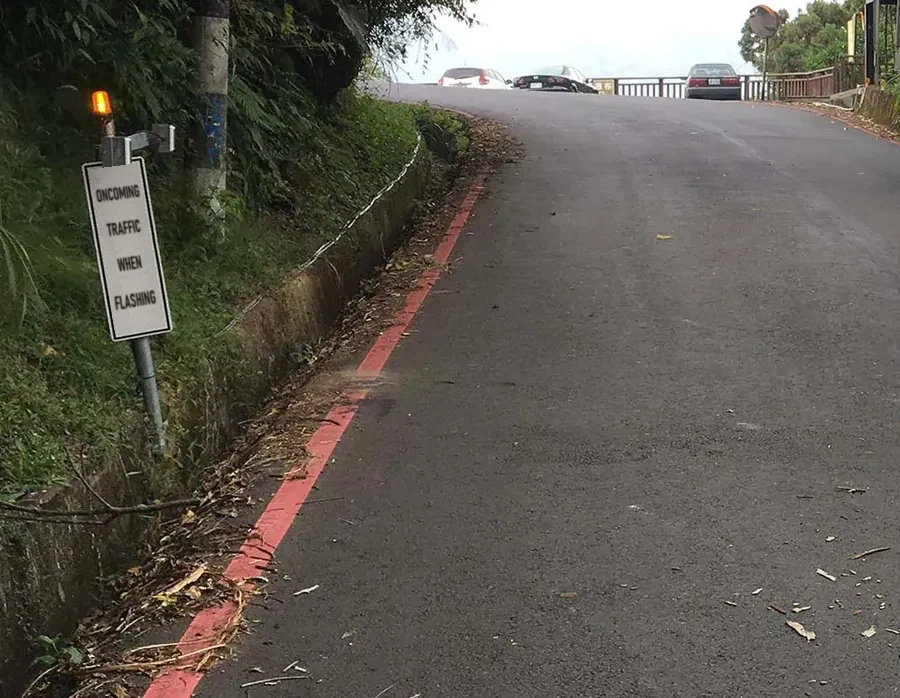
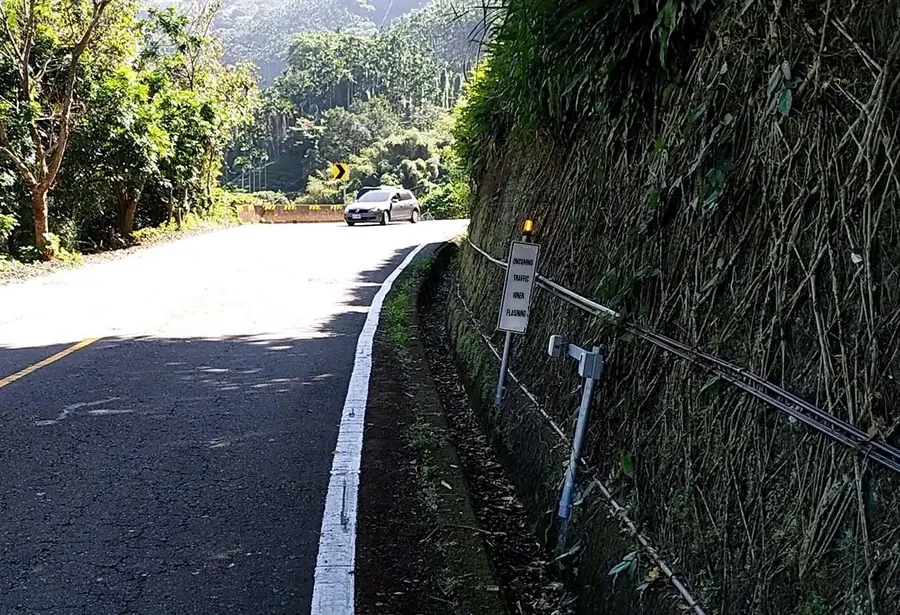
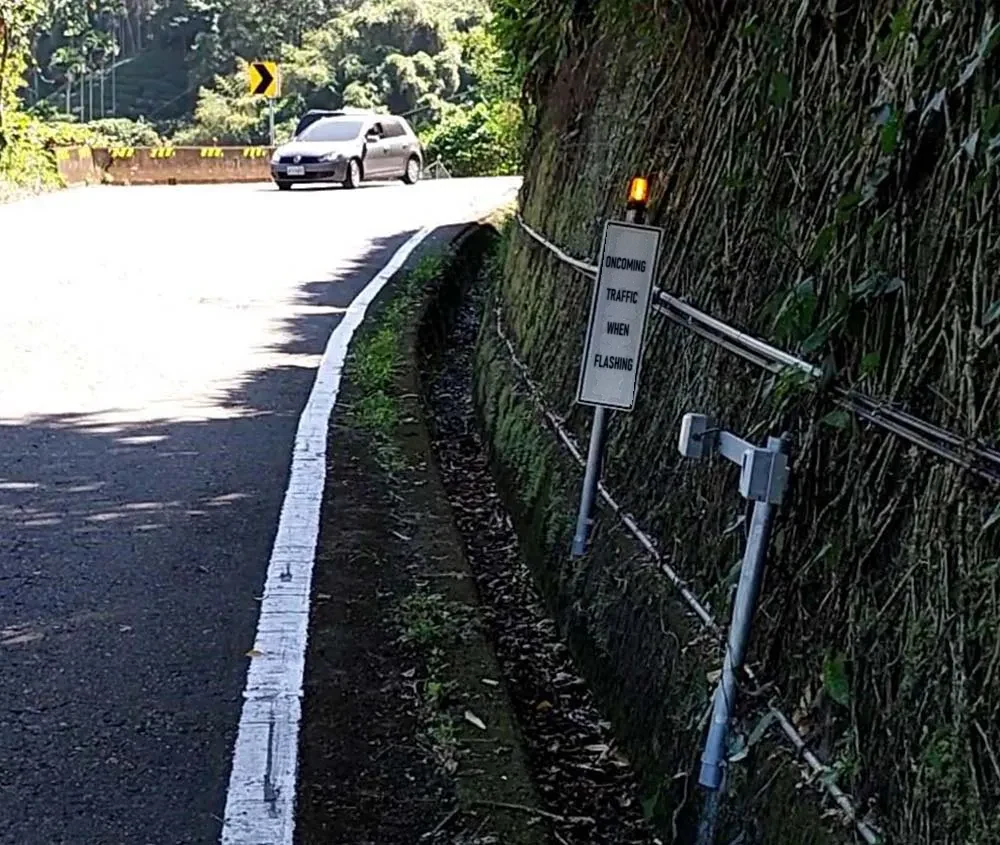
The LED warning light is mounted on a steel pole together with a warning sign at the roadside; its main function is to warn oncoming traffic.
Power Box
- The stainless steel enclosure holds the battery and secures the solar power management module. Side openings make cable routing easy, and a hook design on the back allows the box to be mounted on a steel pole for fast installation.
- A solar power system supplies power to the infrared sensor transmitter and the warning light.
- Solar power module: A 60W solar panel and power management module supply system power. Paired with a 55AH battery, the system can fully charge the battery in 1–2 sunny days with direct sunlight, and once fully charged, it can run for 7–10 days in rainy or overcast weather without solar charging.
Control Box
- Stainless steel enclosure with side openings for easy cable routing and a hook design on the back for mounting on a steel pole, enabling fast installation.
- Powered by the solar power system, the control module controls vehicle sensing and the warning lights, and connects to the network to upload relevant information to the cloud system.
- Control circuit board: Two controller modules—one handles sensor input and warning light output, and the other uploads data to the Cloud via NB-IoT. The input side uses optocouplers to receive analog sensor signals, the output side uses a relay module to control the warning lights, and an ADC provides voltage sensing to monitor battery level.
Cloud Server
Stores uploaded sensor data and supports remote configuration and monitoring. The cloud platform records all reported information, which can be queried by various criteria, compiled, and downloaded as EXCEL spreadsheets for analysis.
Development Highlights
Rugged and Durable
Specifically designed for outdoor wireless applications, built to withstand frequently changing outdoor environments.
Green Energy Power Supply
Choose solar or wind power supply based on site conditions.
Cloud Data Upload
Data is automatically uploaded to the Cloud system for traffic control centers to monitor and analyze.
High Reliability
Equipped with a temporary data storage mechanism to ensure the completeness and continuity of uploaded data.
Easy Installation
No need to worry about complex wiring and host settings; safe and easy to install.
Remote Updates
Device settings and firmware updates can be performed remotely via IoT, providing convenience and labor savings.
AIoT Road Safety Warning System – The Optimal Solution for Narrow Mountain Curves
- Sensors detect a vehicle about to enter a narrow curve
- The warning light on the opposite side flashes to alert drivers that a vehicle has already entered the curve, preventing simultaneous entry and reducing accidents and congestion caused by forced passing on narrow curves.
- Powered by green energy (solar or wind), ideal for mountainous and remote areas where running power lines is impractical. There is no need to worry about the cost and complex work of adding mains power, and installation is not restricted by terrain or location—making it safer, easier to install, and more cost-effective.
Flexible Application Across Multiple Road Types
Adjacent monitoring devices can be interconnected via wireless communication technology.
Use the APP for further configurations, making it adaptable to a wider variety of intersection types.


Success Case
Our client has already installed the system on multiple road sections in the Chiayi mountains