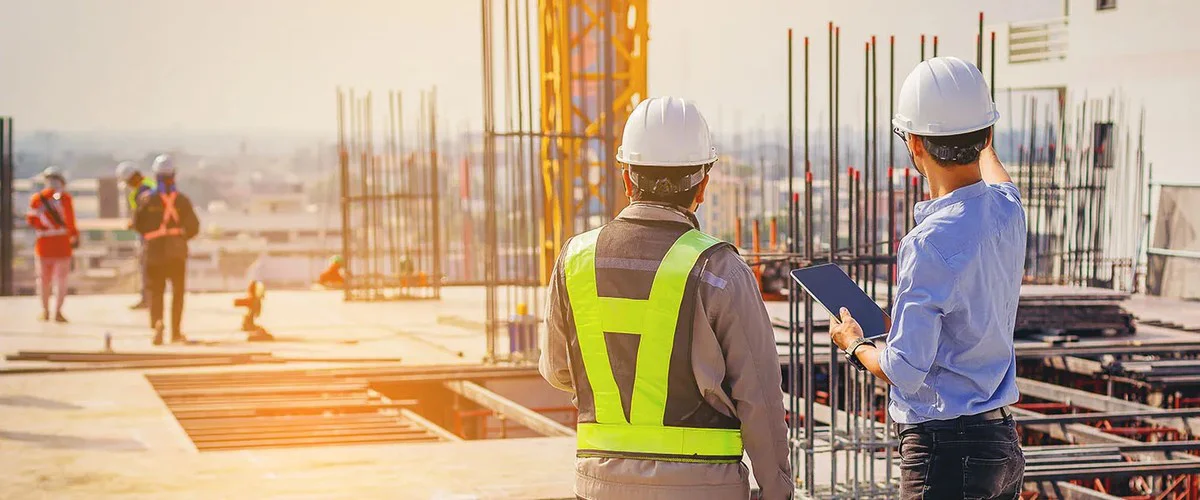
Preventing heat stroke on a construction site takes three things: check the heat hazard risk level before work to plan working hours; measure WBGT in sun-exposed work areas and set limit alerts; and arrange water, rest, shade and cooling by level, and keep records. From 2026, main contractors and subcontractors must identify high-temperature risk together.
Construction sites are the first priority of the Ministry of Labor's annual outdoor high-temperature special inspections. Starting from what site managers and safety officers do every day, this article sets out a heat hazard checklist you can follow directly: why sites are especially hot, the daily routine, where to put monitoring points, how to make sure workers really see the warnings, how contractors share duties, and what to do when something happens.
Why Is a Construction Site Hotter Than the Weather Forecast?
- Sun exposure and no shade: roofs, steel-frame floors and road surfaces are in direct sun all day.
- Heat reflected from the ground and materials: concrete, rebar, asphalt and metal sheets absorb and reflect heat, and globe temperature is often much higher than air temperature.
- Non-breathable gear: helmets, reflective vests, long sleeves and gloves make it hard for sweat to evaporate. The guidelines require raising the heat hazard level by one when non-breathable, heavy protective clothing is worn.
- Heavy work: tying rebar, moving formwork and digging are heavy work, and the body produces a lot of heat itself.
- The work face keeps changing: in the basement today, on the roof next week, so where it is hot moves with the project.
So on the same day and the same site, WBGT under a shade canopy and on the roof can differ by several degrees. For a worked example, see How to Calculate WBGT.
Daily Heat Hazard Routine on Site
| Time | What to do | Who is responsible |
|---|---|---|
| Evening before | Check the next day's high-temperature forecast and heat hazard level forecast, and schedule heavy work | Site manager |
| Before work | Check the day's level on the High-Temperature Work Protection Information Website; confirm drinking water, rest area, shade and fans; remind workers of heat illness symptoms at the pre-work briefing | Safety officer, foreman |
| Morning | Arrange rest by on-site WBGT and level; schedule new workers by heat acclimatization | Foreman |
| Around midday (hottest) | Patrol more, reduce or suspend heavy work; at Level 4 and above, confirm shade, cooling equipment and a rest area | Safety officer |
| Afternoon | Keep watching on-site values; WBGT may rise again when wind picks up or clouds clear | Foreman |
| After work | Record the day's level, times limits were exceeded, measures taken and anyone who felt unwell | Safety officer |
For how to set the rest proportion by WBGT and work intensity, see WBGT Rest Break Schedule.
Where Should WBGT Monitoring Points Go?
- The hottest work face with the most people: roof, steel-frame floors, roof waterproofing, road paving areas.
- A comparison point: put one near the rest area or site office, to show whether shade and cooling are working.
- Zones on a large site: one representative point for each contractor or work zone, so an alarm tells you which zone it is.
- Moving with the project: as the structure goes up, move the monitoring point up too. Solar-powered, wireless equipment is the easiest to move.
Measure at around the height of workers' bodies. Do not put it against a scorching surface, or in the shade or next to an air-conditioner outdoor unit.
Warnings Must Be Seen and Heard by Workers
Heat hazard warnings most often fail because the numbers are on the manager's phone and the workers do not know. Workers in gloves and helmets with their hands busy need these on site:
- A warning light: shows the current state at a glance, and crews far away can see it too.
- An alarm: sounds when limits are exceeded, to remind people to stop, rest and drink water.
- Phone notification: the site manager, safety officer and contractor contacts all receive it at the same time, so no one has to keep watching the numbers.
- Existing public address system or display boards: we can assess linking them by switch signal through a Smart Control Box.
The notification list should include deputies; update it for leave and shift changes.
How Should Contractors Share Duties?
A Ministry of Labor press release of July 2026 states that high-temperature work risk is part of contracting safety management, and the principal business unit (main contractor) and subcontractors must jointly identify high-temperature work risks and put protective measures in place. In practice, it can be divided like this:
| Item | Main contractor (principal business unit) | Subcontractor |
|---|---|---|
| Risk identification | Raise high-temperature hours and hot areas at the coordination organization meeting | Provide the work content and work intensity of its own crew |
| Shared facilities | Shade, rest areas, drinking water, site-wide monitoring and warnings | Use them as required and report shortfalls |
| Schedule changes | Set unified work rules for high-temperature hours | Schedule its own crew's rest according to the rules |
| Patrols and reporting | Patrol more and receive alarms | Foremen watch workers' condition and report anyone feeling unwell immediately |
When the whole site shares one set of monitoring and warnings and every subcontractor looks at the same number, there are fewer arguments than when each judges "is it hot today" for themselves.
What to Do When Someone Has Heat Stroke
- Stop work at once and move the person to a cool, ventilated place.
- Loosen clothing, remove helmet and vest, and cool the person with water, ice packs and fanning.
- If the person is conscious, give small sips of water or an electrolyte drink.
- If the person is unconscious, has convulsions, or is very hot with no sweating, call 119 immediately and keep cooling.
- Report to the site manager and safety officer, and record the time, place, the heat hazard level and the on-site values at the time.
Know in advance where the nearest hospital is and who is responsible for first aid. This is also required by Article 324-6 of the Regulations on Occupational Safety and Health Facilities, "set up an emergency medical, reporting and response mechanism". For regulations and penalties, see Heat Hazard Regulations and Penalties.
Records: Useful for Inspections and Afterwards
Each day's level or on-site WBGT, the times limits were exceeded, who the alarms notified, how work was adjusted that day and whether anyone felt unwell: these records are useful in special inspections, in sorting out contractor responsibility and in incident reviews. Handwritten records are easily incomplete, and automatic cloud storage from monitoring equipment is the easiest way.
How YenProtek Helps Sites Manage Heat Hazards
Heat Safety Guardian is a heat hazard alert system developed in-house by YenProtek. It calculates the WBGT heat index in real time and, when limits are exceeded, triggers on-site sound and light alarms and LINE notifications. The standard kit includes the main unit, an NB-IoT communication module, a solar power module, a sound and light alarm and an app cloud management system. No extra power or network wiring is needed, so it suits temporary sites and work areas where equipment positions change often. Environmental data and event records before and after an alarm are kept automatically in the cloud. YenProtek has also carried out a construction safety high-temperature monitoring project: a micro-weather station measured temperature, humidity, globe temperature and wind speed and calculated the WBGT heat index to help the site assess heat hazard risk.
Besides heat, sites often have to watch noise, dust and strong wind. The same station can be expanded with more sensors. See Construction Site Environmental Monitoring: Noise, Dust, Strong Wind and Heat Covered by One System. For alcohol and body temperature checks before work, see Smart Alcohol and Body Temperature Screening.
To find out how many points your site needs and what it costs, go to Online Quote, choose a configuration and submit, or contact us. For product specifications, see the Heat Safety Guardian product page.
Frequently Asked Questions
Q1: On a construction site, should I use the heat index or WBGT?
Both. OSHA's heat hazard risk level is determined by the heat index, so check the information website before work each day to plan the work. Sites have a lot of sun and reflected heat, so the actual local heat is often higher than the area value. Measure WBGT on site in the hottest work areas.
Q2: What must be done on a construction site at heat hazard Level 4?
Under Article 303-1 of the Regulations on Occupational Safety and Health Facilities, provide shade and cooling equipment such as fans and water mist at the work area, and a rest area with a cooling effect nearby, with sufficient drinking water.
Q3: Do subcontractors' workers have to be covered too?
Yes. The Ministry of Labor states that high-temperature work risk is part of contracting safety management, and main contractors and subcontractors must jointly identify high-temperature work risks and put protective measures in place.
Q4: How do I install monitoring equipment on a site with no power or internet?
Choose equipment with solar power and built-in mobile communication. Heat Safety Guardian uses solar power and NB-IoT. Put it on a tripod and it starts measuring, and it can be moved to a new work face as the project progresses.
Q5: What subsidies are available for heat stroke prevention on construction sites?
The Ministry of Labor OSHA's 2026 high-temperature protection subsidy covers shade and cooling equipment and heat protection gear for SMEs and self-employed persons, and adds heat hazard detection and alert devices. See the summary in How to Apply for Heat Hazard Subsidies.
Further Reading: WBGT and Heat Hazard Series
- What Is WBGT? Wet Bulb Globe Temperature Explained (Series Overview)
- How to Calculate WBGT: Outdoor and Indoor Formulas with Examples
- WBGT Rest Break Schedule: High-Temperature Work Rest Standard Table
- What Is the Heat Index? Heat Index Chart, Levels and How It Differs from WBGT
- Heat Hazard Regulations and Penalties: What Employers Must Do Under the 2026 Occupational Safety and Health Act
- How to Apply for Heat Hazard Subsidies
- How to Choose a WBGT Meter: Handheld vs Fixed Monitoring Station
References
- Regulations on Occupational Safety and Health Facilities, Articles 303-1 and 324-6.
- Occupational Safety and Health Administration, Ministry of Labor, Guidelines for the Prevention of Heat Hazards in High-Temperature Work, third edition.
- Ministry of Labor, press release "Fighting the Heat, Protecting Workers: Ministry of Labor Heat Hazard Seminar", 2026-07-17.
- Ministry of Labor, outdoor high-temperature special inspection campaign, 2026-05.
Article updated: 2026-11-10. The heat stroke first aid content is general guidance. In an emergency, call 119 and follow the instructions of medical staff.