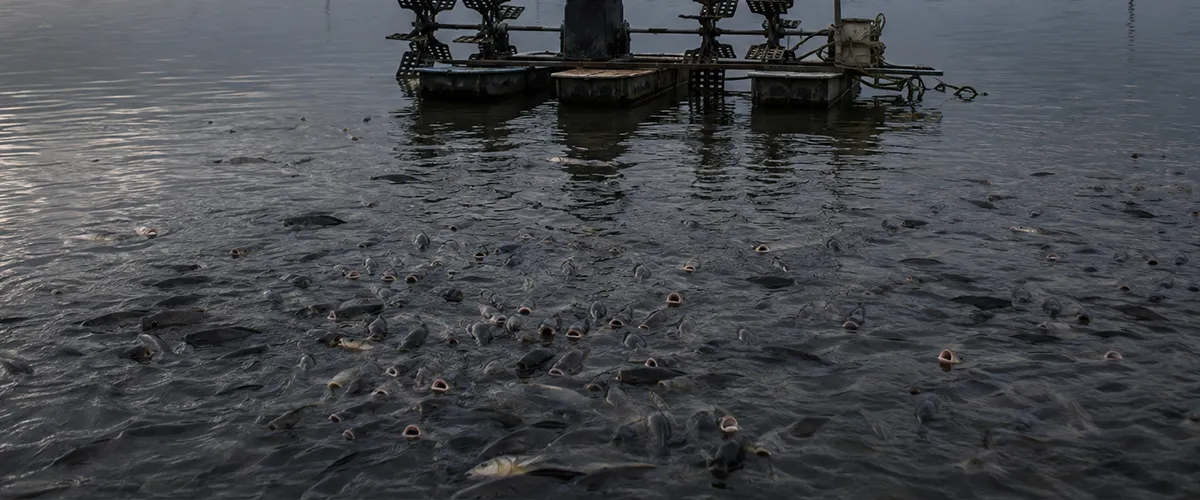
Article Summary | Since mid-September 2026, many provinces in central and eastern Thailand have been flooded. As of 19 October, 22 provinces and 3 districts of Bangkok were still affected, and fish ponds, shrimp ponds and farmland were submerged over large areas. When the water rises, what people fear most is often not the water itself but a power outage that no one knows about: the aerators have stopped, the pumps are not running, and even the equipment that watches over the site has lost power too. Starting from this flood, this article sets out three things that fish farms, farms and factories can prepare in advance for flooding and power outages: being notified when the power fails (a Power Outage Alert Module with a built-in battery; the NB-IoT and 4G versions still send alerts after the power is lost), being notified when the water comes, and being able to switch equipment on from a phone after receiving the notification.
1. What Happened in the Thailand Floods This Time?
The floods in Thailand began in mid-September. NASA noted that this year's rainy season brought long, heavy rain; in late September a low-pressure system stayed over the area for several days, and moisture from the Gulf of Thailand made the rain heavier. Water from the north kept flowing south into the central plains, and on 2 October the Chao Phraya Dam raised its discharge to about 2,500 cubic metres per second to speed up drainage.
According to the Thailand Department of Disaster Prevention and Mitigation (DDPM), more than 3.14 million people were affected as of 11 October. As of 19 October, although water levels were falling in most places, 22 provinces and 3 districts of Bangkok were still affected, with about 1.83 million people impacted, and Pathum Thani Province was hit hardest.
Losses in agriculture and fisheries were also heavy. According to Thailand's Ministry of Agriculture and Cooperatives, as of 2 October about 1.64 million rai (about 260,000 hectares) of farmland was flooded, most of it rice paddies; in aquaculture, fish ponds and shrimp ponds covering about 41,000 rai (about 6,600 hectares) were affected across 24 provinces and about 5,000 farming households. On 19 October the Thai Meteorological Department (TMD) issued another heavy rain warning, noting that heavy rain was still possible in Bangkok and the central, eastern and southern regions until the 25th. (Data as of 19 October 2026)
2. What Flooding Fears Most Is a Power Outage No One Knows About
In a flood, utility poles and distribution boxes can lose power as soon as they are under water. For a fish pond, a power outage means the aerators (paddlewheels) stop and the dissolved oxygen in the water begins to fall; if it happens in the middle of the night and you only find out when you check the ponds at dawn, it is often too late.
What is worse, many of the devices that watch over a site are on the same power source as the aerators and lose power together with them during an outage. Just when an alarm is needed most, the site goes quiet.
YenProtek's Power Outage Alert Module is made for moments like this. It is added to the power supply line of existing equipment such as aerators, pumps and feeders, so the equipment itself does not need to be replaced; as soon as it detects a power outage, a sudden voltage drop or abnormal current, it notifies you proactively.
The key point: for places that may lose power across the whole site, such as fish ponds, choose the NB-IoT or 4G version. The module has a built-in battery, so it still has power after an outage; the NB-IoT and 4G versions also communicate through a built-in SIM card and do not rely on on-site network equipment. Even when the whole site is out and every other device has stopped, they can still send the alarm — after a power outage, it will be the last device on site that still has power and can still notify you. In Thailand and other countries, you can choose the 4G version according to the local telecom network. If the network drops for a while, data is stored first and resent once it is restored. The Wi-Fi version suits indoor sites that already have a stable network; during an outage it depends on whether the on-site network equipment still has power.
Notifications can be sent by LINE, SMS or email, or by voice call, to several people at the same time, and you can also set up sequential notification of more people in charge. When you are asleep at night, a phone call is less easily missed than a phone push notification.
3. When the Water Rises, Who Knows First?
Besides power outages, the other thing to know about early is the water level. YenProtek's Flood Alert System is configured before it leaves the factory; once you receive it, just fix it in place following the installation guide and connect power, and it is ready to use. When the water level reaches the set alert threshold, an on-site audible and visual alarm sounds, and managers are notified at the same time by LINE, SMS or email.
It also has a backup power design: after external power is lost, it can keep monitoring and alarming within the backup time; when the network is temporarily down, data is stored first and resent once it is restored.
On a fish farm you can install it beside the pond or outside the embankment: when rain pours in and the pond is about to overflow the bank, or when the water level outside the embankment rises and there is a risk of backflow, you are notified early instead of finding out only after the fish have escaped. At places that are normally unattended, such as pumping stations, collection wells, warehouses and greenhouses, several points can also be viewed on the same screen.
4. Once You Know, How Do You Get Pumps and Generators Running?
Receiving a notification is only the first step; next, the equipment has to be set running. YenProtek's Smart Control Box lets existing equipment such as pumps and aerators be switched on and off remotely from a phone. In the middle of a rainy night, there is no need to wade out through the rain.
Combined with the Flood Alert System, you can set a rule such as “start the pump when the water level is reached” according to site conditions, so that pumping out starts early; if the network goes down, the control box keeps running automatically on the settings it last downloaded from the cloud.
If the site has a backup generator and the generator has a remote-start interface, a setup with the Smart Control Box and related electrical equipment can be evaluated separately to start the generator during a power outage, so that the aerators can resume supplying oxygen first.
One reminder: the Smart Control Box only handles the switching action of “power on, power off”. For high-power or three-phase motors such as aerators, paddlewheels and pumps, and for generator-related wiring, a qualified electrician must wire an external circuit, which then hands the switching over to the control box.
5. How Can Fish Farms, Farms and Factories Set Things Up?
- Fish ponds and shrimp ponds: install a Power Outage Alert Module (NB-IoT or 4G version) on the main aerators and pumps (one module can monitor up to 4 equipment circuits); install the Flood Alert System beside the pond or outside the embankment; connect pumps and standby aerators to the Smart Control Box. To also switch aerators on automatically based on dissolved oxygen, you can add AquaPack; this function requires the LoRa communication version.
- Farms and greenhouses: install the Flood Alert System at pumping stations and collection wells, and connect drainage pumps to the Smart Control Box.
- Factories: install the Flood Alert System in electrical rooms, equipment rooms and basements; for equipment such as cold-chain equipment where any stoppage means losses, install a Power Outage Alert Module.
YenProtek's equipment is designed and manufactured by a team in Taiwan, and remote technical support is provided to overseas customers. Connection bands, telecom networks and certification requirements differ from country to country; please tell us the country and site where you will use it, and we will confirm a suitable communication version and supply method.
Conclusion: Get Three Things Ready Before the Rainy Season Ends
The rainy season is not over, and the Thai Meteorological Department is still issuing heavy rain warnings. Rather than looking for equipment after the water arrives, it is better to get three things ready now: be notified when the power fails, be notified when the water comes, and be able to act from your phone once notified. To find out how to equip your own fish pond, farm or factory, please go to Contact Us and tell us about your site and country, or first pick an equipment combination in the Online Quote tool. To learn more about the risks of fish pond power outages, read “A Fish Pond Power Outage Is No Small Matter” next.
FAQ | Common Questions About Flood and Power Outage Alerts
Q1: During a power outage, the Power Outage Alert Module has no mains power either. Can it still send notifications?
Yes. The module has a built-in battery, so it still has power after an outage. To get the alert out, choose the NB-IoT or 4G version, which communicates through a built-in SIM and does not rely on the on-site network. In Thailand and other countries, you can choose the 4G version according to the local telecom network. For the Wi-Fi version, it depends on whether the on-site network equipment still has power; for fish ponds that may lose power across the whole site, choose the NB-IoT or 4G version.
Q2: Can the Flood Alert System still work during a power outage?
The system has backup power and a data buffering mechanism. After external power is lost, it can keep monitoring and alarming within the backup time; when communication is temporarily interrupted, data is retained and resent once the network is restored. Actual backup and notification capability depends on the selected communication and power options.
Q3: Can a generator be started automatically during a power outage?
If the site's backup generator has a remote-start interface, a setup with the Smart Control Box and related electrical equipment can be evaluated separately to start the generator during a power outage. The Smart Control Box only switches power on and off; for high-power or three-phase motors and generator-related wiring, have a qualified electrician wire an external circuit.
Q4: Can it be used in Thailand?
Connection bands, local telecom networks and certification requirements differ from country to country. Please tell us the country and site where you will use it, and we will confirm a suitable communication version and supply method; remote technical support is provided to overseas customers.