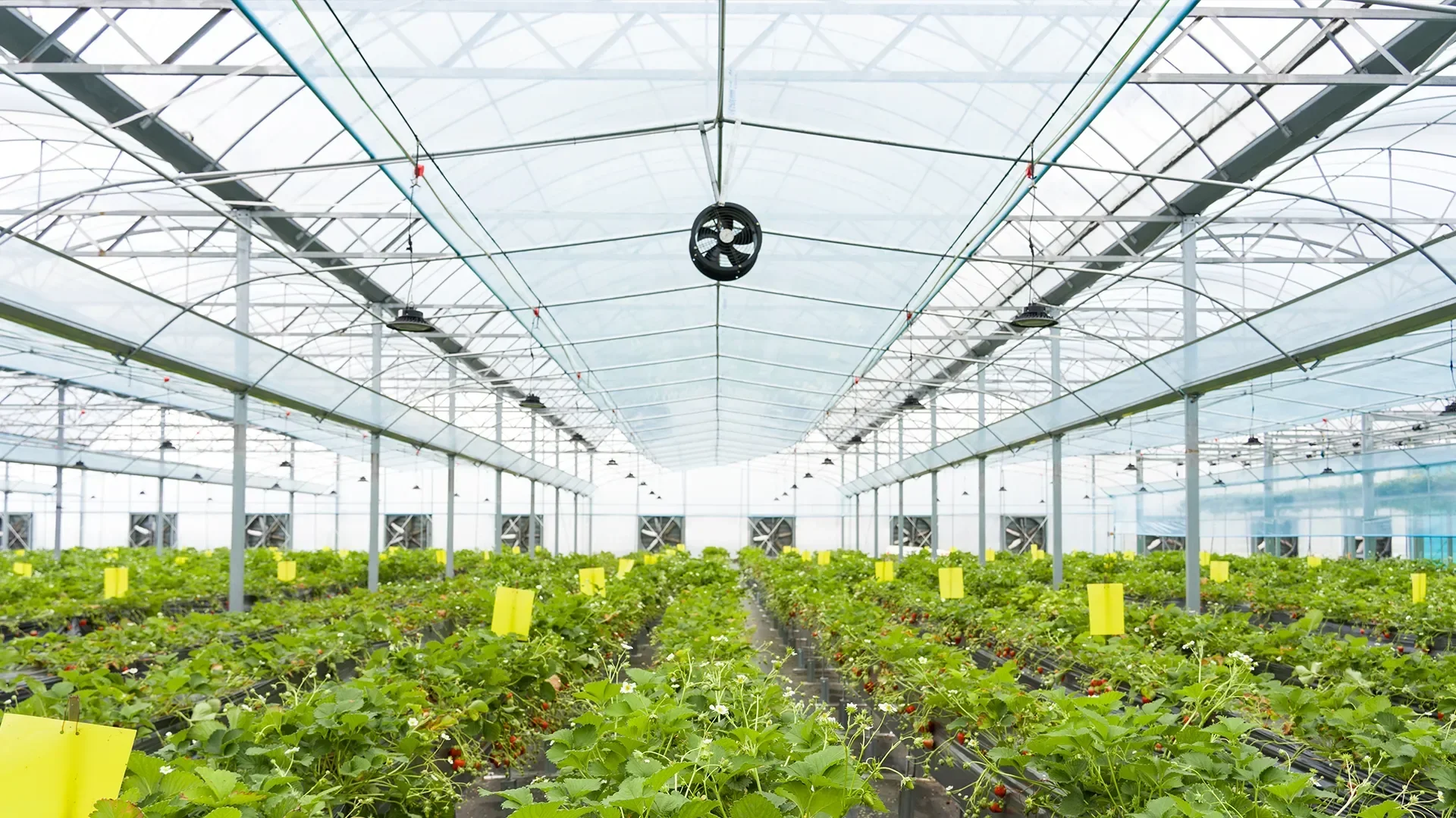
A greenhouse environmental control system does three things: sensors measure the temperature, humidity and light in the greenhouse, a controller decides whether to act, and then it switches equipment such as fans, roll-up side curtains, shade curtains and fogging on and off automatically. Without environmental control, you have to walk out to the greenhouse several times a day, read the thermometer, and open the vents and pull the shade curtains by hand.
Taiwan has more than 10,000 hectares of greenhouses and net houses, and they heat up fast. The Taoyuan District Agricultural Research and Extension Station measured a net house in Bade, Taoyuan for two months and recorded a high of 41.9°C; in another greenhouse measured over one week, relative humidity between 7 pm and 7 am reached as high as 98.2%. Too much heat hurts crops and too much moisture invites disease, and it is hard for one person to keep watch at every hour of the day.
This guide covers the questions farmers ask most: what to measure, how to choose a controller, what to check before buying, where to put the sensors, the order in which to switch equipment on, and what to watch for in Taiwan's summer. It ends with the rules of the Ministry of Agriculture's greenhouse environmental control subsidy.
First, look at what type of facility you have
Different facilities need different things controlled:
- Net house: enclosed with insect netting and ventilated naturally. Common equipment is shade curtains, misting and circulation fans.
- Plastic-film greenhouse with roll-up side curtains and roof vents: ventilated naturally by rolling up the sides and opening the roof vents, often with internal and external shade curtains, fogging and circulation fans added.
- Evapourative cooling pad (fan-and-pad) greenhouse: doors and windows stay shut. Exhaust fans at one end pull air out, and air comes in through the cooling pad at the other end and is cooled on the way.
Most greenhouses in Taiwan are not heated. Some of the US material cited below comes from greenhouses that are heated in winter, and this is marked where it applies.
What three parts make up greenhouse environmental control?
- Sensors: measure conditions inside and outside the greenhouse, such as temperature, humidity, light, wind speed and rain.
- Controller: judges by the conditions you set and decides when to switch on which piece of equipment.
- Equipment under control: circulation (HAF) fans, exhaust fans, side vents or roof vents, roof roll-up curtains, internal and external shade curtains, fogging or misting, evapourative cooling pads, and irrigation.
Controllers fall into roughly three levels. The difference is whether they can adjust in fine steps and whether they notify you when something goes wrong:
| Controller | How it works | Best for |
|---|---|---|
| Mechanical thermostat | Switches on at a set temperature and off below it. It only knows on or off, not how far you are from the set point; the gap between on and off is about 2.2–4.4°C | Small greenhouses with only one or two pieces of equipment |
| Step controller | One unit runs several pieces of equipment, switching on more stages as the temperature rises; the gap between on and off is about 0.6–1.1°C | Greenhouses that want fans, shading and fogging to come on automatically in sequence |
| Computer or cloud-integrated control | Besides step control, you can check on your phone remotely, keep a continuous data record, and get an alarm when conditions go out of range or equipment fails | Farms where people are not often on site, with several greenhouses, or that want to improve management with data |
A mechanical thermostat has a wide gap between on and off, so the temperature swings above and below the set point. US extension services, taking into account better crop growth and larger savings on heating fuel, judge that switching to electronic step controllers pays off in almost all commercial greenhouses. Most Taiwanese greenhouses are not heated, so whether it pays off mainly depends on how many trips you save and how many heat-stress episodes you avoid.
What should you measure inside and outside the greenhouse?
The New South Wales (Australia) government's greenhouse guide says every greenhouse should monitor temperature and relative humidity. What you add beyond that depends on what problem you want to solve:
| Location | Item | What it is used for |
|---|---|---|
| Inside the greenhouse | Temperature, relative humidity | Switch on fans, shading and fogging when it is too hot; ventilate when it is too humid. It can also be converted to vapour pressure deficit (VPD) to judge whether the air around the crop is too dry or too muggy |
| Inside the greenhouse | Illuminance | Decides when to pull and when to retract the shade curtains |
| Inside the greenhouse | Photosynthetically Active Radiation (PAR) | Works out how much light the crop receives in a day (daily light integral, DLI); a PAR sensor is needed to measure it |
| Inside the greenhouse | CO2 | Measure it in greenhouses that apply CO2, to know whether the supplement is enough |
| Inside the greenhouse | Soil or substrate moisture, EC | Decides when to irrigate and whether the fertiliser concentration is right |
| Outside the greenhouse | Temperature, humidity, illuminance or solar radiation | Compare against the inside; pull the external shade curtain earlier when sunshine is strong; measure humidity both inside and outside to know whether running the fans to ventilate actually helps |
| Outside the greenhouse | Wind speed, rain | In strong wind, retract the external shade curtain and close the roof vents; when it rains, close the roof vents |
A few reference figures:
- VPD: The same 80% relative humidity means something different to a crop on a cool day than on a hot day. VPD takes temperature into account, so the same number means the same thing at any temperature, which makes it easier to judge than relative humidity alone. University of Georgia extension material states that the ideal range in a greenhouse is about 0.45–1.15 kPa (depending on the crop); above 1.15, plants wilt easily and leaf edges scorch, and below 0.45 the risk of disease is high.
- Light: Purdue University material states that the daily light integral inside a greenhouse is often 40–70% lower than outdoors and rarely exceeds 25 mol/m²/day. Light inside the greenhouse has to be measured separately; to measure DLI, use a PAR sensor and keep it level and clean.
- CO2: University of Massachusetts material states that when circulation fans are running, applying CO2 up to 800–1,000 ppm is usually enough.
6 things to check when choosing greenhouse environmental control
1. How many kinds of equipment can it control, and can it switch them on in sequence?
First list the equipment in the greenhouse that needs to switch automatically, such as circulation fans, exhaust fans, shade curtains and fogging. Then check that the controller has enough outputs and can give each piece of equipment its own switch-on conditions. The more equipment you have, the more you need step control, where the hotter it gets, the more stages come on. Roll-up and shade curtain motors have to run forward and in reverse, which is wired differently from a plain on/off fan, so ask exactly how it is set up.
2. Are the sensors reliable enough?
Taiwan's greenhouses are hot and humid. The Taoyuan station's development experience is that sensors need to resist corrosion and be replaceable individually when they fail. The Taichung station's greenhouse monitoring system puts two sets of sensors indoors and takes the average; if one set fails, an alarm is sent and control continues on the other set. A temperature and humidity sensor should at least have a sun shield and be mounted where air moves; a ventilated sensor box with a small fan drawing air through is more accurate.
3. Will it notify you when something goes wrong?
A power outage, an equipment fault, temperature out of range or a sensor that stops reporting should all trigger a phone notification. University of Florida material reminds growers that when the power fails, an alarm should notify the grower at home, and it should be tested often; with three-phase power, monitor each phase.
4. What happens when the network or power goes down?
Ask clearly: if the network drops, does the controller still switch on and off automatically by temperature? After power returns, are the settings lost? Among the useful controller features listed in US extension material is “battery backup of settings during a power outage.”
A summer power outage is the most dangerous, because once the fans stop the greenhouse heats up quickly. A fan-and-pad greenhouse normally keeps its doors and windows shut, so you need to be able to open the doors, windows or roll-up curtains by hand for ventilation; for high-value crops, consider a backup generator. When power returns, do not start the motors all at once: starting current is 2–7 times running current, and starting them together easily trips the breaker.
5. Can you operate it by hand on site?
When your phone is not with you and workers are on site, you should be able to read the status and switch equipment on and off directly at the control box. You also need manual force on/off for maintenance or calibration. University of Florida material also recommends wiring a manual switch in parallel with every automatic switch.
6. Is data recorded, and who handles it when something breaks?
Continuous records of temperature, humidity, light and irrigation let you look back, compare this year with last year and find the conditions in which the crop did well. Also ask how long the warranty lasts, how faults are handled and how often the sensors need calibration.
Where you put the sensors determines how accurate the readings are
- At crop height, in the middle of the growing area: what you want to measure is the air the crop feels. Both University of Massachusetts and the New South Wales government recommend crop height, and the sensor should be raised as the crop grows.
- Not on a wall or by the door: mounting on a side wall, end wall or by the door is convenient, but it does not read the temperature in the crop area. Also keep away from air outlets and from directly above heating pipes.
- Shaded and ventilated: a temperature and humidity sensor in direct sun reads high. In a Rutgers University trial, when a heating thermostat was replaced with a ventilated sensor box, the gap between the greenhouse's highest and lowest temperatures fell from about 4.4°C to 1.1°C.
- Mount temperature/humidity and light sensors differently: the Taichung station's experience is that temperature and humidity need shade and ventilation while the light sensor needs to see the sun. The two have different mounting requirements and should not be crammed into the same shield for convenience.
- Put soil sensors where the roots are: keep a fixed distance from the dripper, not right next to it. The Taoyuan station found in measurements that when the probe is close to the dripper, readings come out high. Each time you move it, the baseline of the readings changes too.
- Put a separate set outside: the Taichung station placed a set of temperature, humidity and illuminance sensors outside the greenhouse to compare with the inside.
Temperature in a greenhouse is uneven to begin with. University of Florida material states that in a fan-and-pad greenhouse on a sunny day, the air warms about 0.56°C for every 3 m it travels, and the fan end is often about 3.9–4.4°C hotter than the pad end. University of Massachusetts material also states that in heated US winter greenhouses without circulation fans, night temperatures at the two ends often differ by 5.6–8.3°C. If the greenhouse is long or divided into several zones, place extra sensors at the air inlet end, the middle and the air outlet end so you can see where it runs especially hot.
How to set up the equipment: what comes on first, and what comes on later
Start cooling with the cheap, gentle methods and add more only if that is not enough. The order depends on the facility:
- Naturally ventilated greenhouse (roll-up side curtains, roof vents): open the vents for ventilation, then pull the external shade curtain, and if it is still too hot, turn on fogging.
- Fan-and-pad greenhouse: switch on the first exhaust fan, add more if that is not enough, then pull the external shade curtain, and only last start the cooling pad pump. Doors, windows and roll-up curtains must all be shut tight so that the air comes in through the pad.
Points to note for each piece of equipment:
- Circulation (HAF) fans: keep the air moving normally so the temperature is more even. Turn them off while the exhaust fans are running or the vents are open, otherwise they disrupt the airflow.
- Shading: external shading works better than internal shading. As an example, University of Massachusetts material says 50% shade curtain can lower the temperature by about 5.6°C; the real effect depends on the colour and material of the curtain and on the weather, and white works better than black or green. The US order is to pull shade only when ventilation cannot cool enough, but sunshine in Taiwan is strong, so the Taoyuan station recommends pulling the external shade curtain early, as the temperature starts to rise. Shading also cuts light, so retract it on cloudy days.
- Cooling pad, fogging: stop the cooling pad pump before the fans so that the pad dries out, which avoids algae growth.
A few principles for the settings:
- Space the stages apart in temperature: leave about 1–2°C between stages. For example, after the first fan comes on, the temperature must rise another 1–2°C before it goes to high speed or the second fan is added. The starting temperature depends on the crop and season; do not copy temperatures from other countries.
- Keep heating and cooling set points apart: in a greenhouse heated in winter, set the cooling point 2.8–5.6°C higher than the heating point so that the heater and fans are not on at the same time.
- Avoid equipment cycling on and off: if the temperature gap is set too small, motors start often and wear out easily. Ideally the controller has a “delay between stages” function.
- Pull in the curtains and close the vents in strong wind or rain: use outdoor wind speed and rainfall as conditions, so that the external shade curtain retracts and the roof vents close automatically in strong wind, and the roof vents close in rain.
- When humidity is too high: condensation is most likely in the evening and early morning. University of Massachusetts material recommends watering in the morning where possible so the leaves are dry before evening, and keeping circulation fans running to prevent moisture building up around the leaves. In a greenhouse heated in winter, you can heat and exchange the air 2–3 times an hour after sunset and at sunrise. In an unheated greenhouse, run the fans to ventilate only when it is drier outside than inside, and have your phone remind you when humidity stays high for a long time.
Taiwan summer: the cooling limits of cooling pads and fogging
Cooling pads and fogging work by evapourating water to carry heat away: the drier the air, the better they work, and the more humid it is, the less they achieve. University of Massachusetts material gives an example: at 32°C outdoors, 30% relative humidity can be cooled to about 19°C, while 70% relative humidity can only be cooled to about 28°C. University of Florida material also states that on a Florida summer afternoon the wet-bulb temperature (the reading of a thermometer wrapped in a wet cloth; the more humid the air, the closer it gets to the air temperature) is often 26–27°C, and a cooling pad can at best bring the incoming air down to about 1.7–2.2°C above the wet-bulb temperature.
Summer in Taiwan is also hot and humid, so:
- Pull the external shade curtain first when sunshine is strong: at a strawberry greenhouse in Dahu, Miaoli, the Taoyuan station observed that leaf temperature at midday was clearly higher than air temperature and stayed high for a long time. It recommends using external shading early, as the temperature starts to rise, to reduce the sunlight coming in.
- Keep doors and windows shut: with a cooling pad, air should come in through the pad. If the door is open, air comes in through the door and the cooling is much worse.
- Set an upper limit with indoor humidity: when it is very humid outside, the cooling drop from the pad shrinks and the greenhouse gets damp. You can use the humidity inside the greenhouse as an upper limit: when it is too humid, stop the cooling pad pump first and keep the fans running.
Farmers in Taiwan: what are the rules for the greenhouse environmental control subsidy?
The Agriculture and Food Agency of the Ministry of Agriculture lists the “greenhouse environmental control system” as a separate subsidy item in its Smart Disaster-Resilient Facility Agriculture Promotion Programme (according to the subsidy rules as revised on 3 March 2026):
- Who applies: farmers or farmer groups apply themselves, submitting to the local farmers' association, township office or seed and seedling industry association, and the application is then reviewed by the county or city government and the regional branch of the Agriculture and Food Agency. The land must be legal agricultural land; if it is not your own, attach a land-use consent document or a lease.
- How much: the subsidy is no more than half of the cost, up to NT$150,000 per set, and in principle one set is granted per application. If the greenhouse or net house area is 0.5 hectares or more, more sets can be added with the regional branch's approval.
- Review priority: growing vegetables or fruit (summer vegetables and fruit first), holding Traceable Agricultural Products (TAP) or organic certification, joining a cluster production area, contract production and sales, and facilities set up in a concentrated area.
- Specification requirements: with the application, attach the “Greenhouse Environmental Control System Specification Checklist” and the vendor's product specification sheet. The checklist requires a control box with a display and operating interface, the ability to operate 3 or more kinds of greenhouse environmental control equipment, control components that include a display, control program and relay module, environmental sensors both inside and outside the greenhouse, the ability to record monitoring information, and a “whole new set, with no old equipment connected in series.” Applications may not overlap with equipment subsidised by the Irrigation Agency.
- How the money is paid: after completion inspection and an on-site check are passed, the subsidy is paid to the farmers' association or township office and then transferred to the farmer's account. The farmer has to pay the full amount first, and the claim must attach full-amount invoices and a contract or warranty document stating the warranty terms.
- Years of use: subsidised equipment must be used for at least 5 years, starting from the year after the subsidy.
The rules do not clearly say whether you can apply for environmental control alone on a greenhouse that is already built, or whether subsidised environmental control can connect to existing fans, so ask your local farmers' association or township office before applying. This round of the programme runs from 2023 to 2026, and applications for 2026 have closed. For later application periods and rules, go by the latest announcements from the Agriculture and Food Agency and your local farmers' association or township office.
Greenhouse environmental control with FarmerPack and the Smart Control Box
YenProtek's approach is to separate measuring from controlling and combine them to suit the greenhouse:
- FarmerPack: a solar-powered, modular field micro weather station, which can also be connected to mains power inside a greenhouse. You can choose sensor modules such as temperature and humidity, CO2, illuminance, photosynthetically active radiation (PAR), solar radiation, wind speed, rainfall, and soil temperature, moisture and EC, according to what the greenhouse needs.
- Smart Control Box: lets existing equipment such as fans, fogging and irrigation be switched on and off remotely from a phone, and also start and stop automatically based on sensor data. The control box has a screen interface and can control 3 or more kinds of equipment; each piece of equipment can have its own switch-on conditions, for example, at one temperature the fans come on first, and at a higher one the shade curtain is pulled.
On your phone, set “when … then …”: when the greenhouse temperature is above the set value, turn on the exhaust fans; when outdoor light is very strong, pull the external shade curtain; when soil moisture is below the set value, turn on the water. When a value is abnormal, you are notified by app push notification, SMS or Email. If the network goes down, the Smart Control Box keeps running on the settings it downloaded last; to keep controlling automatically from sensor readings such as the greenhouse temperature even when the network is down, choose the LoRa communication version.
The control box handles on and off; high-power equipment such as fans should be wired by a qualified electrician through an external circuit. For motors that must run forward and in reverse, such as roll-up and shade curtains, the control arrangement is evaluated against the equipment's specifications. To be notified of a power outage, pair it with the Power Outage Alert Module (sending alerts after the power fails is limited to the NB-IoT version and the 4G version with a built-in SIM).
Greenhouse environmental control FAQ
Q1: Does a small greenhouse need environmental control too?
It depends on how often you are on site. In a small greenhouse with one or two fans, an electronic controller with a small temperature gap can improve things a lot. For a greenhouse where nobody is often on site, or where high summer temperatures are a worry, have at least a temperature alarm, so that your phone tells you first when it gets too hot.
Q2: Does greenhouse environmental control have to measure CO2?
Not necessarily. Every greenhouse should measure temperature and humidity; CO2 matters more in greenhouses that apply CO2. When ventilation is high, added CO2 is quickly exhausted. Rutgers University's lettuce greenhouse raised CO2 to 1,000 ppm only when almost no ventilation was needed. Taiwan's summer greenhouses mostly have to ventilate to cool, so look after temperature, humidity and light first.
Q3: The temperature shown by the sensor is different from what my own thermometer reads. Which one is right?
First look at where each is placed. By a wall, by the door, in direct sun or near a fan, the numbers will all differ. Temperature should be measured at crop height, in the middle of the growing area, somewhere shaded and ventilated. US extension material recommends calibrating the thermostat at least once a year; humidity sensors drift after long use in hot, humid places and should be checked against a reference more often than temperature.
Q4: I turned on the cooling pad and the greenhouse is still very hot. Is it broken?
Not necessarily. When the air is humid, the cooling drop from the pad shrinks; at 32°C outdoors and 70% relative humidity, it can only cool to about 28°C. First check that the doors, windows and roll-up curtains are shut, and whether any part of the pad is clogged or dry, and use external shading to cut the sunlight.
Q5: Can my existing fans and shade curtains be connected to environmental control?
Most can. The Smart Control Box switches the equipment's power on and off, so your existing equipment can switch automatically; high-power or three-phase motors are wired by a qualified electrician through an external circuit, and roll-up and shade curtains are evaluated against the equipment's specifications. If you want to apply for the subsidy, the specification checklist says “whole new set, with no old equipment connected in series,” so before applying, confirm with the receiving farmers' association or township office whether subsidised environmental control may be connected to existing equipment.
Q6: Who do I apply to for the greenhouse environmental control subsidy?
Farmers apply themselves to the local farmers' association, township office or seed and seedling industry association, attaching the product specification sheet from the vendor. After acceptance inspection, the subsidy is transferred to the farmer's account. For application periods and rules, go by the latest announcement from the Agriculture and Food Agency.
Want to see how it looks first?
Tell us the size of your greenhouse, what you grow and what equipment you already have, and we will suggest what to measure and which equipment can be connected to automatic control. To see the real phone and platform screens first, you are welcome to request a demo account. For sensing outside the greenhouse, see “How to Choose a Small Farm Weather Station.”
References
- University of Florida IFAS Extension:Fan and Pad Greenhouse Evaporative Cooling Systems(CIR1135)
- University of Florida IFAS Extension:Auxiliary Power Units For Greenhouse Operations(AE63)
- eXtension Farm Energy:Step Controllers Optimize Greenhouse Energy Use
- UMass Extension:Selecting and Maintaining Thermostats
- UMass Extension:Fan and Pad Evaporative Cooling Systems
- UMass Extension:Shade for Cooling Greenhouses
- UMass Extension:Horizontal Air Flow is Best for Greenhouse Air Circulation
- UMass Extension:Reducing Humidity in the Greenhouse
- Purdue Extension:Measuring Daily Light Integral in a Greenhouse(HO-238-W)
- e-GRO Alert(University of Georgia):Vapor Pressure Deficit? Why Should I Track That?
- Rutgers Horticultural Engineering:Floating Hydroponics Greenhouse – Environment Control
- NSW Department of Primary Industries:Computer control systems, sensors and monitoring equipment in greenhouses
- Ministry of Agriculture, Agricultural Policy and Situation: An Introduction to the Greenhouse Remote Wireless Transmission Monitoring System (Taichung District Agricultural Research and Extension Station)
- Ministry of Agriculture, Agricultural Policy and Situation: Research and Development of an Agricultural Wireless Communication Sensing System (Taoyuan District Agricultural Research and Extension Station)
- Ministry of Agriculture, Agricultural Information E-newsletter: Highlights of the Taichung Station Exchange Visit
- Ministry of Agriculture, Agricultural Information Technology Application Development Newsletter, 2024, Third Issue
- Agriculture and Food Agency, Ministry of Agriculture: Subsidy Rules for the Smart Disaster-Resilient Facility Agriculture Promotion Programme