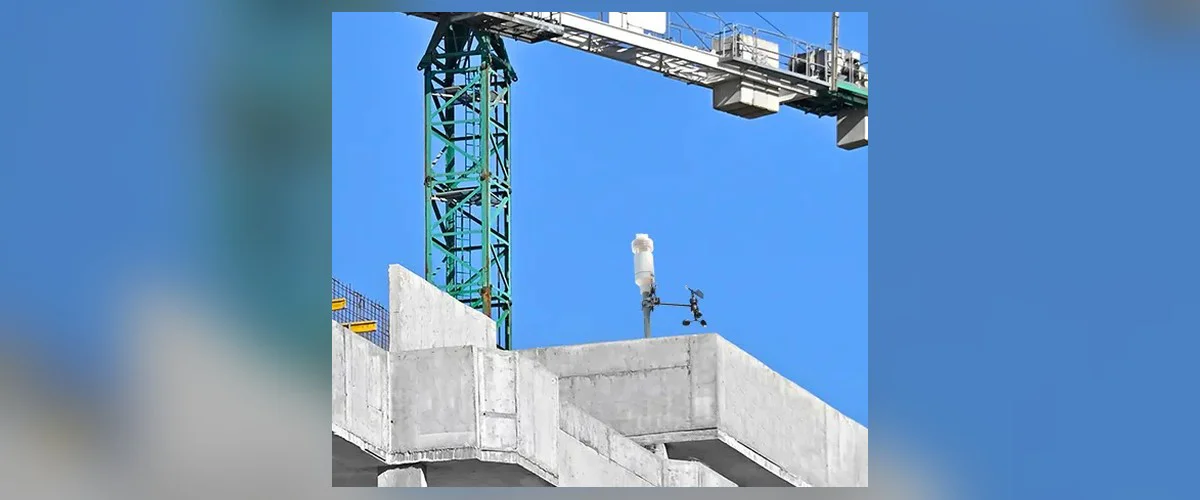
WBGT instruments come in three kinds: handheld (carried by a person, suited to spot checks, patrols and audits), fixed monitoring station (measures automatically 24 hours a day, alarms automatically and keeps records when limits are exceeded), and websites and apps (only area estimates, not on-site values). Choose fixed for sites and plants that need watching every day, and handheld for occasional spot checks.
Searches like "WBGT meter", "WBGT monitoring" and "buy globe thermometer" all ask the same thing: which kind is right for my site? This article compares three approaches in one table, then lists 6 things to confirm before buying, so you can choose well without understanding too much of the theory first.
Handheld, Fixed Monitoring Station and Website/App Compared
| Comparison Item | Handheld WBGT meter | Fixed WBGT monitoring station | Website or phone app |
|---|---|---|---|
| What it measures | The position and time where it is taken | The installed position, continuously | Area values estimated from weather station data |
| Who measures | Someone has to carry it, wait for the reading to settle and read it | No person needed; uploads automatically | No person needed |
| How often | Depends on whether the person is free | All day, continuously | Depends on how often the data updates |
| Who knows when limits are exceeded | The person holding the instrument | On-site warning light and alarm, plus manager phones notified at the same time | The person who goes to look |
| Records | Handwritten or exported | Stored automatically in the cloud, with daily curves and alarms viewable | Mostly no individual on-site records |
| Does it show sunshine and radiant heat? | Yes, if it has a globe | Yes, if it has a globe | Estimated; does not show local differences |
| Suitable | Safety officers on patrol, rotating spot checks across several sites, audits | Sites, plants, farms and school sports fields that need watching every day | Checking roughly how hot it will be before starting work |
The three do not replace each other. A common combination is: check the heat hazard level on the information website before work each day to plan the work; put a fixed monitoring station in the hottest work area to remind people automatically when limits are exceeded; and have safety officers carry handheld instruments to spot-check other work points.
Why Measure On Site Instead of Only Looking at a Website?
The Institute of Labor, Occupational Safety and Health under the Ministry of Labor measured on site in fields and net houses, pastures, construction sites and tea plantations, and found that measured values in farm net houses were clearly higher than predictions on the High-Temperature Work Protection Information Website. It therefore recommends: the heat index on the website can give a first idea of heat hazards in your area, but local conditions differ, and WBGT should be measured on site when necessary. The same study also compared 3 commercial direct-reading WBGT instruments, found very high correlation between their data, and recommends choosing a suitable direct-reading instrument according to site needs and constraints.
In other words, there is little difference between brands in how accurately they measure. The real difference is whether it measures where people are, whether it measures often enough, and whether anyone knows when limits are exceeded.
Which Specifications Matter?
- Does it have a globe temperature? 20 to 30% of WBGT comes from globe temperature. A "heat index meter" that measures only temperature and humidity, with no globe, cannot calculate a true WBGT.
- Globe size: the standard is a black metal sphere about 15 cm (6 inches) in diameter. Schedule 7 of the Implementation Measures for Monitoring the Working Environment says a smaller globe thermometer can be used if properly calibrated.
- Calculates both outdoor and indoor formulas: sunshine and no sunshine use different formulas (see How to Calculate WBGT).
- Measuring range and accuracy: globe temperature often exceeds 50°C in strong sun, so the measuring range must be high enough.
- Standards followed: the international standard for WBGT is ISO 7243. Japan also has JIS B 7922 for WBGT index meters, and Japan's Ministry of Health, Labour and Welfare guidelines recommend measuring with instruments that meet the JIS specification.
6 Things to Check Before You Buy
1. Do you want to "measure" or to "manage"?
If you only want to know how hot it is on one day at one spot, a handheld is enough. To adjust work and remind people to rest by the numbers every day, you need fixed equipment that measures and notifies automatically. Otherwise it easily becomes "we have an instrument but nobody measures".
2. When limits are exceeded, how do people on site find out?
Workers in gloves and helmets with their hands busy do not keep looking at their phones. The question site customers ask most is "Is there a light and a public address announcement?": there should be a warning light people can see and an alarm they can hear on site. If the site already has a public address system or other equipment, we can assess linking it by switch signal through a Smart Control Box.
3. What about managers and safety officers who are not on site?
Check whether a phone push is sent at the same time when limits are exceeded, how many people can be notified, and through which channels (LINE, SMS, email, app push).
4. Is there power and internet on site?
Temporary sites, farmland and fish ponds often have no sockets and no Wi-Fi. Equipment with solar power and built-in mobile communication (such as NB-IoT) works as soon as it is set up, and is easy to carry when the site moves.
5. Can the records be used?
Can you look up and export the time limits were exceeded, who the alarm went to and the value at that moment? Special heat hazard inspections, contractor responsibility and incident reviews all ask for these.
6. What else do you need to measure?
Sites often need noise, dust (PM2.5/PM10), strong wind and rainfall at the same time. Being able to expand the same station is easier than buying several separate instruments.
Where Should a Fixed Monitoring Station Be Installed?
- Near where people actually work and where it is hottest, such as roofs, steel-frame floors, asphalt surfaces and inside greenhouses, not next to an office or under shade.
- Where the site is large or the heat varies a lot, install more points, for example the site entrance and the roof work area, inside and outside a greenhouse as a comparison, or a sports field and an indoor gym.
- Avoid air-conditioning vents and the front of machine exhausts, unless that is where workers have to stand.
Heat Safety Guardian: YenProtek's Fixed WBGT Monitoring Station
Heat Safety Guardian is a heat hazard alert system developed in-house by YenProtek. It calculates the WBGT heat index in real time and, when limits are exceeded, triggers on-site sound and light alarms and LINE notifications. Key specifications (the product page prevails):
| Item | Details |
|---|---|
| Environmental Sensing | Air temperature (-30 to 80°C, ±0.5°C), humidity (0 to 95% RH), globe temperature (-40 to 100°C, ±0.2°C), wind speed (0 to 70 m/s), wind direction |
| WBGT | Calculated in real time by the system using the air temperature, humidity and globe temperature formula |
| Alerts | On-site sound and light alarm, LINE alarm push (SMS, email and app push also supported), cloud data and event records |
| Risk levels | Shown according to the heat hazard risk levels in the OSHA guidelines; alert thresholds can be customised to the site |
| Power and communication | Solar power module and NB-IoT communication module, no power or network wiring |
| Expansion Sensors | Air quality (PM2.5/PM10), decibel noise, rainfall, UV index |
| Platform | App and cloud management system, viewable on phone, tablet and computer; API and MCP integration with existing systems available |
| Warranty | One-year warranty; if it fails during the warranty period, a replacement is sent directly; actual terms are as shown in the quotation |
For full specifications, kit contents and common questions, see the Heat Safety Guardian product page. To find out how many units your site needs and the cost, go to Online Quote, choose a configuration and submit, or request a demo account to see the platform first.
Frequently Asked Questions
Q1: What is the difference between a heat index meter and a WBGT meter?
A heat index meter measures only temperature and humidity and gives a heat index. A WBGT meter adds globe temperature (and some also natural wet-bulb), so it sees sunshine and radiant heat. In strong sun or near a heat source, the gap between the two can be large. See What Is the Heat Index? How It Differs from WBGT.
Q2: Is a handheld WBGT meter enough?
It is enough for spot checks, patrols and audits. But it only represents the time and place where you took the reading, and someone has to measure and record it. If you want to be reminded to rest by the numbers every day, a fixed unit is less likely to miss anything.
Q3: Can a WBGT monitoring station get a subsidy?
The Ministry of Labor's 2026 high-temperature protection subsidy added "heat hazard technology disaster prevention equipment", such as heat hazard detection and alert devices. Whether a device qualifies is decided by the competent authority. See the summary in How to Apply for Heat Hazard Subsidies.
Q4: What if there is no power on the site?
Choose equipment with solar power and built-in mobile communication. The standard Heat Safety Guardian kit includes a solar power module and an NB-IoT communication module, so no extra power or network wiring is needed.
Q5: Can it also monitor noise and dust?
Yes. Depending on the site, you can add air quality (PM2.5/PM10), decibel noise, rainfall and UV index sensors.
Further Reading: WBGT and Heat Hazard Series
- What Is WBGT? Wet Bulb Globe Temperature Explained (Series Overview)
- How to Calculate WBGT: Outdoor and Indoor Formulas with Examples
- WBGT Rest Break Schedule: High-Temperature Work Rest Standard Table
- What Is the Heat Index? Heat Index Chart, Levels and How It Differs from WBGT
- Heat Hazard Regulations and Penalties: What Employers Must Do Under the 2026 Occupational Safety and Health Act
- How to Apply for Heat Hazard Subsidies
- Managing Heat Hazards on Construction Sites: Heat Stroke Prevention Checklist
References
- Ministry of Labor, "Real-Time Measurement to Prevent Heat Hazards: Recommended Method for WBGT Measurement in High-Temperature Work", 2025-08-26.
- Ministry of Labor, Implementation Measures for Monitoring the Working Environment, Schedule 7.
- ISO 7243:2017; JIS B 7922 (Japan's WBGT index meter specification).
- Japan's Ministry of Health, Labour and Welfare, "Guidelines for the Prevention of Heat Illness in the Workplace", 2026-03.
Article updated: 2026-11-10.