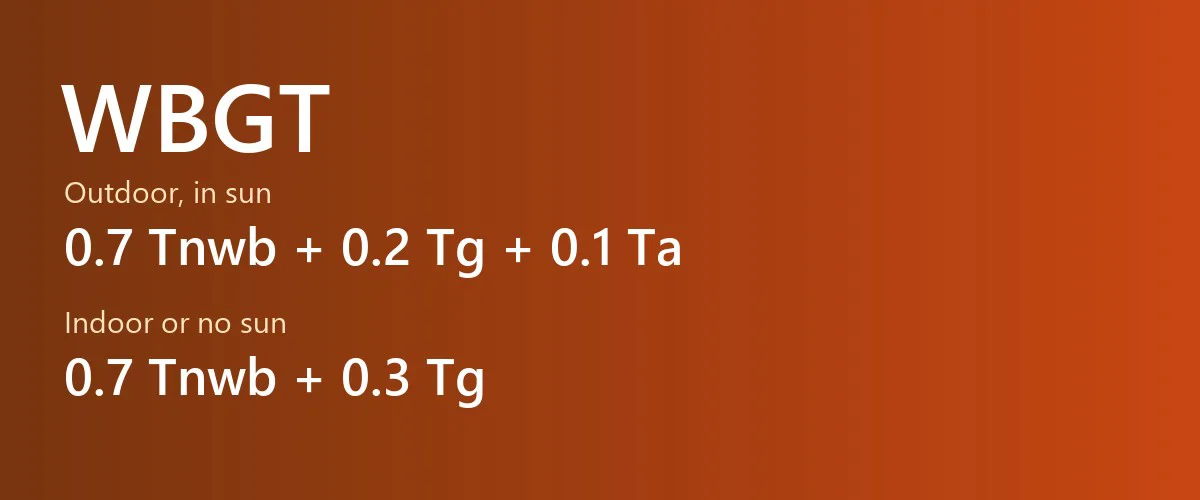
How to calculate WBGT (Wet Bulb Globe Temperature): outdoors in sunshine, WBGT = 0.7 × natural wet-bulb temperature + 0.2 × globe temperature + 0.1 × dry-bulb temperature. Indoors, or outdoors without sunshine, WBGT = 0.7 × natural wet-bulb temperature + 0.3 × globe temperature. All temperatures are in degrees Celsius (°C).
These two formulas are in Article 3 of Taiwan's Standard for Work and Rest Schedules for Workers in High-Temperature Work, and they are the same set used by the international standard ISO 7243 and by Japanese and Thai regulations. They look simple, but the hard part of getting it right is how to measure the three temperatures, where to measure and how to average over a day. This article explains the formulas, the three temperatures, worked examples and common mistakes in plain language.
WBGT Formula: One for Outdoors, One for Indoors
WBGT is not a number read from a single thermometer. It adds three temperatures in proportion. The only difference is whether the sun shines directly on the spot:
| Situation | Formula | Typical places |
|---|---|---|
| Outdoors in sunshine | WBGT = 0.7 × natural wet-bulb temperature + 0.2 × globe temperature + 0.1 × dry-bulb temperature | Construction sites, roads, roofs, farmland, fish ponds, sports fields |
| Indoors, or outdoors without sunshine | WBGT = 0.7 × natural wet-bulb temperature + 0.3 × globe temperature | Factories, warehouses, greenhouses, boiler rooms, outdoors on cloudy days or at night |
The two formulas have one thing in common: natural wet-bulb temperature makes up 70%. In other words, high humidity that stops sweat evaporating is the main reason WBGT rises. Globe temperature represents radiant heat from the sun and heat sources, while dry-bulb temperature (ordinary air temperature) counts for only 10%, and is not in the indoor formula at all. This is why "an air temperature of 33°C" cannot be used directly to judge heat hazard.
Because the three coefficients add up to exactly 1, the formulas work in either Celsius or Fahrenheit: measure in Fahrenheit and the result is WBGT in Fahrenheit.
What Are the Three Temperatures? Dry-Bulb, Natural Wet-Bulb and Globe Temperature
Dry-bulb temperature: ordinary air temperature
This is the air temperature a normal thermometer reads in a shaded, ventilated spot. When the weather forecast says "33 degrees today", that is the dry-bulb temperature.
Natural wet-bulb temperature: the effect of humidity and wind
Wrap the sensing tip of a thermometer in wet gauze and let it cool by evaporation in the natural airflow on site, and the temperature it reads is the natural wet-bulb temperature. The drier the air and the stronger the wind, the faster water evaporates and the lower the wet-bulb temperature; conversely, when it is muggy, humid and still, the wet-bulb temperature is close to the air temperature. This matches how the body cools by sweating: people only cool down if sweat can evaporate.
Globe temperature: radiant heat from the sun and heat sources
A globe thermometer is a hollow metal sphere painted black with a thermometer in the middle. The Ministry of Labor describes it as a "hollow black metal sphere about 15 cm in diameter", and Schedule 7 of the Implementation Measures for Monitoring the Working Environment also lists a 6-inch globe thermometer. A smaller globe thermometer can be used if it is properly calibrated. The globe absorbs direct sunlight, heat reflected from the ground and walls, and radiant heat from machines, so in strong sun the globe temperature is often much higher than the air temperature.
The globe takes time to heat up and stabilise, and a reading taken right after placing it will be too low. Japan's Ministry of Health, Labour and Welfare recommends leaving it for at least 15 minutes before reading. With a handheld instrument, also wait for the value to stabilise as the manual says.
WBGT Calculation Example: Same 33°C, What's the Difference?
The numbers below are an illustration (actual values should come from on-site measurement). On the same afternoon, the air temperature is 33°C and the natural wet-bulb temperature is 27°C in both places. The only difference is whether the sun is shining on them:
| Location | Dry-bulb | Natural wet-bulb | Globe | Formula applied | WBGT |
|---|---|---|---|---|---|
| Sun-exposed reinforcing bar work area | 33°C | 27°C | 50°C | 0.7×27+0.2×50+0.1×33=18.9+10.0+3.3 | 32.2°C |
| Under the shade canopy by the site hut | 33°C | 27°C | 35°C | 0.7×27+0.3×35=18.9+10.5 | 29.4°C |
The air temperature is identical, yet WBGT differs by almost 3°C. Compare with moderate work in the Standard for Work and Rest Schedules for Workers in High-Temperature Work: 29.4°C already requires 25% rest per hour, and 32.2°C requires 50%. In other words, on the same site at the same time, whether you are in the sun or not changes the rest schedule. For how each work intensity maps to rest, see WBGT Rest Break Schedule.
Daily Average WBGT (Time-Weighted Average)
Workers move between locations during a day, and WBGT changes over time. The regulation uses the "time-weighted average WBGT": multiply the WBGT of each period by the working time of that period, add them up, and divide by the total working time.
For example, a worker spends 2 hours preparing materials indoors in the morning (WBGT 30.0°C), 3 hours working outdoors around midday (WBGT 32.0°C), and 1 hour finishing up in the shade in the afternoon (WBGT 29.0°C):
(30.0×2+32.0×3+29.0×1)÷(2+3+1)=185÷6≈30.8°C
Article 5 of the Standard for Work and Rest Schedules for Workers in High-Temperature Work also provides that for workers continuously exposed for more than an hour, the hourly time-weighted average is used; for intermittent exposure, it is calculated over two hours.
Should You Measure at Head, Abdomen and Ankle Height?
In most cases, measuring at one height is enough. The international standard ISO 7243 says that when conditions do not vary much from top to bottom, one measurement at abdomen height is enough; if the heat differs a lot with height (for example, a very hot floor or a heat source overhead), measure at head, abdomen and ankle heights and calculate (head + 2 × abdomen + ankle) ÷ 4. For a standing worker, the three heights are about 1.7 m, 1.1 m and 0.1 m.
A fixed monitoring station is usually mounted near the height at which workers operate, to represent the heat where people are. The key is choosing the right location: do not put it in an office, under a tree, or far from the work area.
Can You Calculate WBGT from Just Temperature and Humidity?
Only roughly, and not accurately. 20 to 30% of the weight in WBGT comes from globe temperature, which is sunshine and radiant heat. With only air temperature and humidity, you cannot tell whether the site is in the sun or whether there is any wind. Australia's Bureau of Meteorology has an approximation that uses only temperature and humidity, and it states itself that it does not take sunshine intensity or wind speed into account and should be used only as a reference.
Online WBGT calculators and phone apps mostly use weather station temperature, humidity and forecast sunshine to estimate an "area" WBGT, not the actual value where you work. The Ministry of Labor's measurement research also found that the measured values in farm net houses were clearly higher than the predictions on the High-Temperature Work Protection Information Website, so it recommends measuring WBGT on site when necessary.
If you only have temperature and humidity, Taiwan's regulations let you use the "heat index" table to judge the heat hazard risk level. For the difference between the two, see What Is the Heat Index? How It Differs from WBGT.
5 Common Mistakes When Calculating WBGT
- Using the indoor formula in strong outdoor sun: with sunshine, use the 0.7/0.2/0.1 formula.
- Using an ordinary wet-bulb reading (psychrometer) as the natural wet-bulb: natural wet-bulb is measured in the natural airflow on site and is usually higher than a forced-ventilation wet-bulb.
- Reading the globe before it has stabilised: a globe that has just been put out reads low, and WBGT will be underestimated.
- Measuring too far from the work area: measuring in an office or under a tree gives a nicer number that is not the heat workers actually face.
- One measurement standing for the whole day: it is usually highest around midday, and when the wind drops or clouds clear, WBGT jumps up. Only continuous measurement shows the change.
Don't Want to Calculate It Yourself? Let Monitoring Equipment Do It
With handheld instruments, someone has to go to the site, wait for the reading to stabilise, write it down, and then check it against a table. When a site needs watching every day, a fixed monitoring device is less effort: it measures automatically, calculates automatically, and notifies automatically when a threshold is exceeded.
Heat Safety Guardian is a heat hazard alert system developed in-house by YenProtek. It calculates the WBGT heat index in real time and, when limits are exceeded, triggers on-site sound and light alarms and LINE notifications. It measures air temperature, humidity, globe temperature, wind speed and wind direction, and converts them to WBGT using the air temperature, humidity and globe temperature formula. It is solar-powered with NB-IoT transmission, so construction sites need no power wiring, and every alarm and the environmental data at that moment are kept in the cloud. For specifications and common questions, see the Heat Safety Guardian product page. To choose between handheld instruments and fixed monitoring stations, see How to Choose a WBGT Meter. For configuration and cost, go to Online Quote.
Frequently Asked Questions
Q1: What is the WBGT formula?
Outdoors in sunshine: WBGT = 0.7 × natural wet-bulb temperature + 0.2 × globe temperature + 0.1 × dry-bulb temperature. Indoors, or outdoors without sunshine: WBGT = 0.7 × natural wet-bulb temperature + 0.3 × globe temperature. The basis is Article 3 of the Standard for Work and Rest Schedules for Workers in High-Temperature Work.
Q2: Which formula applies indoors near very hot machinery?
Use the indoor formula (0.7 × natural wet-bulb + 0.3 × globe). Radiant heat from machines shows up in the globe temperature, and the indoor formula gives the globe temperature a weight of 0.3, higher than the outdoor formula.
Q3: Can WBGT be calculated in Fahrenheit?
Yes. The three coefficients add up to 1, so if all three temperatures are in Fahrenheit, the result is WBGT in Fahrenheit. School sports and work sites in the US mostly use Fahrenheit.
Q4: How big is a globe thermometer, and how long should it sit before reading?
The standard is a hollow black metal sphere about 15 cm (6 inches) in diameter. A smaller globe thermometer can be used if it has been properly calibrated. The globe needs time to stabilise, and Japan's Ministry of Health, Labour and Welfare recommends leaving it for at least 15 minutes before reading.
Q5: Can I use the WBGT shown in a phone app or website directly?
It is fine as a rough guide to "how hot is it today", but it is mostly a regional value estimated from weather data, not the actual value where you work. In exposed, enclosed or hot-source locations, the actual WBGT is often higher, so measure on site when necessary.
Q6: What do I compare the calculated WBGT with?
For indoor high-temperature work, Article 5 of the Standard for Work and Rest Schedules for Workers in High-Temperature Work gives the work and rest proportions per hour by work intensity (light, moderate, heavy). For outdoor work, take measures according to the heat hazard risk level in the OSHA guidelines. See WBGT Rest Break Schedule and Heat Hazard Regulations and Penalties.
Further Reading: WBGT and Heat Hazard Series
- What Is WBGT? Wet Bulb Globe Temperature Explained (Series Overview)
- WBGT Rest Break Schedule: High-Temperature Work Rest Standard Table
- What Is the Heat Index? Heat Index Chart, Levels and How It Differs from WBGT
- Heat Hazard Regulations and Penalties: What Employers Must Do Under the 2026 Occupational Safety and Health Act
- How to Apply for Heat Hazard Subsidies
- How to Choose a WBGT Meter: Handheld vs Fixed Monitoring Station
- Managing Heat Hazards on Construction Sites: Heat Stroke Prevention Checklist
References
- Ministry of Labor, Standard for Work and Rest Schedules for Workers in High-Temperature Work, Articles 3 and 5 (Laws and Regulations Database of the Republic of China).
- Ministry of Labor, "Real-Time Measurement to Prevent Heat Hazards: Recommended Method for WBGT Measurement in High-Temperature Work", 2025-08-26.
- Ministry of Labor, Implementation Measures for Monitoring the Working Environment, Schedule 7.
- ISO 7243:2017, Ergonomics of the thermal environment — Assessment of heat stress using the WBGT index.
- Japan's Ministry of Health, Labour and Welfare, materials on heat illness prevention in the workplace (globe thermometer placement time).
Article updated: 2026-11-10.