

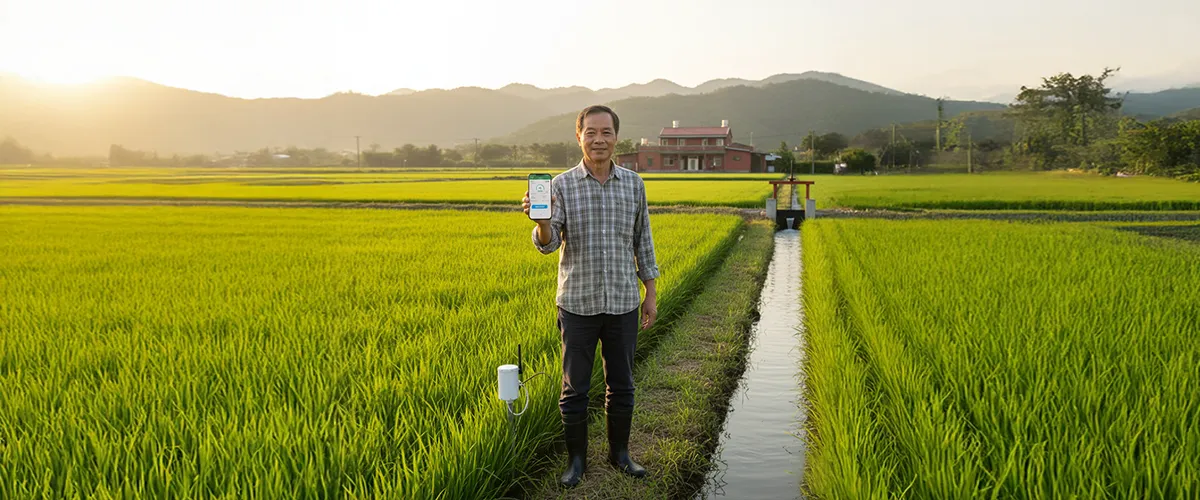
What is Precision Agriculture? Low-Cost Data Tools That Even Smallholder Farmers Can Use
Table of Contents
1. Introduction: Why Should Smallholder Farmers Learn About Precision Agriculture?
Every time I chat with fellow farmers, the question I'm asked most often is: "Doesn't precision agriculture cost a lot of money? Us small farmers probably can't afford it, right?" Hearing this, I always smile and tell everyone: "That's the biggest misconception about precision agriculture!" On the contrary, I must emphasize that smallholder farmers are the ones who need precision agriculture even more. Why? Because large farms have the scale to absorb some losses, but for smallholders, every square meter and every drop of water must be carefully calculated. The help of technology allows limited resources to be maximized. Today, I will introduce you to the core concepts of precision agriculture in the simplest way possible, and break down step by step: How should smallholders get started? How much does it cost? And how do we collect data?
2. What is Precision Agriculture? Easily Understood Through a "Field Navigation System"
Precision Agriculture is not an out-of-reach high-tech concept; it's more of a mindset. Its core is: "Using data to help farmers make smarter decisions."
You can think of it as a "navigation system" for the fields. In the past, farming relied on experience and intuition. Facing changing weather and soil is like driving on an unfamiliar country road; if you aren't careful, you might take a detour or hit a dead end. But with a navigation system, it tells you the road conditions ahead, helping you avoid traffic jams and choose the smoothest route. Precision agriculture is this "navigation system," allowing us to no longer rely on luck, but on science and data for farming.
3. The 3 Pillars of Precision Agriculture: Sensors, IoT, and Big Data
The term precision agriculture might sound fancy, but the concept is very simple. It is supported by 3 pillars: Sensors, IoT (Internet of Things), and Big Data Analysis.
1. Sensors: The "Senses" of the Field
Sensors are like the eyes, ears, and nose of the field, allowing us to keep an eye on the on-site situation at all times. A soil moisture sensor tells you how dry the soil is; a water quality monitor warns an aquaculture farmer when dissolved oxygen is insufficient; a weather station records temperature, humidity, and rainfall. These data replace the traditional, uncertain feeling of "depending on the weather."
2. IoT (Internet of Things): The Data "Megaphone"
Once we have sensors, we need a way to send the data to a place where we can see it. This is the job of IoT. Through technologies like Wi-Fi, 4G, NB-IoT, or LoRa, farm data can be sent to your mobile phone or computer in real-time. Just like home security cameras, you need the internet to watch live footage.
3. Big Data Analysis: The Data "Smart Brain"
Ultimately, how do these cold numbers become useful advice? This relies on Big Data and AI, which can analyze soil drought trends and remind you to water, or determine greenhouse humidity anomalies and automatically turn on ventilation fans. This doesn't rely on guessing, but on science.
4. Why Do Small Farms Need Precision Agriculture Even More? Analyzing 3 Major Problems
I often hear smallholder farmers say: "My land isn't big, I don't need high-tech stuff." But in reality, the problems smallholders face are often more severe and harsh, making them need the help of precision agriculture even more.
Problem 1: Labor Shortage
The most common sight in rural Taiwan is the labor shortage. One person has to take care of multiple plots of land; it's impossible to patrol everywhere every day. In this situation, even just a small soil moisture sensor can help keep an eye on the fields 24/7, keeping you informed of the situation at all times.
Problem 2: Climate Change
Droughts, heavy rains, and temperature differences caused by climate change hit smallholder farmers especially hard. In the past, we could rely on experience to judge "the rain should be about average this year," but now the weather is unpredictable. Precision agriculture data can help you adapt much faster.
Problem 3: High Cost Pressure
With rising costs for fertilizers, water, and electricity, smallholders have no extra capital to waste. The traditional watering method is "more is better than less," but it often washes fertilizers away and stunts crop growth. The advantage of precision agriculture is "just right," using the exact right amount of water and fertilizer without wasting any resources.
5. Real Case Study of a Smallholder Farmer: How a Sweet Potato Farmer in Yunlin Saved 30% on Water Bills
I once consulted for a smallholder sweet potato farmer in Yunlin who had 0.8 hectares of land. Previously, he relied on experience to water his crops, and water bills accounted for 25% of his total costs. Later, he used a simple IoT soil moisture sensor. Unexpectedly, his water bills dropped by about 30%, and the quality of his sweet potatoes became much more consistent. This is the best reflection of "low investment, high return."
Therefore, smallholder farmers should stop thinking that "technology is a toy for large farms." In this era, smallholders are actually the most suitable and necessary group to adopt precision agriculture.
6. 3 Steps for Smallholder Farmers to Start with Precision Agriculture
If you ask me: "I want to try it out, but how do I start?" My advice is: Take it step by step; don't rush to turn your field into a space center. Almost any smallholder farmer can follow these 3 steps:
-
Step 1: Start with a Single Sensor
The most highly recommended entry-level option is the "soil temperature and humidity sensor." Watering is the most common and easily understandable agricultural decision. With soil moisture data, you can avoid "over" or "under" watering. This step doesn't require a large investment; you can get started with just a few thousand dollars. -
Step 2: Upload Data to the Cloud
Once you have one or two sensors, you can pair them with IoT data transmission to send the data to a Cloud platform. This way, whether you are setting up a stall at the market or working out of town, you can use your mobile phone to check your farm's status at any time. -
Step 3: Move Towards Automated Control
Once you are familiar with the data, you can add automated control systems. For example, pair it with a smart IO control box and set it up: "Soil moisture below 30% → Automatically turn on the water pump." At this point, your farming has truly entered "autopilot" mode.
Many people worry: "I don't know anything about programming, is it hard?" In fact, our FarmerPack - Smart Field Sensor along with the environmental control platform are entirely "Plug and Play." There is absolutely no need to write any code. It's like buying a coffee machine; you just press a button to brew coffee without adjusting the pressure yourself.
The principle for smallholder farmers adopting precision agriculture is just one sentence: "Don't rush, take it step by step."
7. FAQs on Precision Agriculture: Costs, Tools, and 3 Common Misconceptions
Q1: How much do sensors cost?
This is what everyone cares about the most. In reality, you can start with a soil temperature and humidity sensor. The entry-level soil temperature and humidity meter for the FarmerPack - Smart Field Sensor costs less than 3,000 NTD. Although other advanced equipment like mini weather stations or visual detection systems are more expensive, it is recommended to start with the most pressing problems first; there is no need to install everything all at once. Moreover, many manufacturers and the government have subsidy or rental programs, which can greatly reduce the burden.
Q2: How can the data be used?
Data applications can be divided into three levels:
- Local Display: Sensors display data directly on a screen, suitable for simple observation.
- Cloud Platform: Upload data to a Cloud platform so you can check reports via your phone or computer at any time. This is the approach of the YenProtek FarmerPack and is currently the most popular model.
- Automated Control: Data drives on-site equipment, such as "Temperature > 35°C → Automatically turn on ventilation fan." This is an advanced application that saves the most labor.
Q3: Common Misconceptions
- Misconception 1: Precision agriculture is always expensive.
→ Fact: Modular and rental plans make it much easier for smallholder farmers to afford. - Misconception 2: You must know how to program.
→ Fact: The FarmerPack Smart Field Sensor combined with YenProtek's environmental monitoring platform is now "Plug and play," making it as easy to use as a home appliance. - Misconception 3: It is only suitable for large farms.
→ Fact: Smallholder farmers do not have excess resources to waste, so they actually need precision agriculture even more to save costs.
8. Conclusion: Let Technology Become the Best Assistant for Smallholder Farmers
After our discussion, I believe you have a clearer understanding of precision agriculture. In the end, I would like to summarize it in three sentences:
- Precision agriculture uses data to help make decisions, not some out-of-reach high technology.
- Smallholder farmers can start with one sensor and take it step by step; the return on investment is often much faster than you think.
- Technology is not meant to replace farmers, but to be your most reliable "assistant," helping you spend less time and resources while achieving more stable yields.
I always joke: "Precision agriculture isn't about making you an engineer, but giving you peace of mind so you can enjoy life more." Imagine, when your farm waters itself automatically, you can comfortably sip tea and check your mobile app as if the farm is talking to you. Isn't this the future of farming life we all dream of?
If you have any questions about precision agriculture, or want to know how to get started on your farm, feel free to contact us at any time!
Author
Holds a Master's degree from the Institute of Plant Biology at National Taiwan University (NTU), the Department of Botany at National Chung Hsing University (NCHU), and the Department of Plant Medicine and Food Science at National Pingtung University of Science and Technology (NPUST). He has profound expertise in plant sciences and ecological conservation. Currently serves as an instructor for the Ecological Conservation Club at Yonghe Community College, an ecology lecturer for the Society of Wilderness (SOW), and an executive director of the Nature Trail Association. He combines theory with practice, dedicating himself to promoting nature education and ecological protection. He continuously imparts professional knowledge in an easy-to-understand manner, acting as an important bridge between the public and nature.