

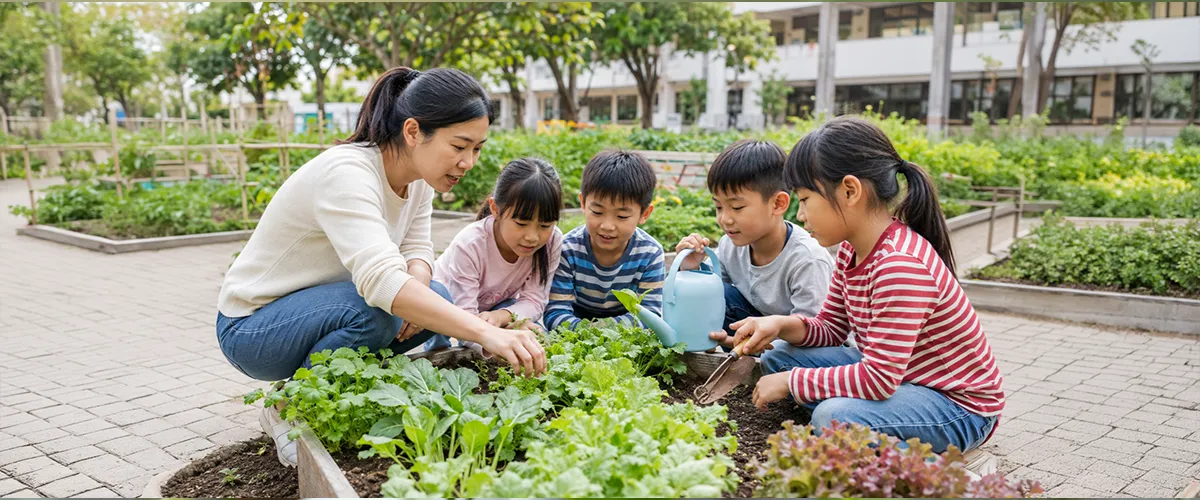
How to Make Food and Agriculture Education Fun: From Planting Vegetables to Smart Agriculture — Building a School Garden That Thinks
Table of Contents
Introduction: Why Does Food and Agriculture Education Need a New Approach?
Food and agriculture education is more than having students plant, water, and harvest vegetables — and more than teaching them where food comes from. Truly good food and agriculture education should help students understand the relationships between food, agriculture, the environment, climate, land, water resources, and everyday life. The legislative purpose of Taiwan's Food and Agriculture Education Act likewise states explicitly that food and agriculture education should strengthen the connections between diet, the environment, and agriculture, improve public health, and promote the sustainable development of farming and fishing villages, agriculture, and the environment.
In recent years, many schools have launched campus gardens, food and agriculture curricula, sustainability education, SDGs, STEM, or STEAM programs. But in practice, teachers often run into very real problems:
- Students are enthusiastic at first, but eventually only the teacher is left tending the garden.
- Someone waters on weekdays, but no one manages the garden on weekends and school breaks.
- The crops grow poorly, and no one knows whether it is too much heat, too little water, insufficient light, or a soil problem.
- Every class is just watering, weeding, and observing — the curriculum is hard to deepen.
- Teachers want to connect science, technology, IT, and environmental education, but lack hands-on tools.
So if food and agriculture education is to become more engaging, it cannot stop at "the school has a vegetable patch." The garden should become a place for learning where students can observe, ask questions, run experiments, keep records, and hold discussions. This is exactly why smart agriculture belongs in food and agriculture education.
With sensors, a micro weather station, soil monitoring, a cloud platform, and I/O automation equipment, students are not merely tending plants — they can begin to understand:
- Do we really need to water today?
- What happens to the plants when soil moisture drops?
- Does insufficient light affect growth?
- Did the soil actually get wetter after the rain?
- How does automated irrigation make decisions from data?
- Why does agriculture need IoT and data management too?
When the campus garden evolves from a "planting activity" into a "smart agriculture lab," food and agriculture education is no longer just an experiential class — it becomes an integrated platform for natural science, technology, IT education, environmental education, and sustainability literacy. Starting from the pain points schools commonly face, this article explains how to make food and agriculture education more engaging and pedagogically deeper, and shows how the FarmerPack and I/O Control Box can build a smart campus garden that generates data, waters itself automatically, and gets students thinking.
It's Not Just About Planting — It's About Helping Students Understand How Food Is Produced
When most people hear "food and agriculture education," the first thing they think of is growing vegetables. Students till the soil, sow seeds, water, weed, and harvest, then take the produce home or cook with it. These activities matter, because they let children participate in food production with their own hands and show them that food does not simply appear from the supermarket or the dinner plate.
But if food and agriculture education stops at "we grew a pot of vegetables once," it easily becomes a one-off experience. Students may remember watering and picking, without truly understanding the relationship between plant growth and the environment. Food and agriculture education with real depth should let students see the system behind food production. For example:
- Why do plants need water?
- What is the difference between too much water and too little?
- How do soil, light, temperature, and rainfall affect crops?
- Why do farmers need to watch the weather?
- Why does climate change affect food production?
- How can automation and IoT help manage agriculture?
The Ministry of Agriculture's food and agriculture education information platform likewise consolidates resources, event information, lesson plans, and training courses in one place, making it easier for everyone to access materials for promoting food and agriculture education. A school garden, then, is not just a garden — it is a place where students can move from everyday experience into scientific inquiry.
Why Is School Food and Agriculture Education So Hard to Sustain?
Food and agriculture education looks like a natural fit for schools, but once it is underway, teachers often discover that planting itself is not the hard part — sustained management and building it into a complete curriculum are.
Problem 1: Students Start Out Interested, Then Only the Teacher Is Left Tending the Garden
Many food and agriculture programs begin with great energy. Students sow seeds, plant markers, and water together, and everything feels fresh. But after a few weeks, enthusiasm can fade. Students forget to observe, watering becomes a chore, and eventually the garden is maintained by the teacher, administrative staff, or the custodian.
This is usually not because students dislike food and agriculture education, but because the activity offers no stream of newly discovered questions. If every trip to the garden is just watering, novelty wears off; but if students can see soil moisture shifts, temperature changes, rainfall records, and light differences, the garden becomes a learning site with fresh data every day.
Problem 2: No One Waters on Weekends and School Breaks
The most common management pain point for a school garden is weekends, long holidays, and summer and winter breaks. On weekdays a duty roster can cover the watering, but who takes the weekend? And what happens to the plants when students are away for the break? Under high heat, consecutive sunny days, or a long dry spell, the crops can suffer quickly.
This is why many schools start asking about automated irrigation. Automated irrigation is not just about convenience — it keeps the garden minimally cared for outside class time, so no one has to start over after every holiday.
Problem 3: The Crops Grow Poorly, but No One Knows Why
When plants struggle, there is rarely a single cause. It might be too little water, too much water, poor soil drainage, insufficient light, excessive heat, waterlogged soil after rain — or pests, disease, or a soil nutrient problem. Without data, students can only observe with the naked eye. That is valuable learning, but it makes deeper analysis difficult.
For example, when students see wilting leaves, their instinct is to say "it needs water." But if the platform shows the soil moisture is actually high, they start to wonder: maybe it is not a lack of water — maybe something is wrong in the root zone? This is one of the key payoffs of combining food and agriculture education with smart agriculture: students no longer just observe phenomena — they begin forming hypotheses.
Problem 4: The Curriculum Is Hard to Connect with Technology, IT, and Natural Science
Many schools want food and agriculture education to tie into STEM or STEAM, but when designing the lessons, they struggle to connect "growing vegetables" with "technology." Smart agriculture offers a very natural bridge, because real farms already run on science and engineering:
- Measure soil moisture with sensors.
- Record environmental changes with a micro weather station.
- Organize data on a platform.
- Track trends with charts.
- Start pumps or valves with a control box.
- Use rules to decide when to water.
All of this maps onto natural science, information technology, applied technology, math and statistics, environmental education, and sustainability topics.
What Is a "School Garden That Thinks"?
A school garden that thinks does not mean the garden literally thinks for itself. It means the garden generates data that lets students ask questions, make judgments, and test their own ideas.
A traditional school garden usually works like this: students see dry soil, so they water; they see the vegetables have grown, so they harvest; they see yellowing leaves, so they ask the teacher. A smart school garden can work like this instead:
- Students see soil moisture dropping and debate whether to water.
- Students compare how the soil changes after sunny days versus rainy days.
- Students observe how plants grow differently under different light conditions.
- Students set an automated irrigation threshold and watch whether the system triggers.
- Students record whether soil moisture actually rebounds after irrigation.
- Students use the data to discuss how plants, climate, and water resources relate.
Food and agriculture education like this comes much closer to a real working farm. Modern agriculture no longer runs on experience alone — it is adopting sensors, IoT, platforms, and automated control. When students encounter these concepts in the school garden, they are not just learning to grow vegetables; they are learning how the agriculture of the future will combine with technology.
How Can Food and Agriculture Education Combine with Smart Agriculture?
Smart agriculture does not have to start with a complex system. For schools, the best approach starts with things students can understand, operate, and experiment with.
Start with Soil Moisture: Do We Really Need to Water Today?
Watering is the food and agriculture activity students know best, and the one best suited to introducing data observation. With soil moisture sensing, students see that soil water is not a matter of gut feeling — it shifts gradually with the weather, irrigation, sunlight, and crop growth. Questions to design around include:
- What is the soil moisture today?
- How much did moisture rise after yesterday's watering?
- Does the soil dry out faster on sunny days?
- How long does soil moisture hold after rain?
- Is soil moisture the same in every zone?
- When a plant looks thirsty, does the soil data back that up?
Activities like these help students grasp the difference between observing and measuring.
Start with Rainfall: It Rained — Do We Still Need to Water?
Students often assume rain means no watering, but in reality it depends on the rainfall amount, intensity, soil infiltration, and drainage. Light rain may only dampen the surface; a short downpour may mostly run off; and continuous rain may leave the soil waterlogged. If the school garden records rainfall, the teacher can lead discussions such as:
- How much rain fell today?
- Did soil moisture increase after the rain?
- Should automated irrigation pause after rain?
- If it rains for days on end, are the plants at risk of waterlogging?
This ties weather, soil, water resources, and plant growth together.
Start with Light: Why Do Plants Grow Toward the Light?
Food and agriculture education also pairs well with phototropism experiments. For example, place different plants under different light conditions and observe differences in growth direction, leaf color, stem length, and growth rate. Combined with light sensing or sunshine records, students can see more clearly:
- Which zone gets stronger light?
- Which zone stays shaded by buildings or trees for long periods?
- Do light differences affect plant vigor?
- Do plants really grow toward where light is more abundant?
Activities like these bring food and agriculture education, natural science, and experimental design together.
Start with Automated Irrigation: Help Students Understand How IoT Works
Automated irrigation is the smart agriculture application students feel most directly. It is not abstract technology, but an action they can see: the system decides the soil is dry, then a pump or valve starts and the garden begins to water. This guides students through the basic flow of IoT:
- Sensors collect data.
- Data goes to the platform.
- The platform checks whether the conditions are met.
- The control box starts the equipment.
- The equipment carries out the irrigation.
- The system logs the result.
For students, this is a complete "data to action" pipeline.
Activity Design: From Tending Plants to Understanding Plants
The following activities work well once a school has set up a smart garden.
Activity 1: Soil Moisture Observation Diary
Have students record soil moisture, weather, plant condition, and whether they watered each day. Students can investigate: Which day was the soil driest? How much did moisture rise after watering? How do rain and hand-watering differ in effect? Is plant condition related to soil moisture? This activity suits natural science, math charting, data organization, and written record-keeping.
Activity 2: Comparing the Garden on Sunny, Cloudy, and Rainy Days
Have students compare garden data under different weather, observing changes in air temperature, air humidity, soil moisture, rainfall, and leaf condition. This helps students understand how weather conditions affect agriculture, and connects to climate change and food production topics.
Activity 3: Phototropism Experiment
Have students grow plants under different light conditions, observing alongside light data or sunshine records. Discussion prompts: Do plants grow toward the light source? What changes appear in plants with insufficient light? Does the same species grow differently in different spots? Which spot on campus is best for growing vegetables? This activity is a great fit for elementary science class, food and agriculture education, and campus environment observation.
Activity 4: Design a Set of Automated Irrigation Rules
Have students discuss and set the conditions for automated irrigation. For example: water only when soil moisture falls below a threshold, pause irrigation after rain, cap watering at a set duration, run automated irrigation on holidays, and let students observe on weekdays while the system covers weekends. This activity teaches students that automation is not random action — it requires rules, conditions, and safety limits.
Activity 5: Compare Hand-Watering with Automated Irrigation
Have students compare the two approaches: hand-watering is more hands-on, automated irrigation more consistent; people forget, but can observe on the spot; the automated system keeps records, but must be configured correctly. Finally, guide students to the insight that technology does not replace people — it helps people manage more consistently.
How Do the FarmerPack and I/O Control Box Apply to Food and Agriculture Education?
Bringing smart agriculture into food and agriculture education does not require a full-scale farm system from day one. For schools, what matters most is equipment that serves the teaching while easing the teacher's garden maintenance burden. The FarmerPack and I/O Control Box together form a smart garden architecture well suited to campuses.
FarmerPack: Get the School Garden Generating Data
The FarmerPack helps schools collect environmental and soil data from the campus garden — air temperature, air humidity, rainfall, sunshine, soil moisture, soil temperature, soil pH, soil EC, and wind speed and direction. The actual sensor configuration can be adjusted to the school's curriculum goals, site conditions, and budget.
For food and agriculture education, the FarmerPack's greatest value is not the hardware itself, but giving students data to observe and discuss. Instead of just saying "it's hot today," students can see the temperature figure; instead of "the soil seems dry," they can see soil moisture trends; instead of "it rained yesterday," they can discuss how rainfall relates to soil water. Once the garden starts generating data, food and agriculture education can rise from an experiential activity to inquiry-based learning.
I/O Control Box: Turn Automated Irrigation into an Observable Technology Experiment
The I/O Control Box helps schools turn platform decisions into physical actions — controlling water pumps, solenoid valves, or other irrigation equipment. In a campus garden it can handle automated irrigation, weekend watering, basic upkeep over summer and winter breaks, starting the pump when soil moisture runs low, setting different watering conditions per lesson plan, and letting students observe soil moisture before and after each control action.
For teachers, this eases the pressure of daily manual care; for students, it shows that automated control is not magic, but a loop of sensing, decision, control, and feedback.
Cloud Platform and App: Let Students See the Data Change
Sensors alone do not necessarily make data understandable to students. With the platform or App, teachers can walk students through live readings, historical trends, and equipment logs. Teaching scenarios the platform supports include: checking today's environmental data in class, comparing temperature and soil moisture across dates, watching the curves before and after watering, discussing whether automated irrigation triggered, and compiling data into worksheets or presentations. This makes the school garden more than a plot of land — it becomes a data-rich space that accumulates learning records.
What Should Schools Think Through Before Adopting Smart Food and Agriculture Education?
First: Is the System Mainly for Teaching, or for Maintenance?
Some schools adopt automated irrigation mainly to solve the no-one-waters-on-weekends problem; others want smart agriculture as a curriculum highlight; some need both. If maintenance is the priority, the design should emphasize stability, simplicity, and safety; if teaching is the priority, it should emphasize data visualization, student comprehension, and curriculum extensibility.
Second: Does the Garden Have Stable Power and Connectivity?
A smart garden needs confirmed access to mains power and Wi-Fi, 4G, LoRa, or another communication method. If the garden sits close to the classrooms, Wi-Fi may suffice; if it is in a far corner of campus or an open outdoor area, 4G or another method may be needed; and if you want to avoid running cables, solar power is worth evaluating. These conditions shape equipment selection, installation, and ongoing maintenance.
Third: What Irrigation Equipment Is Already in Place?
Before adopting I/O automation, confirm whether the site already has a water source, piping, a water pump, solenoid valves, a control panel, safety switches, and drainage. If there is only a tap, basic irrigation piping may need to be planned; if a pump or valves already exist, evaluate whether they can integrate with the control box.
Fourth: What Data Should Students See?
There is no need to install every sensor at once. For food and agriculture education, we recommend starting with the data students grasp most easily: soil moisture, air temperature, air humidity, rainfall, and sunshine. These connect most directly to plant growth, watering, and weather changes, and lend themselves best to classroom activities.
Fifth: How Will Lessons and Observation Records Be Organized?
Equipment is only a tool — instructional design is the key. Before adoption, plan ahead: Observe weekly or daily? Which readings will students record? Compare different zones? Run phototropism or irrigation experiments? Let students set the automated irrigation conditions? Present results at the end of the term? When equipment data is tied to curriculum tasks, the smart garden stops being a hardware showcase and becomes a genuine teaching space.
What Benefits Come from Combining Food and Agriculture Education with Smart Agriculture?
Turn Passive Experience into Active Inquiry
Traditional food and agriculture education is often teacher-led activity. A smart garden lets students read the data themselves, pose questions, form hypotheses, and verify them through observation. That puts students much closer to doing real scientific inquiry rather than completing a one-time activity.
Make the School Garden Easier to Sustain
Automated irrigation covers weekends, school breaks, and the days teachers cannot attend to the garden, reducing the risk of an abandoned plot or withered crops.
Make Food and Agriculture Education Naturally Cross-Disciplinary
One smart garden can connect to many subjects:
- Natural science: plant growth, water, light, weather.
- Information technology: sensors, data, platforms, IoT.
- Applied technology: automated control, pumps, valves.
- Math: charts, trends, comparisons.
- Social studies and environment: food, climate, water resources, sustainability.
- Language arts: observation logs, presentations, report writing.
Help Students Understand What Future Agriculture Looks Like
Modern agriculture is no longer just hoes, hoses, and experience — it is adopting sensors, AIoT, cloud platforms, and automated control. Encountering smart agriculture in the school garden helps students understand that technology does not live only in phones and computers; it can also solve problems in agriculture, the environment, and food supply.
Conclusion: Engaging Food and Agriculture Education Doesn't Just Have Students Planting — It Gets Them Asking Questions
The value of food and agriculture education is not merely teaching students how vegetables are grown, nor adding another plot to the campus. Truly meaningful food and agriculture education lets students understand the relationship between food production and the natural environment through planting, observing, recording, and discussing. When the school garden gains smart agriculture tools, students can move beyond "watering every day" to asking:
- Do we really need to water today?
- Why are the plants growing poorly?
- How does weather affect the soil?
- How do sensors help manage agriculture?
- How does automated control make plant care more consistent?
- How will future agriculture combine with technology?
The FarmerPack gets the school garden generating soil, weather, and environmental data; the I/O Control Box lets pumps or valves run automated irrigation on set conditions. Together, they turn food and agriculture education from a farming experience into a campus learning program that combines smart agriculture, STEM, environmental education, and sustainability literacy.
Engaging food and agriculture education is not about taking students to the garden for a one-time activity — it is about making the garden a real-world classroom students can observe, discuss, and think in every day. If your school is planning food and agriculture education or a smart campus garden, get in touch with us and let's design the right solution together!
FAQ | Common Questions About Food and Agriculture Education and Smart School Gardens
Q1: What is food and agriculture education?
Food and agriculture education connects diet, agriculture, the environment, and everyday life so that students understand food production, agricultural culture, local food, healthy living, and environmental sustainability. Taiwan's Food and Agriculture Education Act likewise defines its purpose as strengthening the connections between diet, the environment, and agriculture, and promoting agricultural and environmental sustainability.
Q2: Does food and agriculture education require a school garden?
Not necessarily. It can be delivered through coursework, food experiences, farm visits, learning about agricultural products, cooking activities, and environmental education. But a campus garden is an excellent format for schools, because it lets students observe plant growth over the long term and connects natural science with everyday experience.
Q3: Why is food and agriculture education a good fit for smart agriculture?
Because smart agriculture turns plant growth, soil moisture, weather changes, and irrigation actions into observable data. Students are not merely tending plants — they learn to measure, compare, analyze, and judge, making food and agriculture education far more inquiry-driven.
Q4: What can the FarmerPack do in food and agriculture education?
The FarmerPack helps schools collect environmental and soil data from the campus garden — temperature, humidity, rainfall, sunshine, soil moisture, soil temperature, and more. This data can be used for classroom observation, chart analysis, plant growth comparisons, and food and agriculture education showcases.
Q5: How can the I/O Control Box be used in a school garden?
The I/O Control Box controls water pumps, solenoid valves, or other irrigation equipment, so the campus garden waters itself automatically on set conditions — for example, starting irrigation when soil moisture drops below a threshold, or handling basic watering automatically on holidays.
Q6: Will automated irrigation take away students' chances to care for plants?
No. Automated irrigation is not meant to replace students — it keeps the garden stable, especially on weekends, long holidays, and school breaks. Weekday lessons can still have students observing, recording, setting rules, and discussing data, which actually makes plant care a deeper learning experience.
Q7: Can food and agriculture education combine with STEM or STEAM?
Yes. A smart school garden can connect natural science, information technology, applied technology, math, environmental education, and language expression. Students learn about sensors, IoT, automated control, data charts, plant growth, and sustainability — an ideal theme for cross-disciplinary learning.
Q8: What should a school prepare before adopting a smart garden?
We recommend first confirming the teaching goals, garden location, water source, power, network, whether automated irrigation is needed, which data you want to observe, and who will maintain the system. If pumps or valves will be controlled, also confirm whether the existing irrigation equipment is suitable for connecting to a control system.
Author

Holds a Master's degree from the Institute of Plant Biology at National Taiwan University (NTU), the Department of Botany at National Chung Hsing University (NCHU), and the Department of Plant Medicine and Food Science at National Pingtung University of Science and Technology (NPUST). He has profound expertise in plant sciences and ecological conservation. Currently serves as an instructor for the Ecological Conservation Club at Yonghe Community College, an ecology lecturer for the Society of Wilderness (SOW), and an executive director of the Nature Trail Association. He combines theory with practice, dedicating himself to promoting nature education and ecological protection. He continuously imparts professional knowledge in an easy-to-understand manner, acting as an important bridge between the public and nature.