

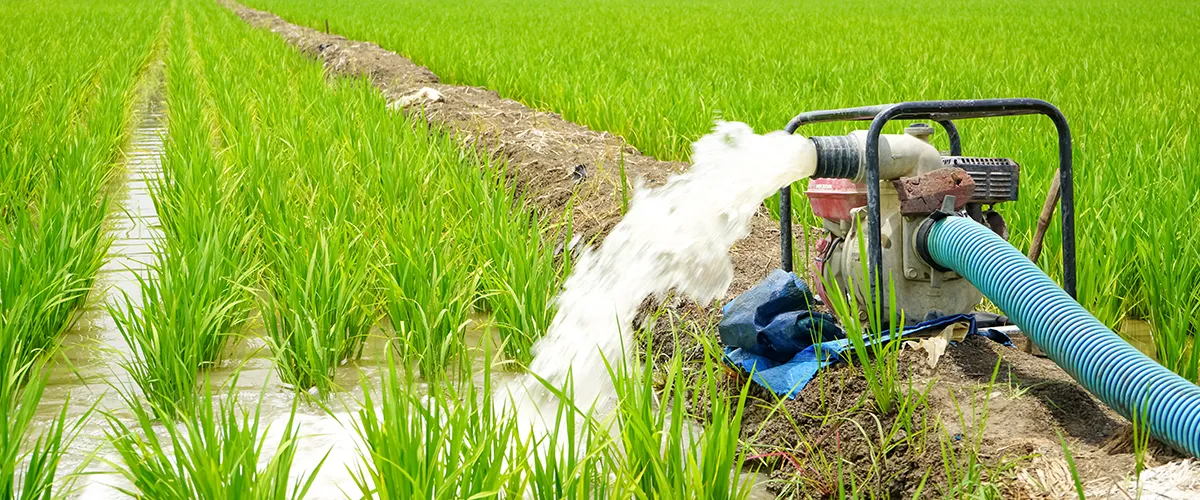
What Is an Automatic Sprinkler System? Stop Watering by Guesswork and Let Irrigation Start and Stop Automatically Based on the Environment
Watering in the Rain, Skipping the Drought? Don't Let a Timer Sprinkler Waste Your Water and Power
Ordinary automatic sprinklers and waterers can only run on a timer: when the time comes, they spray, they keep spraying on rainy days, and they add nothing extra during heat and drought. YenProtek's automatic sprinkler system combines the soil moisture and microclimate data from the FarmerPack, and uses an Auto I/O Control Box to control water pumps and solenoid valves. When the soil is too dry it starts automatically, and when it rains or moisture is sufficient it stops automatically, so every drop is applied exactly when it is needed.
SOLUTION|Learn About the Automatic Sprinkler System SolutionTable of Contents
Article Summary|For many agricultural sites, irrigation is something that happens every day yet is not always easy to judge: Does soil have to be watered just because it looks dry? It rained yesterday, so does the field still need irrigation today? Some areas of the same field are wet while others are dry, so should they follow the same irrigation schedule? Traditional agriculture has long relied on farmers' experience to judge when to water. That experience is extremely valuable, but as climate change intensifies, labor shortages become obvious, production scales grow, and the pressure of water resource cost and quality management rises, relying on visual observation and fixed-time irrigation alone is increasingly unable to meet the management needs of modern agriculture.
The core of automatic sprinkling and Precision Agriculture is not to make the farm more complicated, but to help managers answer a very practical question: When should you water? How much should you water? Which zone needs attention first? Was the irrigation actually effective? Through soil moisture sensing, microclimate monitoring, rainfall records, crop growth stage assessment and cloud data management, agricultural managers can gradually move from "watering by intuition" to "irrigating based on data." This is not only about saving water, but is the first step toward reducing the risk of crop water stress, avoiding over-irrigation, improving management efficiency and building data-driven agricultural management.
1. Why Is "Watering" Not as Simple as It Looks?
Watering may seem to be the most basic task in agriculture, but in reality, irrigation management involves crop type, growth stage, soil conditions, weather changes, drainage conditions, root depth and irrigation equipment efficiency.
Many people assume that you water when the soil is dry, or that watering once every morning and evening on a fixed schedule is enough. But in actual field management, both too much and too little water management can affect crops. With too little water, crops may experience water stress that affects growth rate, leaf condition, flowering, fruiting and yield; with too much water, the result may be root oxygen deficiency, poor soil aeration, nutrient leaching and increased disease, and it may even make crops look "water-deprived" when in fact the roots are damaged and unable to absorb water normally.
Therefore, the truly difficult part of irrigation management is not simply "whether to water," but judging:
- Is the soil really short of water right now?
- Is the shortage in the surface layer, or in the soil layer where the roots are?
- Did yesterday's rainfall actually soak into the soil?
- After irrigation, does the water stay in the effective root zone?
- Do different areas need different irrigation strategies?
- Does this watering help the crops, or add disease and waste?
These questions are hard to judge by eye alone. This is exactly why automatic sprinkling, automatic sprinkling and Precision Agriculture are gaining attention.
2. Five Common Problems with Traditional Irrigation
Problem 1: Looking Only at the Soil Surface Easily Misjudges the True Moisture State
Many farmers judge whether watering is needed by how dry or wet the soil surface is. But the surface condition does not necessarily reflect the moisture in the soil layer where the roots are. Sometimes the surface looks very dry but there is still enough moisture below; sometimes the surface has just been wetted but the water has not actually penetrated to the root zone; sometimes the soil surface is moist while the lower layer lacks moisture due to drainage or soil differences.
If you look only at the surface, two kinds of mistakes can occur: one is over-irrigating because you think there is a water shortage, and the other is thinking there is already water when the crop roots are in fact still short of moisture. A good automatic sprinkler system pays more attention to the moisture state of the "effective root zone" rather than just the soil surface.
Problem 2: Watering at Fixed Times Without Considering Weather or Crop Needs
Many farms set fixed irrigation times, such as watering once every morning and once every evening, or irrigating once every two days. This approach is convenient to manage, but the problem is that the weather is different every day, and crop needs also change with the growth stage.
- On sunny, hot and windy days, water evaporates and transpires faster.
- On cloudy, cool and humid days, water is consumed more slowly.
- The seedling stage, vegetative growth stage, and flowering and fruiting stage all have different water requirements.
- After continuous rainfall, the soil may not need irrigation again for a short period.
This is also the limitation of most automatic sprinklers and automatic waterers on the market: they can only run on a timer, spraying when the time comes, still spraying on rainy days, and not adding water automatically during heat and drought. If these changes are not considered, fixed irrigation can cause either insufficient or excessive water. The real point of an automatic sprinkler system is to make watering not just follow a schedule, but to reference soil, weather and crop conditions and start and stop automatically based on the environment.
Problem 3: The Same Field Is Not Necessarily Equally Dry
The field environment is not entirely uniform. The same field can have differences in moisture distribution because of terrain elevation, soil texture, shade, drainage, irrigation pipe positions or crop density.
- Some spots dry out faster.
- Some spots easily accumulate water.
- Some spots are close to the water source and receive more irrigation.
- Some spots drain quickly and cannot retain moisture.
- Some spots have strong sunlight and transpire faster.
If the entire field uses the same irrigation time and volume, some areas may end up short of water while others are over-wet. This is exactly why Precision Agriculture emphasizes "zone management."
Problem 4: After Irrigation, You Don't Know Whether It Was Actually Effective
Very often, a farm only knows that "watering happened" but does not know "how effective the watering was." For example: After irrigation, did soil moisture rise? How long before it started to drop? Was this irrigation too short? Was it too long and wasteful? Did the water concentrate in the surface layer and fail to reach the root zone? Did different areas respond differently after irrigation?
Without data records, it is hard to compare the effects of different irrigation strategies, and hard to know which irrigation method best suits the site. An automatic sprinkler system can use soil moisture change curves to let managers see the moisture changes before, during and after irrigation. This has more management value than simply recording "watered today."
Problem 5: When Anomalies Occur, They Are Often Discovered Too Late
Water management problems usually do not happen suddenly but accumulate gradually. For example, soil moisture may drop for several consecutive days while crops show no obvious wilting yet, but are in fact already approaching water stress; by the time the leaves show clear problems, the crops may already be affected. Likewise, excessive wetness may start with soil moisture staying too high for a long time, then increase root pressure or disease risk.
Traditional field-patrol methods are easily affected by manpower, time, weather and subjective judgment. An automatic sprinkler system can use real-time monitoring and alert settings to remind managers before problems escalate.
3. What Is an Automatic Sprinkler System?
An automatic sprinkler system (also often called an automatic watering system or automatic irrigation) refers to a management approach that uses sensors, weather data, communication equipment, cloud platforms and control systems to help agricultural managers more precisely judge when to water, which zones to irrigate and how much water to apply. The biggest difference from ordinary automatic sprinklers and waterers is that it does not simply turn the water pump into a timed switch, nor does it merely digitize the watering schedule. When an automatic sprinkler system further combines data-based judgment with automatic control, that is what is generally called Smart Irrigation.
Truly valuable automatic sprinkling should include three levels:
- Knowing the on-site conditions.
- Helping judge whether irrigation is needed.
- Making irrigation actions recordable, traceable and optimizable.
Entry-level automatic sprinkling can start with soil moisture monitoring and anomaly alerts; a more advanced approach can combine rainfall, temperature and humidity, sunlight, wind speed and crop growth stages; more mature automatic sprinkling control can further link water pumps, valves and control equipment so the system automatically starts or stops watering according to set conditions. Therefore, an automatic sprinkler system is not an all-at-once fully automatic system, but a data-driven management method that can be adopted gradually according to the farm's needs.
4. How Does Automatic Sprinkling Relate to Precision Agriculture?
Precision Agriculture is an important concept within Smart Agriculture, emphasizing more precise management according to different areas, different crops, different growth stages and different environmental conditions. Automatic sprinkling is one of the easiest applications of Precision Agriculture to understand and to put into practice, because water management exists in nearly all agricultural settings, and watering decisions directly affect crop growth, resource use and management cost.
Traditional irrigation often means "watering the whole area together"; Precision Agriculture hopes to gradually achieve "watering only where needed, only when needed, and to the appropriate degree." This does not mean every field needs a lot of equipment, nor that full automation must be achieved from the start. The first step of Precision Agriculture is to build data observation capability, that is, to first know:
- Where dries out more easily?
- Where does moisture recover fastest after irrigation?
- Where accumulates water easily?
- Under which weather does moisture drop fastest?
- Which growth stage is most sensitive to moisture changes?
When these questions can be answered by data, farm management begins to move from experience-based management toward precise management.
5. What Data Does an Automatic Sprinkler System Need?
Soil Moisture: The Core Data for Judging Water Shortage
Soil moisture is one of the most core pieces of data for automatic sprinkling. It helps managers understand the current water content of the soil and whether water actually enters the soil after irrigation. But soil moisture cannot be judged by a single number alone; you also need to look at the trend.
For example, if the soil moisture in one area drops from 42% to 35% and then to 28%, it means moisture is continuously being lost; if after irrigation it only recovers from 28% to 30%, it may mean the irrigation volume was insufficient, the irrigation time was too short, or the sensor location was not affected by the irrigation; if it stays too high for a long time after irrigation, it may mean poor drainage or over-irrigation. So the true value of soil moisture is not only telling you how much there is now, but letting you see the "process of moisture change."
Rainfall: Avoiding Over-Irrigation After Rain
Rainfall data helps judge whether natural rain has already provided enough water. Many farms encounter this situation: it rained yesterday, but they don't know exactly how much rain fell, nor whether the rain was really enough. Light rain may only wet the soil surface with limited help to the root zone; a short burst of heavy rain may cause runoff, so the water actually infiltrating the soil is not necessarily much; continuous rainfall may cause waterlogging and root pressure.
With only the impression that "it rained," managers find it hard to precisely adjust irrigation strategy. With rainfall records, they can more soundly judge whether to postpone irrigation, reduce irrigation or step up drainage observation.
Air Temperature and Humidity: Grasping Transpiration and Crop Stress
Air temperature and humidity affect crop transpiration and the rate of water consumption. In hot, low-humidity, strong-sunlight and windy environments, the loss of crop and soil moisture usually speeds up; in cool, humid, cloudy environments, water consumption is relatively slower. Therefore, the same soil moisture may carry different management meaning under different weather conditions. If automatic sprinkling can combine air temperature and humidity, it can come closer to the actual on-site water demand rather than operating only on a fixed schedule.
Sunlight and Solar Radiation: Judging Water Consumption and Crop Growth Conditions
Sunlight affects crop photosynthesis and also the water consumption of soil and plants. Under continuous high-sunlight and high-temperature weather, soil moisture may drop faster; in continuously rainy or low-light environments, irrigation demand may decrease but disease risk may increase. Looking only at soil moisture may miss the changes caused by weather; combining sunlight data gives a more complete understanding of the crop environment.
Wind Speed and Direction: Affecting Transpiration, Spray Irrigation and Work Safety
Wind speed also has an important impact on agricultural sites. When the wind is strong, crop transpiration may increase and the soil surface may dry faster; if spray irrigation or spraying is used, wind speed also affects uniformity and drift risk. Therefore, wind speed and direction data are not only weather records but also help with irrigation and field work decisions.
Equipment Status: Confirming the System Actually Executed
Besides environmental data, an automatic sprinkler system must also look at equipment status. What managers really need to know is not only "whether the system issued a command" but also "whether the equipment actually started." For example:
- Whether the water pump started.
- Whether the valve opened.
- Whether the irrigation time matched the setting.
- Whether the equipment was interrupted abnormally.
- Whether soil moisture recovered after irrigation.
With only control commands and no status feedback, managers may still mistakenly think irrigation was completed.
6. How Does an Automatic Sprinkler System Decide "Whether to Water"?
Automatic sprinkling does not look at a single condition, but makes decisions by combining multiple pieces of data. The simplest approach is to set upper and lower limits for soil moisture: when soil moisture falls below the set value, it prompts irrigation or starts the irrigation equipment; once soil moisture recovers to a safe range, irrigation stops. But in actual agricultural settings, this judgment can be even more nuanced.
Judgment 1: Whether Soil Moisture Is Below the Management Threshold
This is the most basic irrigation judgment. Different crops, soils and growth stages suit different moisture ranges. Managers can set an initial threshold based on on-site experience, then adjust it after observing the data for a period of time. The point is not to find the perfect number from the start, but to first establish an observable and correctable management mechanism.
Judgment 2: Whether the Rate of Soil Moisture Decline Is Abnormal
Sometimes soil moisture has not yet fallen below the threshold, but the rate of decline clearly speeds up, which may mean it will soon enter a water shortage state. For example, under hot, strong-sunlight or windy weather, moisture may drop faster than usual. At this point the system can remind managers in advance rather than waiting until crops show obvious water shortage before acting.
Judgment 3: Whether There Has Been Recent Rainfall
Irrigation decisions should incorporate rainfall data. If there has been enough recent rain, irrigation can be postponed or reduced; if it was only brief light rain, it may not be enough to replenish root zone moisture; if soil moisture has not recovered after heavy rain, it may indicate that drainage, runoff or the measuring point location needs to be checked. Looking at rainfall and soil moisture together is more reliable than looking at either one alone.
Judgment 4: Which Growth Stage the Crop Is Currently In
Different growth stages have different sensitivities to moisture. The seedling stage needs to avoid drastic moisture fluctuations; the vegetative growth stage needs stable moisture to support growth; if moisture management is unstable during the flowering and fruiting stage, it may affect quality and yield; before harvest, moisture strategy may need to be adjusted according to crop characteristics. Automatic sprinkling does not apply the same standard to all crops, but should be adjusted together with crop management experience.
Judgment 5: Whether Irrigation Achieved the Expected Effect
A good automatic sprinkler system not only asks "whether to water" but also "whether the watering worked." If soil moisture shows no obvious change after every irrigation, you may need to check: whether the irrigation time was too short, whether the water pressure was insufficient, whether the drip lines were clogged, whether the sensor location was unreasonable, or whether the soil drains too quickly. If the soil stays too wet for a long time after irrigation, you may need to check: whether the irrigation volume was too much, whether drainage was poor, whether the irrigation frequency was too high, or whether the crop roots were affected. This "watering effect feedback" is a very important management value of automatic sprinkling.
7. Automatic Sprinkling Is Not Just About Saving Water, It Reduces Risk
When many people talk about automatic sprinkling or automatic sprinkling, the first thing they think of is saving water. This is of course an important benefit, but the value of automatic sprinkling goes beyond that.
Reducing the Risk of Water Shortage
When soil moisture keeps dropping, the system can remind managers in advance, avoiding waiting until crops show wilting, flower drop, fruit drop or growth stagnation before acting.
Reducing the Risk of Over-Irrigation
Over-irrigation is not only a waste of water; it may also cause nutrient leaching, root oxygen deficiency and disease risk. Through soil moisture monitoring, managers can avoid the long-term problems caused by the habit of "watering a bit extra just to be safe."
Reducing the Burden of Manual Patrols
An automatic sprinkler system lets managers first check the status of each zone from a phone or platform, then decide whether they need to go on-site to handle it. This is especially helpful for dispersed farmland, remote sites or farms managing large areas.
Building Irrigation Records and a Management Basis
Only with records can there be improvement. An automatic sprinkler system can save watering times, soil moisture changes, rainfall records and equipment start/stop status, so that in the future the farm can compare management results across different seasons, different areas and different crop batches.
Making Agricultural Experience Easier to Pass On
The experience of senior farmers is very important, but if experience is not recorded, it is hard to replicate and pass on. Automatic sprinkling can gradually convert experience such as "when to water" into data, rules and a management basis that can be discussed, so that new staff can more quickly understand on-site conditions.
8. What Should You Think Through Before Adopting an Automatic Sprinkler System?
Automatic sprinkling is not necessarily effective just because you buy the equipment. Before adopting it, you should first clarify the on-site problems and management goals.
First, Is What You Want to Solve Water Shortage, Over-Wetness, or Labor Shortage?
Different pain points affect the system design.
- If the main problem is water shortage, focus on soil moisture, rainfall and irrigation effectiveness.
- If the main problem is over-wetness, focus on drainage, rainfall, low-lying areas and the long-term water content of the soil.
- If the main problem is labor shortage, focus on remote monitoring, alert notifications and equipment status reporting.
- If the main problem is management records, focus on data retention, reports and historical trends.
Clarify the problem first, so it doesn't become installing equipment just for the sake of installing equipment.
Second, Where Should the Sensors Be Installed?
The sensor location directly affects the credibility of the data. Soil sensors should be placed as much as possible in a position that represents the moisture state of that area, rather than wherever is most convenient to install. You usually need to consider: crop root depth, irrigation pipe positions, soil differences, terrain elevation, drainage conditions, shade and sunlight, and management zoning. If one measuring point cannot represent the whole area, you may need zone monitoring rather than expecting a single sensor to answer all questions.
Third, Monitor First, or Go Straight to Automatic Control?
For most farms, we recommend starting with monitoring. Observe for a period first, understand the relationship between soil moisture, rainfall and irrigation effectiveness, then decide whether to adopt automatic control. If you jump straight to automatic control but the thresholds are set unreasonably and the sensor locations are incorrect, it may instead cause incorrect irrigation. A more robust adoption sequence is:
- Monitor first.
- Then set alerts.
- Then establish irrigation rules.
- Finally, adopt automatic control.
This better fits the actual risks of agricultural sites.
Fourth, Who Will Look at the Data? Who Will Handle Anomalies?
A system is not just about being able to collect data; someone must be able to use the data. Before adoption, you should confirm: Who will look at the platform? Who will receive alerts? Who handles it after an alert occurs? Can on-site staff understand the data? Does it need to be simplified into red-yellow-green lights or status indicators? Is there a need to produce management records or reports? If data is not connected to actual workflows, it is hard for it to generate value.
9. How Can an Automatic Sprinkler System Be Adopted? Start with Three Stages
Stage One: Soil and Weather Monitoring
In the first stage, we recommend establishing data sources first. At the most basic level, you can start with soil moisture, air temperature and humidity, rainfall, sunlight or other microclimate data, so the farm knows the actual on-site conditions. The focus of this stage is not automation, but seeing changes that were previously invisible, such as: How long does the soil take to dry? How long does moisture last after rain? How fast does moisture drop on hot days? How large are the differences between areas? Does moisture recover after irrigation?
Stage Two: Alerts and Irrigation Recommendations
Once data has accumulated for a while, you can establish preliminary management rules, such as: reminding when soil moisture falls below a set value, reminding to watch irrigation during continuous high temperatures, reminding to postpone irrigation after rain, reminding about drainage when soil stays too wet for a long time, and sending an alert when equipment does not start normally. The focus of this stage is to let managers not have to constantly watch the data, but to have the system proactively remind them of situations that need attention.
Stage Three: Automatic Irrigation and Equipment Control
When monitoring data is stable, irrigation rules are clear and equipment safety is sufficient, you can further adopt automatic control, such as: starting the water pump when soil moisture is below the threshold, automatically shutting off after irrigation reaches a set time, stopping irrigation once soil moisture recovers to the target value, pausing irrigation during rain, and stopping equipment and notifying staff when an abnormal state occurs.
But automatic control must retain safety mechanisms, such as manual switches, emergency shutdown, operation logs, permission management and on-site confirmation procedures. Agricultural sites have many variables, so we do not recommend going fully automatic without a monitoring foundation.
10. How Does YenProtek Technology Help Farms Move from "Watering by Intuition" Toward Data-Driven Irrigation?
What an automatic sprinkler system really needs is not a single sensor, nor a simple remote switch, but an infrastructure that can connect on-site data, communication, platform and equipment control. YenProtek Technology can, according to the farm's needs, help build a Smart Agriculture foundation system from environmental monitoring to automatic control.
FarmerPack: Building Farm Environment and Soil Data
FarmerPack can be used for environmental monitoring and soil data collection in agricultural settings, helping managers grasp key information such as field temperature and humidity, rainfall, sunlight and soil moisture. It suits sites that want to first understand the farm's status, build long-term data, improve irrigation decisions or carry out data-driven agricultural management. Its role is not to directly replace farmers' judgment, but to give farmers and managers clearer on-site data to reference.
Auto I/O Control Box: Letting Irrigation Equipment Execute by Conditions
When a farm has already established basic monitoring data and wants to further link on-site equipment, it can pair with the Auto I/O Control Box for equipment control, for example controlling water pumps, valves, fans or other on-site equipment according to soil moisture, time schedules or platform settings. The value of this kind of control box is to make equipment not merely "able to switch on and off," but able to execute actions according to on-site conditions and management rules.
Cloud Platform and App: Making Data Visible, Traceable and Manageable
If automatic sprinkling has only on-site equipment, it is still not easy to manage. Through a cloud platform and app, managers can view real-time data, historical trends, anomaly notifications and equipment status. This helps a farm move from "whether watering happened" further toward a management model of "when to water, how long to water, and how effective it was afterward."
From Monitoring to Control, Adopted Gradually According to the Site
Every farm has different conditions and does not necessarily need to achieve complete automation at once. Some sites suit starting with soil and microclimate monitoring; some sites need alert notifications added; some sites already have irrigation equipment and can further integrate control; some sites need to be re-planned according to water source, power, network and irrigation zoning. YenProtek Technology can, according to on-site conditions, help evaluate sensing items, communication methods, power supply methods, platform features and equipment control methods, so that an automatic sprinkler system starts from actual problems rather than adopting a system just for the sake of adopting a system.
Conclusion: The Point of Automatic Sprinkling Is Not Watering More or Less, but Watering with More Basis
Irrigation is one of the most basic and most critical management tasks in agriculture. In the past, farmers relied on experience to judge when to water. This experience is extremely important and should not be replaced by technology. But facing climate change, labor shortages, the scaling-up of farmland and the pressure of quality management, agricultural sites need more real-time, continuous and traceable data to assist judgment.
The true value of automatic sprinkling is not making the farm more high-tech, but helping managers answer more clearly: Is watering needed now? Which zone needs water more? Was irrigation effective? Is there a risk of over-irrigation or water shortage? In the future, can experience be converted into traceable management rules? When a farm begins to accumulate soil, weather, irrigation and equipment data, it can gradually move from watering by intuition toward data-driven irrigation and Precision Agriculture management. Automatic sprinkling is not the whole of Precision Agriculture, but it is often the easiest step to begin with.
FAQ|Common Questions About Automatic Sprinkling and Precision Agriculture
Q1: What is an automatic sprinkler system?
An automatic sprinkler system is a management approach that uses soil sensing, weather monitoring, communication technology, cloud platforms and control equipment to help a farm judge when to water, which zones to irrigate and how effective the watering was. Its focus is not simply switching a water pump on and off, but making watering decisions more data-driven.
Q2: How is an automatic sprinkler system different from an ordinary automatic sprinkler?
Ordinary automatic sprinklers and waterers are mostly timer-controlled, spraying when the time comes and unable to judge whether it is raining or whether the soil is already wet enough. An automatic sprinkler system combines soil moisture, rainfall and microclimate data, starting and stopping irrigation automatically according to environmental conditions and keeping records for management and adjustment, which is also why it is called Smart Irrigation.
Q3: How does automatic sprinkling relate to Precision Agriculture?
Automatic sprinkling is one of the important applications of Precision Agriculture. Precision Agriculture emphasizes management according to different areas, crop states and environmental conditions, and automatic sprinkling applies this concept to water management, letting a farm adjust its watering strategy according to soil and weather conditions.
Q4: Does automatic sprinkling have to be fully automatic all at once?
Not necessarily. Automatic sprinkling can start with monitoring, such as soil moisture, rainfall and microclimate monitoring, then gradually add alert notifications, watering recommendations and equipment control. For most farms, establishing a stable data source first is more important than pursuing full automation from the start.
Q5: Is installing only a soil moisture sensor enough?
Not necessarily. Soil moisture is important data, but irrigation decisions are also affected by rainfall, temperature, humidity, sunlight, wind speed, crop growth stage and soil conditions. For more precise management, we recommend judging together with microclimate data and on-site irrigation records.
Q6: Can automatic sprinkling save water?
Yes, but the value of automatic sprinkling is not only saving water. It can also reduce the risk of water shortage, avoid over-irrigation, reduce manual patrols, build watering records, and help the farm improve its long-term water management strategy.
Q7: Are small farms also suitable for adopting an automatic sprinkler system?
Yes, but they do not have to adopt a complete system all at once. Small farms can start with the most valuable monitoring items, such as soil moisture, rainfall or environmental temperature and humidity, then gradually add alerts, platform management or automatic control as needed.
Q8: What is the most important thing before adopting automatic sprinkling?
The most important thing is to first clarify the management pain points, such as water shortage, over-irrigation, labor shortage, incomplete irrigation records, or too large a moisture difference between areas. After confirming the problem, then decide on sensing items, installation locations, communication methods and whether control equipment is needed.
Q9: Will automatic sprinkling replace farmers' experience?
No. Automatic sprinkling converts farmers' experience into a data basis that is easier to observe, compare and trace. A truly good automatic sprinkler system should assist farmers' judgment rather than ignore on-site experience.
Author

AIoT System Architecture and Smart Industry Application Planning
Long dedicated to AIoT, IoT system integration and Smart Industry application planning, with over 15 years of experience focused on Smart Agriculture, smart fisheries, industrial IoT, edge computing, cloud platforms and AI application adoption. With hands-on experience in sensor integration, equipment connectivity, data transmission, platform architecture and on-site application implementation, he helps different industries turn on-site equipment and data into usable management systems and decision-making bases.