Updated 2026-11-13
Duty/standby alternation is a control method in which the two pumps in the sump take turns running, and one takes over if the other fails; when the water level is too high, both can also run together. But the switching depends on the control panel, so if the alternating relay, the level controller or the control panel's own power supply fails, neither pump will run. This kind of failure often happens in the middle of the night with nobody on site, and by the time it is found, the basement is already flooded.
Summary | This article explains how duty/standby pump alternation works in a building basement, why both pumps can stop at once, and why nobody knows even though the control panel has an alarm. It then sets up three lines of defence, which are the duty pump's power, the standby pump's power and the sump water level, so that the people in charge are notified as soon as a pump has a problem. At the end are a 5-minute check you can do tonight, a checklist for before the heavy rain season, 8 questions to ask your M&E contractor, and a proposal you can bring to the managing agent or RMC.
1. One phone call: the duty pump failed, and the standby pump did not take over
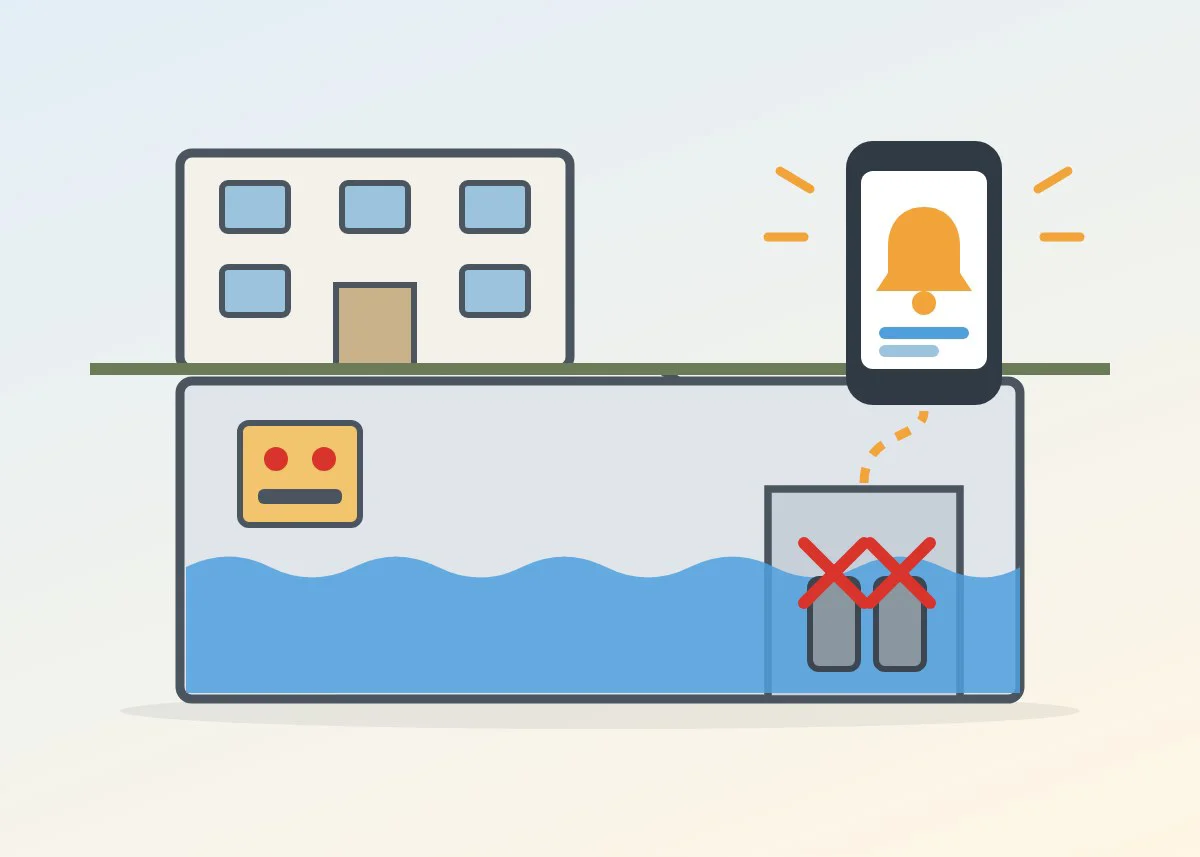
We recently received a phone call. A pump in the basement of a building had failed. The control panel should have switched automatically to the standby pump, but the switch responsible for the changeover had failed at the same time, so the standby pump never received power.
It happened in the middle of the night, with nobody in the basement. The water kept rising, and by the time someone noticed in the morning, the whole basement level was under water, and the fit-out and equipment of the shops on that level all had to be redone. The residents' request afterwards was clear: as soon as a pump has a problem, someone must know right away, and whatever needs replacing should be replaced early.
Equipment fails, and that is nobody's fault. The gap to fill is a failure that nobody knows about.
2. What is duty/standby pump alternation?
At the lowest point of a building's basement there is a sump (also called a sump chamber or pump chamber), where rainwater, seepage and wash water collect. Two submersible drainage pumps (also called submersible pumps or sewage pumps) sit in the sump, and a float switch or a level controller (electrode probes) senses the water level: when the water reaches a certain height the pump starts, and when it has been pumped down to a low level it stops. The pump control panel next to it contains an alternating relay, which decides which pump's turn it is this time.
- Duty/standby alternation: the two pumps take turns as the duty pump, switching at every start, so that wear is shared evenly and you can confirm that both pumps normally run.
- Failover: when the running pump trips or fails, the control panel switches to the other one.
- Simultaneous running at high water level: when water comes in too fast and the level goes above the alert height, both pumps run together.
Some buildings do not alternate at all but only switch to the standby pump after the duty pump fails. With this setup the standby pump does not run normally, so if it has failed or has no power, you cannot tell.
3. Why do both pumps stop at once? 6 common failures
| Where it fails | What happens | Can you tell normally? |
|---|---|---|
| Alternating relay, contactor | One pump stops and the other does not receive the start command | No, not until the moment a switchover is needed |
| Control panel power supply | The circuit breaker trips or the power supply wiring fails, and both pumps lose power | Only by opening the control panel |
| Level controller, float switch | Jammed by debris or worn out, so the pumps are not told to start even when the pit is full | No, you only find out when the water level rises |
| The standby pump's circuit | The circuit breaker has tripped or the selector switch has been turned to manual or off, so the pump does not run when its turn comes | Fine normally, discovered only when its turn comes |
| The pump itself | Impeller jammed by sand, gravel or debris, thermal overload relay tripped, or winding burned out; if the switchover also fails, no pump is pumping | Noise, vibration and frequent tripping are warning signs |
| Power outages | No power in the whole building, both pumps stop together, and the water keeps flowing in | Heavy rain often comes with power outages, so the power is gone just when pumping is needed most |
The alternating relay was removed and the pumps set to “single-pump operation”: when an alternating relay fails, the site sometimes removes it first and sets one pump to run alone. The pump still pumps, but there is no backup, and the next time this pump fails, no pump is pumping. Record single-pump operation in the maintenance log, let the managing agent know, and restore alternation as soon as possible.
Another case is water coming in faster than it is pumped out, for example a burst pipe or a water pipe left open, so the pumps run continuously and still cannot empty the sump. Whatever the cause, it eventually shows up in the sump water level.
4. The control panel has an alarm, so why does nobody know?
- The alarm is only on site: on many control panels the alarm is an indicator light and a buzzer on site. In the middle of the night nobody is in the basement, so nobody sees or hears it.
- Gaps in maintenance: it is generally recommended to inspect the pumps every 3 to 6 months. If a pump suddenly fails between two inspections, you only find out when the water comes up.
- Patrols cannot cover everything: the staff on duty have many things to look after and cannot stay beside the sump all the time.
- The standby does not run normally: when the standby pump or its circuit has failed, it looks exactly the same from the outside.
Call your contractor when you see any of these signs: a pump runs continuously and does not stop, starts and stops very frequently, trips often, gets louder or vibrates more, or the water level is already high but the pump is not running.
5. Three lines of defence: watch the power, and watch the water level
Pump fault early warning means adding current and voltage monitoring to the pump control panel, so that when a pump has no power or an abnormal current, the person in charge is notified at once on their mobile phone and can act before the water comes up. Watching the power catches trips, no power and abnormal current; what watching the power cannot catch (a stuck float, a blocked pipe, water coming in too fast) eventually shows up in the water level.
| Line of defence | What it guards | How it works |
|---|---|---|
| First line: the duty pump's power | Duty pump trips, has no power, voltage drops sharply, or current is abnormal | Add a Power Outage Alert Module to the pump control panel, in parallel on the existing wiring, with no need to replace the pump. Voltage and current are recorded, so you can see frequent trips, rising power consumption and frequent starts and stops, and use them as a reference for maintenance and early replacement. |
| Second line: the power of the standby pump's circuit | Hidden faults such as the standby circuit having had no power all along | One module monitors up to 4 circuits. The duty pump, the standby pump and the control panel power supply can each take one. If any circuit loses power, you are notified right away, without waiting until the duty pump fails to find out. Where exactly it connects depends on the control panel wiring. |
| Third line: sump water level | Float stuck, no switchover, blocked pipe, water coming in too fast | The Flood Alert System measures the water level from above with ultrasound, without touching the water, and is a separate system from the existing float switch, so the two back each other up. It notifies you when the level reaches the alert value and also gives a light and sound alarm on site; with a built-in backup battery, it keeps alerting during a power outage. |
| Optional: automatic takeover | People are still on the way, and the water is already rising | The Smart Control Box can start another pump automatically according to the water level. It only switches power on and off; high-power or three-phase pumps are wired by a qualified electrician through an external circuit. Whether to set it up this way is for the managing agent or residents' management company (RMC) to decide. |
How an alert travels at night
Before dawn, the duty pump trips. The Power Outage Alert Module first places a voice call to the management staff on duty; if there is no response, it notifies the M&E person in charge and then the managing agent in turn (escalation), while a mobile message goes to everyone at the same time, so everybody knows who is handling it now. The Power Outage Alert Module can notify by LINE, SMS, email and voice call; the Flood Alert System uses LINE, SMS, email and a light and sound alarm on site.
Can the alarm still get out when the whole building loses power?
Choose the NB-IoT or 4G version of the Power Outage Alert Module, with a built-in SIM card, so that it can still send when the power is out; with the Wi-Fi version, the network equipment also loses power when the building does. Reception in basements is often poor, so before choosing a version, take a mobile phone to the distribution board and to the sump and check whether there is a signal. For how to choose a version, see How to Choose a Power Outage Alarm.
Maintenance, patrols and real-time alerts: what each one can see
| Approach | Can see | No | When you find out |
|---|---|---|---|
| Periodic M&E maintenance | Pump wear, floats, switchover test | A sudden failure between two maintenance visits | At the next maintenance visit, or when the basement floods |
| Patrols by staff on duty | The water level and any unusual pump noise at the moment of the patrol | The gaps between patrols | At the next patrol |
| Add real-time alerts | Power trips, no power, abnormal current, rising water level | It does not repair the pumps; people still have to handle the response | The moment it happens |
Real-time alerts do not replace maintenance and patrols; they cover the stretches in between when nobody is watching. We do not predict when a pump will fail and we do not guarantee there will be no flooding; what it does is make sure someone knows right away when something goes wrong.
6. A 5-minute check you can do tonight
- Open the pump control panel and check that the selector switches of both pumps are on “Auto” and have not been turned to manual or off.
- Check whether any circuit breaker has tripped.
- Look at the current water level in the sump and write it down; write it down at every later inspection, so you know what abnormal looks like.
- Ask the maintenance contractor: when was the last time the “one pump stops, the other takes over automatically” test was done?
- Make sure the staff on duty know whom to call when something happens in the middle of the night, and post the list in the duty room.
7. Basement drainage checklist before the heavy rain season
- Clear rubbish and sludge from the sump and drainage channels; check that the float moves up and down freely and the cable is not tangled.
- Run each pump manually once to confirm it pumps water.
- Switchover test: have the contractor stop one pump and see whether the other takes over by itself.
- The indicator lights and overload alarm on the control panel are normal, and there are no loose connections or burn marks on the wiring terminals.
- Who supplies power in an outage: whether the generator or uninterruptible power supply is connected to the pumps, whether there is enough fuel, and whether it has been test-run.
- The flood barriers at basement entrances and exits are complete, and the staff on duty have practised using them.
- Update the emergency contact list: staff on duty, M&E person in charge, managing agent, maintenance contractor.
- If early alerts are already installed, send a test alert and confirm that everyone receives it.
This checklist can go straight into the inspection items of the M&E maintenance contract. During a flood, do not enter a flooded basement or power distribution room rashly.
8 questions to ask your M&E maintenance contractor
- How many phases and how much horsepower are our pumps? How many years have they been installed?
- Do the two pumps alternate, or does the standby only switch in after the duty pump fails? Has the alternating relay been changed to single-pump operation?
- What component does the switching? When was the switchover last tested?
- When were the float switches or level controllers last replaced?
- Does the control panel have an abnormal alarm output? Who is notified at the moment?
- If something happens in the middle of the night, how long does your emergency repair take to arrive?
- Are maintenance records kept in writing? Can we get a copy each time?
- If we add pump power monitoring and a sump water level alarm, is there space in the distribution board, and does it need separate wiring?
8. How to write a proposal to the managing agent or RMC
Subject: Add real-time abnormality alerts to the basement pumping equipment.
Description: If the basement pumping equipment in this building fails at night or on a holiday, it currently will not be found until someone patrols. To act before the standing water spreads, we propose to add:
- Pump power monitoring: when either pump trips, loses power or draws abnormal current, notify the staff on duty by voice call and mobile message, then notify the next person in charge in turn.
- Sump pit water level alarm: notify when the water level reaches the alert value, with a light and sound alarm on site; the alarm continues during a power outage.
Expected effect: when equipment is abnormal, someone knows and acts at the first moment; power and water level records are kept as a basis for maintenance and early replacement.
Attachments: contractor quotation, equipment description, opinion of the maintenance contractor.
To persuade residents there is no need to talk technology; three sentences are enough: “Last time it happened in the middle of the night and nobody knew.” “This is about letting people know, not replacing equipment.” “There are records, so maintenance and pump replacement later have a basis.”
9. Want to know how your building would be connected?
Send us photos of the control panel and the sump, and tell us your country, and we will work out which circuits to connect and which communication version suits. Building pumps are often three-phase or high-power, and three-phase pumps need the Power Outage Alert Module (Three-Phase) to monitor current; how to connect depends on the distribution board, and after confirmation a qualified electrician carries out the installation. Connection frequency bands, local mobile networks and certification requirements vary by country, and we will confirm a suitable communication version and how it can be supplied; remote technical support is provided to overseas customers. Feel free to leave your details through Contact Us, or call +886-2-7752-3952.
Frequently Asked Questions
Q1: What is duty/standby pump alternation?
A control method in which the two pumps in the sump take turns running, and the other takes over if one fails. When the water level is too high, both pumps can also run together. The control panel handles the switching.
Q2: Why can both pumps still stop at once if they alternate?
If the alternating relay, level controller, float switch or the control panel's own power supply fails, neither pump receives a start command or any power. When the power goes out, both pumps stop together as well.
Q3: What happens if the alternating relay fails? Can it be switched to single-pump operation?
If the alternating relay fails, the pump whose turn it is may not receive the start command, and neither pump runs. Switching to single-pump operation lets one pump keep pumping for now, but there is no backup anymore, so record it and restore alternation as soon as possible.
Q4: The control panel already has an alarm light. Do we still need remote alerts?
On many control panels the alarm is only an indicator light and a buzzer on site. If nobody is in the basement in the middle of the night, nobody knows. A remote alert sends the alarm to the mobile phone of the person in charge.
Q5: Do we have to replace the existing pumps or control panel?
No. The Power Outage Alert Module is added in parallel on the existing wiring and can monitor up to 4 circuits. The Flood Alert System measures the water level from above the sump and is a separate system from the existing float switch. Three-phase pumps are monitored with the Power Outage Alert Module (Three-Phase), with the wiring done by a qualified electrician.
Q6: Can alerts still be sent during a power outage?
Choose the NB-IoT or 4G version of the Power Outage Alert Module, which has a built-in SIM card, and it can still send alerts. The Wi-Fi version loses its network when the building loses power. The Flood Alert System has a built-in backup battery and keeps alerting during an outage.
Q7: Can it predict when a pump will fail?
No. But power records show frequent trips, rising power consumption and frequent starts and stops, which you can use as a reference for maintenance and early replacement.
Q8: Can it be used outside Taiwan?
Connection frequency bands, local mobile networks and certification requirements vary by country. Tell us the country and the site, and we will confirm a suitable communication version and how it can be supplied. Remote technical support is provided to overseas customers.
Further Reading
- How to Choose a Power Outage Alarm: What Sets Wi-Fi, NB-IoT and 4G Apart, and Whether the Alarm Gets Out During a Blackout
- Monitor Water Tank and Reservoir Level Remotely: Pump Starts When Level Is Low and Stops When Full
- Who Is Responsible for Basement Flooding in Taiwan's Buildings? Management Committee Duties and Subsidies (in Chinese)
References
- PRO360, Pump Repair Guide (updated 2026-01-02): common pump failures and recommended inspection frequency.
Article updated: 2026-11-13.