

Not Just High Temperature: What Is WBGT? From Heat-Hazard Classification to Outdoor-Work Safety Management
The Risks of High-Temperature Work Often Begin Long Before Anyone Feels Unwell
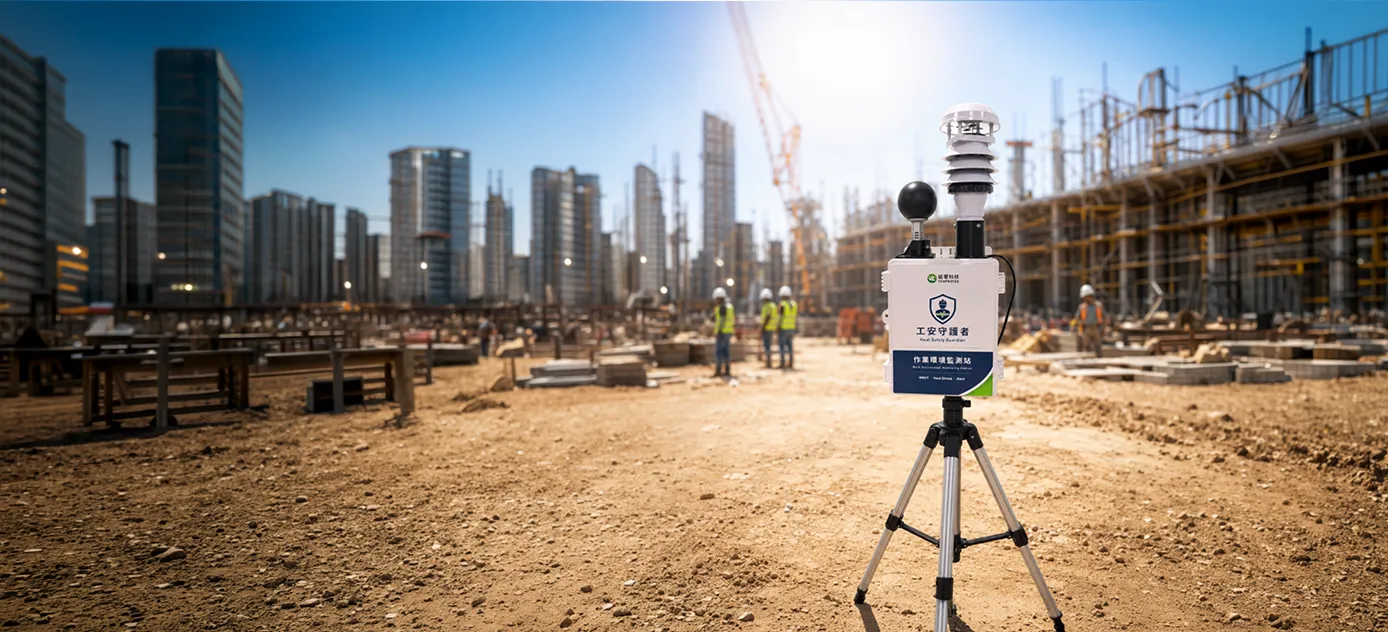
The most dangerous thing about outdoor work in summer is not just that the air temperature is high, but that on-site workers may be exposed at the same time to high heat, high humidity, direct sun, stagnant muggy air, no wind and heavy physical labor. WBGT combines these factors into a single, manageable heat-hazard indicator. YenProtek Technology pairs the Heat Safety Guardian with the I/O Control Box to help companies go all the way from on-site measurement and real-time classification to alerts and equipment control.
SOLUTION|Learn About the WBGT Heat-Hazard Alert SystemTable of Contents
Article Summary|Many people are used to looking only at air temperature, such as 32°C, 35°C or 38°C today. But in occupational safety, sports training and outdoor-activity management, air temperature alone is often not enough. At the same 33°C, the heat stress the human body feels can be completely different in a cool, ventilated spot, on a sun-baked construction site, in a stifling greenhouse, beside an asphalt road surface, or under a metal roof. WBGT (Wet Bulb Globe Temperature) takes air temperature, humidity, radiant heat and air movement together into account to assess the heat stress the human body bears in a given environment.
In Taiwan, the Occupational Safety and Health Administration of the Ministry of Labor has issued the Guidelines for the Prevention of Heat Hazards in High-Temperature Work, with the third edition revised on June 20, 2025, covering a heat index table, heat-hazard risk levels and the corresponding management measures. Heat-hazard management therefore cannot stop at 'it's hot out, remind everyone to drink more water.' It should build a management system that can measure conditions on site, classify risk in real time, send proactive notifications, keep records, and, when necessary, trigger warning lights, public-address broadcasts, fans or sprinkler equipment. This article gives a complete introduction to what WBGT is, why it is better suited to heat-hazard assessment than air temperature alone, which sites especially need monitoring, and how to build a more complete heat-hazard management mechanism for outdoor work.
Why You Can't Look at Air Temperature Alone
Many site managers ask, 'The Central Weather Administration says it's 34°C today, so can't we just look at the air temperature?' The answer is: that's not enough. The heat stress the human body feels comes not only from air temperature but also from humidity, solar radiation, wind speed, work intensity, clothing, protective equipment, rest time and individual physical condition.
For example, at the same 34°C:
- In a shaded, breezy, low-humidity spot, the body may still be able to regulate itself through sweating and heat dissipation.
- In a windless, high-humidity, strong-sunlight spot, sweat does not evaporate easily, the body's ability to shed heat drops, and heat stress builds up quickly.
- If on-site workers are also wearing reflective vests, hard hats or protective clothing, or doing physical work such as hauling, construction or farming, the risk rises further.
When Academia Sinica introduces the concept of 'health meteorology,' it also notes that WBGT considers air temperature, relative humidity, solar radiation and wind speed at the same time, and that the times and places where high air temperatures occur do not coincide with the times and places of high WBGT values, so the two cannot substitute for each other. This is exactly why on-site heat-hazard management cannot rely on the weather forecast alone; what truly affects worker safety is the actual thermal environment at the person's location. Reflected heat from a construction site's ground, metal roof panels, heat exhausted by machinery, greenhouse structures, stifling livestock housing, sun-baked school playgrounds, and the hot, humid environments of fish ponds or farm fields can all make the on-site WBGT differ noticeably from the general air temperature.
What Is WBGT?
WBGT is an environmental indicator used to assess heat stress. Its purpose is not to tell you 'what the temperature is right now,' but to help judge the combined heat load the human body bears in a given environment. Traditional WBGT measurement uses three kinds of temperature data:
- Dry-bulb temperature: close to ordinary air temperature.
- Natural wet-bulb temperature: reflects humidity and evaporative cooling conditions.
- Globe temperature: reflects the radiant heat from solar radiation, ground-reflected heat or surrounding heat sources.
OSHA technical materials explain that when there is a solar load outdoors, WBGT incorporates the natural wet-bulb temperature, globe temperature and dry-bulb temperature; for indoor environments or outdoor environments with no solar radiation load, a different calculation is used. Put simply, WBGT is closer than ordinary temperature to 'the thermal environment a person actually experiences on site.' The questions it can answer include: Has this work area already reached a heat-hazard risk level today? Within the same construction site, which zone is more dangerous? Does rest frequency need to be increased around midday? Do outdoor work hours need to be adjusted? Is it necessary to remind workers to rehydrate and cool down, or to activate on-site alerts? Should heat-hazard events and on-site environmental data be recorded?
How Is WBGT Different from the Heat Index?
Both WBGT and the heat index relate to high-temperature risk, but they are used in different situations. The heat index usually uses air temperature and relative humidity to describe how muggy the body feels, and is suited to public weather warnings, general high-temperature risk alerts or regional lookups. WBGT is better suited to occupational safety, sports training, outdoor work and on-site management, because it also takes factors such as radiant heat and air movement into account. OSHA explains that WBGT is the core tool occupational-hygiene professionals use for heat-hazard assessment, and that the heat index cannot replace the more precise WBGT heat-hazard assessment.
For a company's own sites, it can be understood this way: the heat index works well as a regional risk reference, while WBGT works well for on-site work risk management. For example, the heat-hazard risk lookups provided by central government or the Ministry of Labor can help a company grasp regional risk first; but to manage a specific construction site, warehouse, greenhouse, fish pond, school playground or outdoor work area, you should go further and assess the actual on-site environment.
Which Sites Especially Need WBGT Monitoring?
1. Construction Sites and Outdoor Engineering Work
Construction sites are among the most typical high-temperature work environments. Workers often handle rebar, formwork, concrete, exterior walls, roofing, waterproofing, road works or electromechanical installation under direct sun. Sites may lack shade, the ground and building materials readily absorb heat, and hard hats, vests and protective gear add to the burden of shedding heat. Relying on the weather forecast alone makes it hard to grasp the actual heat risk on different floors, on the roof, at basement entrances, on paved areas, beside machinery or in enclosed zones.
2. Agriculture, Horticulture and Food-and-Farming Education Sites
Agricultural work is often carried out outdoors, including harvesting, transplanting, weeding, fertilizing, spraying, hauling, greenhouse operations and school vegetable-garden upkeep. Greenhouses and net houses deserve particular attention, because they can combine high heat, high humidity, poor ventilation and accumulated solar heat all at once. For schools, if there is a campus farm garden, food-and-farming education activities or outdoor lessons, WBGT monitoring can also help decide whether to adjust activity times and add hydration and rest breaks.
3. Aquaculture and Fish-Pond Operations
Fish ponds, shrimp ponds and aquavoltaic (fishery-and-solar) sites are usually open and offer little shade, and on-site staff may need to patrol ponds, clean, feed, repair equipment or work on paddlewheels, aerators and pipelines outdoors. Such sites have high humidity and strong sunlight and often sit in open areas where people find it hard to stay for long. WBGT monitoring can help managers grasp the on-site heat hazard rather than only looking at air temperature.
4. Warehousing, Logistics and Semi-Outdoor Work Areas
It is not only fully outdoor settings that need heat-hazard management. Warehouses, loading docks, sheet-metal factory buildings, semi-outdoor loading and unloading areas, sun-exposed parking lots and large machinery zones can all generate heat stress because of poor ventilation, heat-absorbing roofs or workers' hauling tasks. If a site has no air conditioning, or workers spend long periods carrying, sorting, loading and unloading goods, WBGT monitoring and tiered alerts should also be evaluated.
5. Campuses, Sports Grounds and Outdoor Activities
WBGT is also often used in sports, military training and campus activity management, because exercise and outdoor lessons raise the body's metabolic heat, and the risk increases when high heat, high humidity and sun exposure occur at the same time. For schools, WBGT is not only an occupational-safety tool but can also serve as a reference for the safety management of outdoor lessons, physical-education classes, club activities and food-and-farming education.
What Functions Should a WBGT Monitoring System Have?
A practical WBGT heat-hazard management system should not just show a single number on a screen. What a site truly needs is a complete process that goes from 'measurement' to 'management.'
1. Measuring WBGT On Site
The first step is to obtain on-site environmental data. WBGT sensors should be installed, as far as possible, in positions that represent the workers' actual working environment, rather than only in an office, in the shade, or far from the work area. If the site is large, multi-point monitoring may be needed, for example a site entrance and a rooftop work area, the inside of a greenhouse and an outdoor reference point, a school playground and vegetable garden, the center of a fish pond and the management station, or the inside of a warehouse and its loading dock. Multi-point data helps managers see that not the whole site is equally hot, but rather which zone and which time period carries the highest risk.
2. Establishing Risk Classification
The WBGT value itself needs to be turned into easily understood risk levels (normal, caution, warning, high risk, danger). The high-temperature work protection information website of the Occupational Safety and Health Administration, Ministry of Labor provides heat-hazard risk-level lookups and explains that 'below the high-temperature risk level' refers to cases where the heat index is below 26.7. For a company building its own system, the key is to translate the data into management language that can be acted on in the field, for example:
- Green: normal work, keep monitoring.
- Yellow: remind workers to rehydrate and watch their condition.
- Orange: add rest and shade, and have supervisors step up patrols.
- Red: activate high-temperature management measures and adjust work arrangements.
- Purple or extreme risk: suspend or adjust high-risk work and activate emergency management procedures.
The actual levels and measures should be designed according to the company's internal rules, the Ministry of Labor's guidelines, the type of work, the work intensity, clothing and the condition of personnel.
3. Notifying Managers in Real Time
If WBGT is only displayed on a device screen and no one happens to be looking, it is hard to realize its management value. The system should therefore have proactive notification features, such as APP push notifications, LINE messages, Email, SMS, platform alerts, on-site display boards, warning lights or buzzers, and public-address systems. A notification should not just say 'high-temperature anomaly,' but should include which site, which measuring point, the current risk level, the time the anomaly occurred, the recommended management measures, and whether on-site warning equipment has already been triggered, so that supervisors can quickly decide whether to adjust work, notify contractors, arrange rest or send someone to patrol.
4. Linking to On-Site Warning and Control Equipment
The most easily overlooked point in WBGT management is this: an alert should not stop at a phone notification. If on-site workers are busy working, wearing gloves or a hard hat and cannot check a phone right away, or if several contractors share the site, a more direct on-site reminder is needed. Through the I/O Control Box, the WBGT system can drive equipment according to the risk level, for example turning on warning lights and buzzers, triggering public-address reminders, switching on fans, starting misting or sprinkler cooling equipment, controlling an electronic display board to show the risk level, or notifying the management station or guardhouse. This kind of linked design lets WBGT be not just data, but part of on-site safety management.
5. Keeping Historical Records and Reports
Heat-hazard management also needs records. The system should be able to keep WBGT historical data, the times each risk level occurred, alert-dispatch records, personnel acknowledgment records, equipment-linkage records, on-site response records, and daily, weekly or monthly reports. This data can be used for occupational-safety management, contractor management, training, improvement plans, internal audits and incident reviews. With only real-time alerts and nothing more, it is hard to know afterward which time periods were most dangerous, which area needs improvement, and whether the measures were actually carried out.
How Does a WBGT System Differ from an Ordinary Temperature and Humidity Sensor?
An ordinary temperature and humidity sensor can only provide air temperature and relative humidity. It is suitable for environmental monitoring but not enough to fully reflect the heat hazard of outdoor work. WBGT brings together factors such as humidity, radiant heat and air movement, and is better suited to managing heat stress on the human body. A simple comparison follows:
| Item | Ordinary Temperature and Humidity Sensor | WBGT Monitoring |
|---|---|---|
| Main data | Air temperature, relative humidity | Wet-bulb, globe and dry-bulb related data, forming the WBGT indicator |
| Considers sunlight / radiant heat? | Usually not | Yes |
| Suitable for outdoor heat-hazard management? | Only as a reference | Better suited |
| Can it do risk classification? | Needs additional rules | Can classify by WBGT / heat-hazard management rules |
| Suitable uses | Environmental monitoring, greenhouses, warehousing | Outdoor work, construction sites, agriculture, campuses, sports grounds, heat-hazard management |
This does not mean a temperature and humidity sensor has no value; it simply serves a different purpose. If you only want to know the environmental conditions, a temperature and humidity sensor already helps; if you want to do heat-hazard classification, occupational-safety management and outdoor-work safety reminders, you should evaluate WBGT monitoring.
Heat-Hazard Management Cannot Rely on Equipment Alone; It Also Needs Management Measures
A WBGT system can help detect risk, send notifications and keep records, but it is not a tool that replaces a management system. Heat-hazard prevention still needs to be paired with rehydration, shade and rest areas, adjusted work hours, reduced continuous exposure time, shift rotation, training, recognition of heat-illness symptoms, attention to new and non-heat-acclimatized workers, and established emergency-response procedures.
NIOSH notes that WBGT can be used to determine the recommended exposure limit for heat-acclimatized workers and the alert limit for unacclimatized workers; the Ministry of Labor likewise reminds outdoor workers that they can look up heat-hazard risk and weather forecasts, and that employers should establish a heat-acclimatization mechanism for new workers, increasing work exposure time gradually. The most important value of a WBGT system, therefore, is to give management measures a clearer trigger: reminders do not wait until 'the supervisor feels it's hot,' and action is not taken only when 'someone feels unwell'; instead, when the risk level reaches the set condition, the system can proactively remind, notify, record and drive equipment.
What Should You Think Through Before Adopting a WBGT Monitoring System?
1. Which Kind of Site Are You Managing?
Different sites have different heat risks. On construction sites the focus is sun exposure, floor levels, steel structures, roofs and heavy physical work; on farms it is outdoor work, stifling greenhouses and work timing; at fish ponds it is open sun exposure and high-humidity environments; on campuses it is students, teachers and activity management; in warehousing it is sheet-metal buildings, loading docks, hauling and ventilation. As the site changes, so do the measuring-point locations, alert thresholds, notification recipients and linked equipment.
2. How Many Points Should You Monitor?
A small site may need only one device, while a large construction site, campus, farm or plant may need multi-point monitoring. The goal of multi-point monitoring is not to install more equipment, but to find the differences in heat risk between areas; for example, within the same site, the roof is hotter than the ground, an asphalt area is hotter than grass, the inside of a greenhouse is more stifling than outdoors, and the area beside machinery is hotter than open space.
3. Do You Need a Real-Time Display Board, or Back-End Management?
Some sites need on-site workers to see the information directly, so they suit an electronic display board, warning lights or public address; other sites are mainly managed by supervisors, where the focus is the APP, the platform, reports and notification records. The more complete approach is to have both an on-site display board and a back-end platform.
4. Who Should the Alerts Notify?
A heat-hazard alert should not go to just one person. It is best to design the notification recipients according to the site, for example the on-site supervisor, occupational-safety staff, the site manager, campus-safety or general-affairs staff, the contractor contact, the guardhouse or management center, and a second-in-line contact, so as to avoid a situation where a single person does not read the alert or cannot handle it immediately.
5. Do You Need to Link On-Site Equipment?
If a site already has warning lights, buzzers, public address, fans, misting, sprinklers or an electronic display board, you can evaluate linking them through the I/O Control Box. But before linking equipment, you need to confirm the equipment's voltage and control method, whether it can be safely started remotely, whether manual confirmation is required, whether accidental activation must be avoided, whether manual/automatic switching is needed, and whether there is a feedback signal when equipment fails.
6. How Will the Data Be Stored and Used?
After adopting a WBGT system, a company should think about how the data will be used: for daily safety reminders, monthly reports, improving on-site shade and rest areas, contractor management, or campus-activity risk management, or to support ESG, occupational-safety and sustainability management reporting? If the reports and record fields are planned well from the start, the resulting data will be far more valuable.
How Does YenProtek Technology Help Build a WBGT Heat-Hazard Management System?
YenProtek Technology can, according to a site's needs, help build a WBGT heat-hazard management system spanning sensing, communication, the platform, alerts and on-site equipment linkage.
WBGT Sensing and On-Site Monitoring
WBGT sensing points are planned according to site conditions to help managers grasp the on-site heat-hazard situation. Applicable sites include construction sites, farms and greenhouses, aquaculture farms, campuses and outdoor activity venues, warehousing and logistics loading docks, semi-outdoor factory work areas, and solar, aquavoltaic or large outdoor sites. For related products, see the Heat Safety Guardian and Construction Safety Heat Stress Monitoring.
Cloud Platform and Real-Time Classification
The system can upload WBGT data to a platform that presents real-time readings, historical trends, risk classification and anomaly records, helping managers view the current heat-hazard status, compare the risk at different measuring points, look up alert records, confirm high-risk time periods and produce management reports.
Anomaly Notifications via APP, LINE, Email and More
When WBGT reaches a set level, the system can proactively notify the relevant people so that on-site data does not go unnoticed. As needed, the notification can include the measuring-point name, the current risk level, the time of occurrence, recommended measures, whether equipment was triggered, and whether personnel acknowledgment is required.
I/O Control Box Linkage with Alerts and Equipment
The YenProtek I/O Control Box can turn platform or on-site conditions into equipment actions, supporting on-site reminders and automation for heat-hazard management. Linkable equipment includes warning lights, buzzers, public-address equipment, electronic display boards, fans, misting equipment, sprinkler equipment and other on-site control devices. For example, when WBGT reaches a high-risk level, the system can send a notification and switch on an on-site warning light at the same time; at an even higher risk level, it can further trigger a public-address reminder or notify a supervisor to adjust the work.
Historical Records and Management Reports
The system can keep records of WBGT data, alerts, equipment linkage and personnel acknowledgments, helping companies with occupational-safety management, training, internal audits and improvement tracking. This turns heat-hazard management from a matter of verbal reminders into a management process that can be recorded, tracked and improved.
Which Adoption Scenarios Suit a WBGT Heat-Hazard Management System?
Scenario 1: A Construction Site Wants to Establish a High-Temperature Work Reminder Mechanism
A construction site can place WBGT sensing points in the main work area, the roof area, the steel-structure area or at the entrance, and when the risk level rises, notify the site manager, occupational-safety staff and the contractor contact, while reminding workers to rehydrate and rest through an on-site display board or warning light.
Scenario 2: A Campus Wants to Manage Outdoor Lessons and Food-and-Farming Education Activities
A school can set up WBGT monitoring on the playground, the campus farm garden or the outdoor activity area, helping teachers and administrators decide whether physical-education classes, outdoor activities, vegetable-garden upkeep and club activities need to be rescheduled or given extra rest breaks.
Scenario 3: A Farm and Greenhouse Want to Grasp High-Temperature Work Risk
A farm can combine the FarmerPack, WBGT sensing and the I/O Control Box to grasp the heat risk in the field, greenhouse or work area. If the site has fans, misting or shading equipment, linked control can also be evaluated.
Scenario 4: An Aquaculture Farm Wants to Protect Outdoor Patrol Staff
Fish ponds and aquavoltaic sites can combine WBGT with Aqua Pack water-quality monitoring and equipment-status monitoring, letting managers grasp both the heat risk to working staff and the equipment risk at the farm at the same time.
Scenario 5: A Company Wants to Build Recordable Occupational-Safety Management Data
A company needs not only real-time reminders but also long-term data as a basis for improvement. A WBGT system can help a company accumulate records of high-risk time periods, the number of alerts, before-and-after differences from improvements, and on-site responses.
WBGT Quick Comparison Table
| Comparison Item | Ordinary Air Temperature | Heat Index | WBGT |
|---|---|---|---|
| Main use | Knowing the air temperature | General mugginess and regional risk reference | On-site heat stress and work risk management |
| Considers humidity? | No | Yes | Yes |
| Considers sunlight and radiant heat? | No | Usually insufficient | Yes |
| Considers air movement? | No | Usually insufficient | Yes, reflected through related measurements |
| Suitable for general weather forecasting? | Yes | Yes | Can serve as a supplement |
| Suitable for outdoor work management? | Insufficient | Can be an initial reference | Better suited |
| Suitable for on-site tiered alerts? | Insufficient | Can be used for regional reminders | Suited to on-site monitoring and tiered management |
| Suitable for linking on-site equipment? | Not recommended on its own | Depends on management rules | Well suited to pairing with a control box and warning system |
Conclusion: The Value of WBGT Is Not One More Number, but Giving Heat-Hazard Management a Trigger to Act On
High-temperature work is not something to deal with only once someone feels unwell. Truly effective heat-hazard management should let rising risk be seen, notified and recorded as it happens, and let on-site workers and managers know what measures to take. The value of WBGT is not just that it is more complete than air temperature, but that it can turn a complex thermal environment into a manageable risk indicator.
Once WBGT sensors, the cloud platform, risk classification, the notification mechanism and the I/O Control Box are integrated, a company can build a more proactive heat-hazard management process: on-site measurement, real-time classification, proactive notification, on-site warning, equipment linkage, historical records, report tracking and continuous improvement. For construction sites, agricultural sites, aquaculture, campuses, warehousing, logistics and outdoor work environments, WBGT is not merely environmental data, but an important line of defense that safeguards people's safety.
FAQ|Common Questions About WBGT and Heat-Hazard Management
Q1: What is WBGT?
WBGT stands for Wet Bulb Globe Temperature, sometimes also called the composite-temperature heat index. It takes factors such as temperature, humidity, radiant heat and air movement together into account to assess the heat stress the human body bears in a given environment.
Q2: How is WBGT different from ordinary temperature?
Ordinary temperature only reflects air temperature. WBGT goes further and considers humidity, sunlight, radiant heat and air movement, making it better suited to heat-hazard management for outdoor work, sports, campus activities and occupational safety.
Q3: Is WBGT the same as the heat index?
No. The heat index is usually based mainly on air temperature and humidity and is suited to public weather or regional risk reference. WBGT is better suited to on-site work risk assessment, because it can incorporate factors such as radiant heat and air movement.
Q4: Which sites are suitable for adopting WBGT monitoring?
Construction sites, outdoor engineering works, farms, greenhouses, fish ponds, aquavoltaic sites, school playgrounds, food-and-farming education sites, warehouse and logistics loading docks, semi-outdoor factories, solar sites and other high-temperature outdoor work environments are all suitable for evaluating WBGT monitoring.
Q5: Can a WBGT system send alerts automatically?
Yes. A WBGT system can send APP, LINE, Email, SMS or platform alerts according to set thresholds and risk levels, and can also work with on-site warning lights, buzzers, public address or electronic display boards.
Q6: Can WBGT be linked to equipment?
Yes. Paired with the I/O Control Box, it can link warning lights, public address, fans, misting, sprinklers or other on-site equipment according to the WBGT risk level. However, the linkage method needs to be evaluated according to the on-site equipment, electrical safety and management procedures.
Q7: Does installing a WBGT system replace occupational-safety management?
No. A WBGT system is a tool that assists heat-hazard management; it cannot replace hydration, rest, shade, training, heat acclimatization, observation of personnel and emergency-response procedures. Its value is to give management measures a clearer trigger to act on.
Q8: Can WBGT data be used for reports?
Yes. The system can keep WBGT historical data, risk levels, alert records, equipment-linkage and personnel-acknowledgment records, serving as data for occupational-safety management, improvement tracking, training, contractor management or internal audits.
Further Reading
- Stable Outdoors, Even More Stable Indoors: Why Outdoor IoT Is the True Test of IoT Capability
- What Agricultural Sensors Are There? A Complete Introduction to Soil, Weather, Water-Quality and Environmental Monitoring
- Comparing IoT Communication Technologies: How to Choose Between Wi-Fi, LoRa, NB-IoT and 4G?
- What Businesses Must Know Before Adopting IoT: A Complete Analysis from Sensing to Platform
References
- Occupational Safety and Health Administration, Ministry of Labor, Guidelines for the Prevention of Heat Hazards in High-Temperature Work, third edition.
- Occupational Safety and Health Administration, Ministry of Labor, High-Temperature Work Protection Information Website.
- OSHA, Heat Hazard Recognition / Technical Manual.
- NIOSH, Occupational Exposure to Heat and Hot Environments / Heat Safety Tool App.
- Academia Sinica, Health Meteorology and WBGT explanation.
Author

AIoT System Architecture and Smart Industry Application Planning
Long dedicated to AIoT, IoT system integration and Smart Industry application planning, with over 15 years of experience focused on Smart Agriculture, smart fisheries, industrial IoT, smart occupational safety, edge computing, cloud platforms and AI application adoption. With hands-on experience in sensor integration, equipment connectivity, data transmission, platform architecture and on-site application implementation, he helps different industries turn on-site equipment and data into usable management systems and decision-making bases.